

Approximately 8.3 billion people live in the world in 2026, according to the latest UN population estimates. Roughly:
4.12 billion are women and girls
4.18 billion are men and boys
The 2026 Lipedema World Alliance consensus states that prevalence among adult women remains unknown, with published estimates ranging from less than 1% to 12%.
If those percentages were applied very approximately to the world’s female population, they would suggest:
1%: approximately 41 million
5%: approximately 206 million
10%: approximately 412 million
12%: approximately 494 million
Lipedema has also been documented in men, but published cases remain rare and no reliable global prevalence estimate exists. Although a figure of 0.2% has appeared in parts of the literature, the evidence is not strong enough to conclude that approximately 8.4 million men have lipedema.

These calculations are illustrations of scale, not reliable estimates of how many people have lipedema. The prevalence range relates to adult women, while the global female population also includes children, and diagnostic recognition varies considerably between countries. We therefore cannot conclude that more than 400 million women have lipedema. What we can say is that… lipedema may affect tens or even hundreds of millions of people worldwide, while the true number remains unknown. Men can also develop lipedema, but no credible global prevalence estimate currently exists.
One Global Community, Many Different Lives
At LipedemaScience, we bring people from all over the world together under one umbrella. Your gender, age, location, stage of lipedema and personal management choices do not determine whether you belong here. What matters is that we meet one another with kindness, share what we know, support each other and cheer one another on.
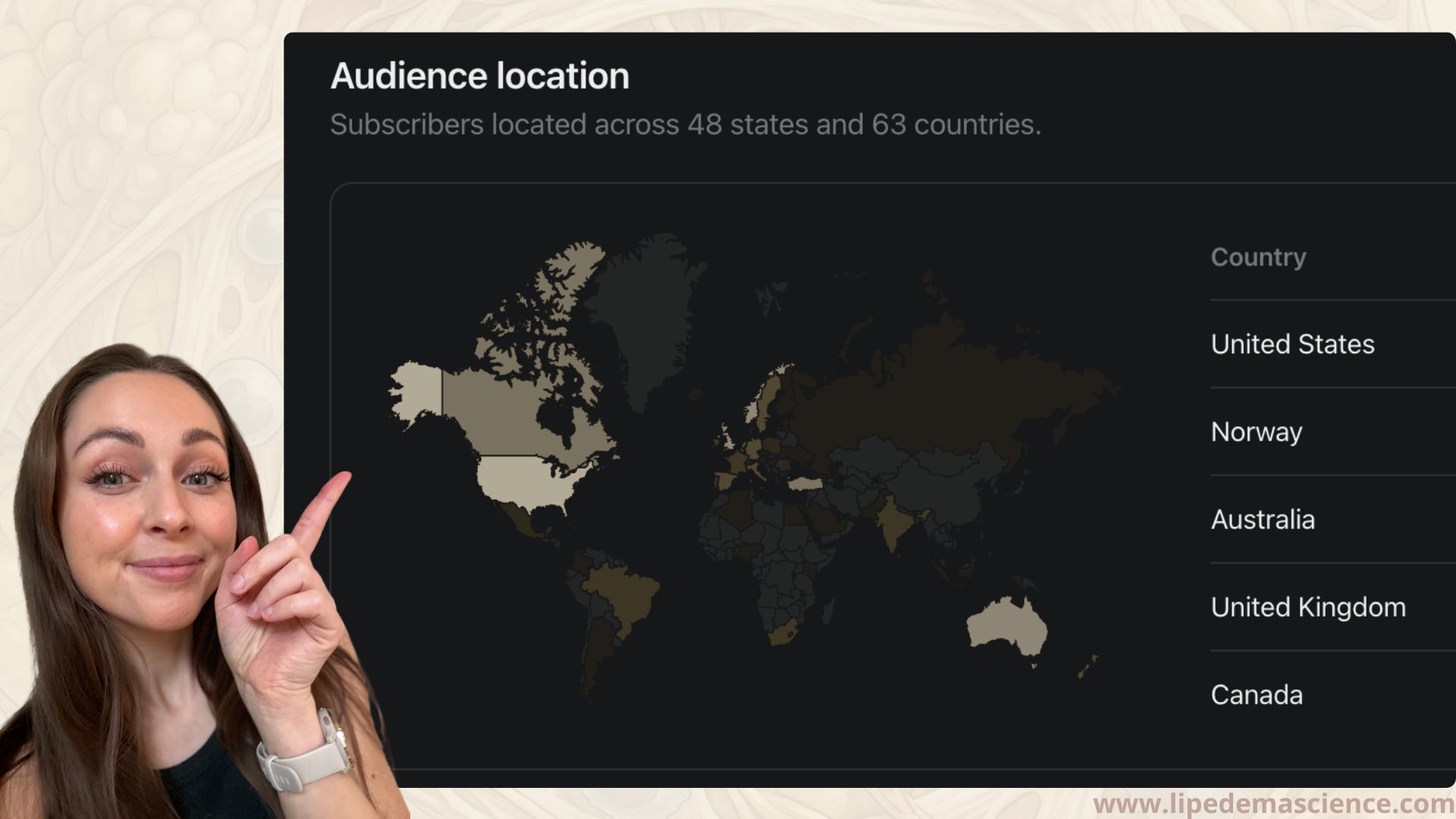
The LipedemaScience community now reaches 63 countries. The people represented by these numbers live in different climates, cultures and healthcare systems, but geography is only one part of the picture. We also differ in how lipedema presents, how advanced it is, which symptoms affect us most and whether we live with other conditions alongside it. Age, hormonal life stages, work, family responsibilities, financial resources and access to qualified healthcare can all influence which forms of management are realistic, appropriate or sustainable.
Personal goals and preferences matter too. One person may be trying to reduce pain enough to remain at work, while another is preparing for surgery, rebuilding strength after treatment or trying to manage symptoms without access to specialist care. Some people can obtain compression garments, physiotherapy and medical follow-up. Others must navigate lipedema largely on their own.
This is why one universal lipedema management protocol cannot meet everyone’s needs. Shared principles and evidence-based guidance are valuable, but they must leave room for individual symptoms, health conditions, circumstances and choices. We are each navigating our own journey, but we can learn from one another and support each other along the way.
Top 10:
🇺🇸 United States (45.10%)
🇳🇴 Norway (11.67%)
🇦🇺 Australia (8.36%)
🇬🇧 United Kingdom (7.93%)
🇨🇦 Canada (4.83%)
🇹🇷 Türkiye (3.75%)
🇸🇪 Sweden (1.44%)
🇩🇪 Germany (1.30%)
🇪🇸 Spain (1.15%)
🇳🇿 New Zealand (1.08%)
Not One Lipedema Woman

When you live with a chronic disease that is influenced by food, your relationship with eating can become complicated in ways that are hard to explain to anyone who has not lived it. Food stops being neutral. It becomes a daily negotiation, sometimes a source of comfort, sometimes a source of fear, and often a place where guilt and shame quietly attach themselves. For many women with lipedema, the emotional weight is not only about what they eat, but about what eating represents in a body that can feel unpredictable, painful, and resistant to change.


We Become What We Repeatedly Choose

I’m writing this on the train from Cannes to Milan, thinking about the past few days and what they reminded me of. We spent the week with my partner’s colleague and his wife while the men attended work related events in Cannes. They are a German couple, and I always enjoy spending time with people from other places and hearing how they live. His wife is…
The full LipedemaScience map:
🇮🇹 Italy (1.01%)
🇳🇱 Netherlands (1.01%)
🇫🇷 France (0.86%)
🇮🇪 Ireland (0.65%)
🇮🇳 India (0.58%)
🇿🇦 South Africa (0.58%)
🇧🇪 Belgium (0.58%)
🇵🇹 Portugal (0.50%)
🇧🇷 Brazil (0.50%)
🇮🇱 Israel (0.43%)
🇨🇭 Switzerland (0.43%)
🇭🇷 Croatia (0.36%)
🇵🇱 Poland (0.36%)
🇩🇰 Denmark (0.29%)
🇲🇽 Mexico (0.29%)
🇷🇴 Romania (0.29%)
🇦🇪 United Arab Emirates (0.29%)
🇦🇹 Austria (0.22%)
🇭🇺 Hungary (0.22%)
🇫🇮 Finland (0.22%)
🇮🇸 Iceland (0.22%)
🇧🇬 Bulgaria (0.22%)
🇰🇼 Kuwait (0.22%)
🇸🇦 Saudi Arabia (0.14%)
🇦🇷 Argentina (0.14%)
🇨🇿 Czechia (0.14%)
🇬🇪 Georgia (0.14%)
🇬🇷 Greece (0.14%)
🇰🇪 Kenya (0.14%)
🇱🇺 Luxembourg (0.14%)
🇱🇻 Latvia (0.14%)
🇲🇰 North Macedonia (0.14%)
🇲🇹 Malta (0.14%)
🇵🇰 Pakistan (0.14%)
🇵🇷 Puerto Rico (0.14%)
🇸🇮 Slovenia (0.14%)
🇮🇩 Indonesia (0.07%)
🇪🇬 Egypt (0.07%)
🇺🇦 Ukraine (0.07%)
🇪🇪 Estonia (0.07%)
🇧🇲 Bermuda (0.07%)
🇩🇿 Algeria (0.07%)
🇶🇦 Qatar (0.07%)
🇩🇴 Dominican Republic (0.07%)
🇷🇺 Russia (0.07%)
🇦🇩 Andorra (0.07%)
🇨🇴 Colombia (0.07%)
🇸🇬 Singapore (0.07%)
🇦🇱 Albania (0.07%)
🇧🇸 The Bahamas (0.07%)
🇲🇺 Mauritius (0.07%)
🇳🇬 Nigeria (0.07%)
🇱🇧 Lebanon (0.07%)
Interesting! Also, as the age span increases and we experience living with menopause for longer, women would definitely be more aware of the debilitating effects of lipedema triggered by the hormonal changes such as myself. But I also wonder how modern nutrition has impacted this?? 🧐