

A few days ago, Connie left a note under one of my posts.
She wanted to know why it is that lipedema ladies have hEDS or EDS. She thinks she may have vascular EDS. She has mitral valve prolapse, and another valve less affected. And she wrote something that stayed with me, that for years she has been saying she can feel her bones moving out of joint.
I read it, and my first instinct was to answer quickly. I know this comes up constantly. Every lipedema group I have ever been in has a version of this conversation running somewhere in the comments. Someone posts a photo of their thumb folded back to their wrist. Someone else says she always knew she was double jointed. And underneath it all sits the assumption that these two things belong together, that lipedema and Ehlers-Danlos are somehow the same story told twice.
Then I sat down to actually look, and I could not answer quickly at all.
First, a confession about my own body. I do not have hypermobility.
My lipedema has never pointed that way. No unstable joints, no dislocations, no bendy thumbs, none of it. My picture is the classic one, swollen legs, pain in the tissue, hormonal timing, bruising, the whole familiar shape of it.
I am telling you this because it matters for how you read what follows. If I only wrote about what I recognise from the inside of my own body, LipedemaScience would be very small and very boring. Connie's question is not my question. And that is exactly why I wanted to take it seriously, because a lot of you are living something I am not, and you deserve better than a shrug.
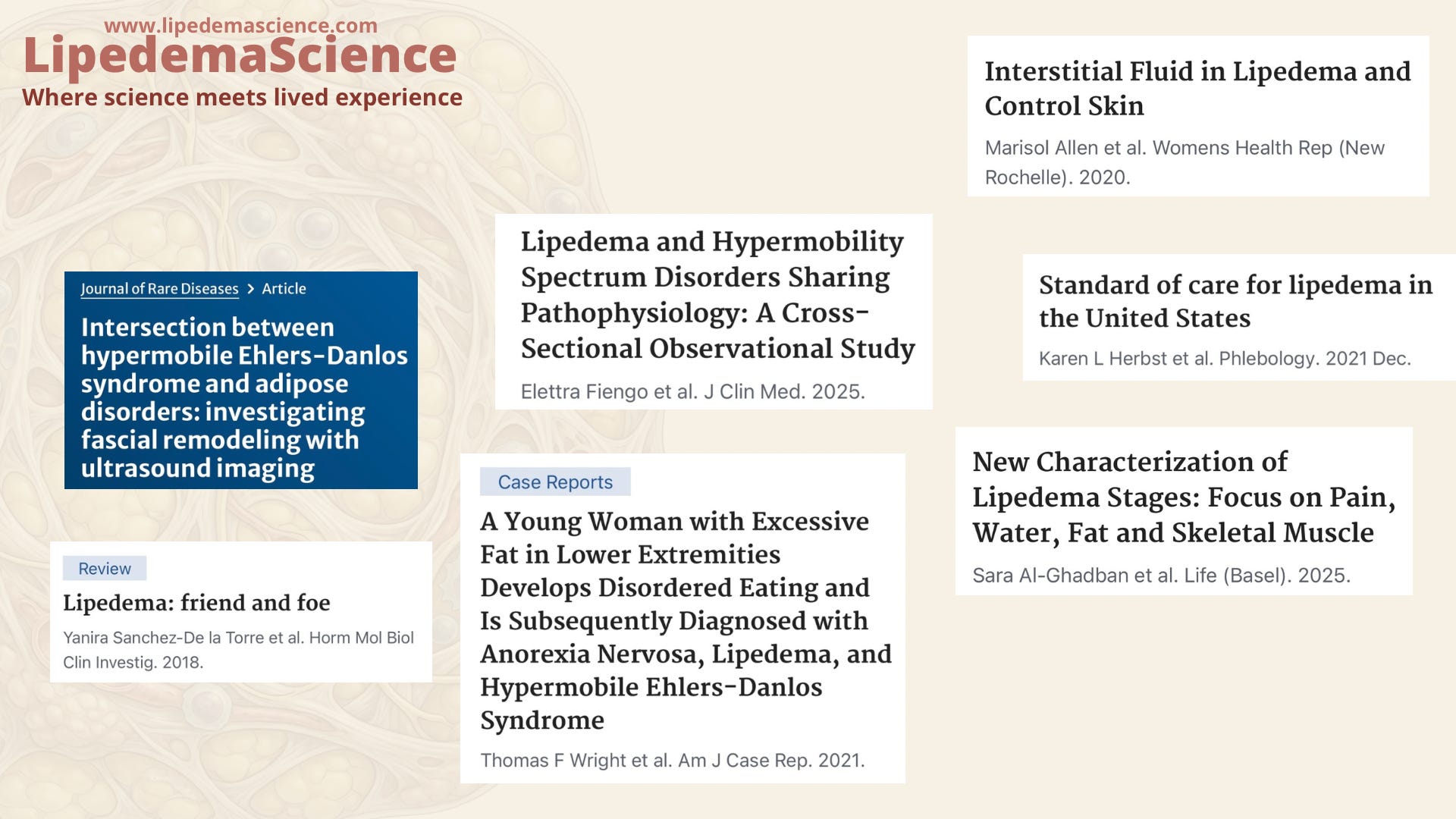
So I went to the literature. Here is what is actually there.
Before any of the studies make sense, we have to separate four things that get blended together in almost every conversation I see.
Joint hypermobility just means that a joint moves further than average. That is all it means. It can be entirely painless and entirely harmless. Plenty of people are bendy and perfectly fine.
HSD, hypermobility spectrum disorder, was introduced in the 2017 classification for people whose hypermobility actually causes problems, pain, instability, injury, but who do not meet the criteria for hEDS or any other named condition. It is not a mild version of hEDS. That is a misunderstanding I want to kill on sight. The symptom burden can be every bit as heavy. The line between them is a formal boundary, not a severity scale.
hEDS, hypermobile Ehlers-Danlos syndrome, is a clinical diagnosis with three requirements that all have to be met. Generalised hypermobility measured on the Beighton score, adjusted for age. Then at least two of three feature groups, which include a list of twelve systemic connective tissue signs, family history, and musculoskeletal complications. And then exclusion of other diagnoses. A high Beighton score alone does not give you hEDS. Neither does being bendy plus tired plus in pain, however real all of that is.
vEDS, vascular Ehlers-Danlos syndrome, is not on this spectrum at all. It is a rare, genetically defined disease, caused by a pathogenic variant in the COL3A1 gene, which codes for type III collagen. It accounts for roughly 5 percent of all EDS cases. The defining problem is fragility of arteries, intestines and the uterus. Arterial dissection or rupture, bowel perforation, organ rupture. It shortens life expectancy. It is diagnosed by finding the variant, not by recognising yourself in a symptom list.
Hold on to that last distinction. I will come back to it, because it is the part of Connie's question that I most want to answer properly.
