

When you live with a chronic disease that is influenced by food, your relationship with eating can become complicated in ways that are hard to explain to anyone who has not lived it. Food stops being neutral. It becomes a daily negotiation, sometimes a source of comfort, sometimes a source of fear, and often a place where guilt and shame quietly attach themselves. For many women with lipedema, the emotional weight is not only about what they eat, but about what eating represents in a body that can feel unpredictable, painful, and resistant to change.
Now zoom out for a moment. Lipedema is estimated to affect around ten to eleven percent of women. The exact number is less important than what it implies. If we imagine the global female population in the billions, we are talking about hundreds of millions of women living with this condition. Some diagnosed. Many not. Some living in countries where the term lipedema is finally entering medical education, others living in places where they may never hear the diagnosis at all. Some have access to specialists, surgery, compression garments, physiotherapy, and supportive communities. Others do not even have access to a doctor who recognizes the disease.
And still, online, we keep acting as if there is one correct way to manage lipedema. As if we can put hundreds of millions of lives into one single box, label it “lipedema management,” and then tell women to follow a checklist and they will be fine. It does not work like that. It never has.
Women with lipedema are not one type of woman. We are not one symptom profile, one stage, one body size, one culture, one food environment, one economic situation, or one psychological history. Some women have lived with restrictive eating, anorexia, bulimia, binge eating, or long periods of chaotic eating patterns. Others have never had an eating disorder, yet still feel their relationship with food shifting because lipedema makes the body so visible and so debated, both by society and sometimes by the medical system. Some women also live with obesity alongside lipedema, and it matters to say this clearly: lipedema is not obesity. They are different conditions. But they can coexist, and when they do, the spiral can become brutal, because lipedema tissue is already associated with pain, inflammation, and often progressive fibrosis. Add a higher mechanical load, more systemic inflammation, more stigma, and more dieting attempts, and the burden multiplies. For some women, the struggle is primarily physical. For others, the psychological cost becomes the heaviest part.
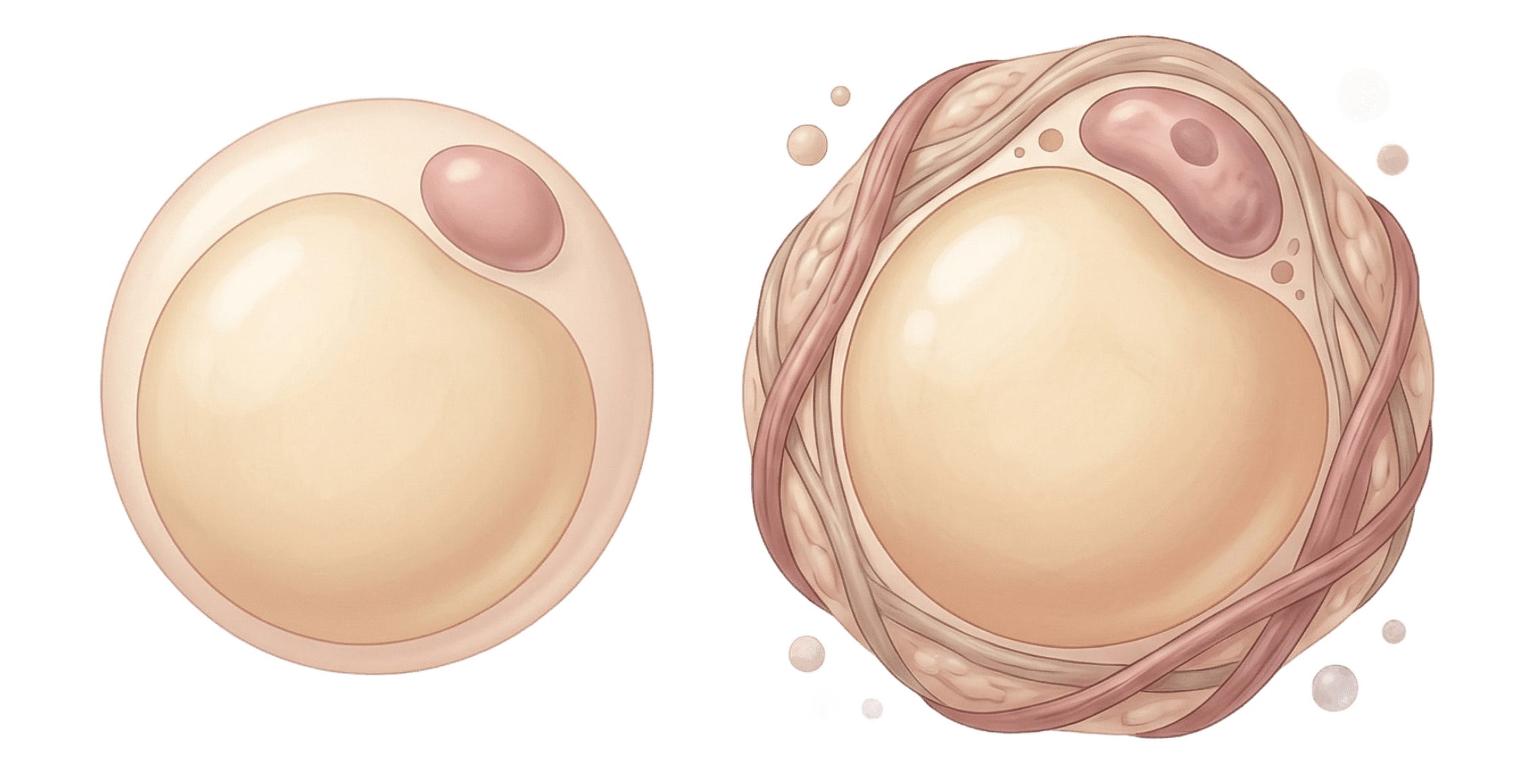
The biology itself is not simple, and it is one of the reasons one-size-fits-all advice becomes so damaging. Lipedema is characterized by changes in adipose tissue such as hypertrophy and hyperplasia, combined with chronic low-grade inflammation and, for many, increasing fibrosis over time. The tissue can be tender and bruises easily. It can stiffen. It can become nodular.
In later stages, swelling can intensify and lymphatic strain may develop. Many women try to lose weight and find that the typical lipedema distribution does not respond the way they were told it should. That repeated experience of effort without expected outcome can do something profound to the mind. It is not only frustrating. It can become identity-shaping. It can create self-blame, shame, and a constant low-level stress response that makes everything harder, including eating, movement, sleep, and mental health.
This is where diet culture sneaks in through a side door and pretends to be medical care. Many women discover that anti-inflammatory approaches, stable routines, and certain dietary changes can influence symptoms, and that is real for many. Some experiment with low carbohydrate or ketogenic patterns and report relief in pain, swelling, or energy. Early studies suggest potential benefits for some people, but the evidence base is still limited and far from definitive.
The problem is what happens when a potentially helpful tool becomes a rigid identity, and when it turns into a moral system instead of a strategy. For some women, strict control feels safe. For other women, strict control is the beginning of relapse into an eating disorder. Restriction may reduce symptoms for one person and destroy psychological stability for another. And when we present a restrictive approach as the “right” approach, we unintentionally push vulnerable women closer to guilt, isolation, and disordered eating.
The research increasingly supports what women have been describing for years: lipedema is associated with a significant psychological burden, higher rates of depressive symptoms and anxiety, reduced health-related quality of life, and challenges with emotional regulation.
When emotions are difficult to identify, accept, or process, food often becomes a coping mechanism, either through emotional eating and overeating, or through rigid restriction in an attempt to regain control. Both patterns come from the same place. They are strategies to regulate discomfort when the nervous system is overwhelmed. Pain, visible body changes, social stigma, and being dismissed in healthcare settings all increase emotional load. That emotional load does not disappear just because someone follows a “perfect” diet. In many cases, chasing perfection is what keeps the stress loop alive.
And this is why I believe we need to change the tone in the lipedema community. We need to stop pointing fingers at other women’s choices. You do not know what someone is dealing with privately. You do not know their trauma history, their comorbidities, their medication profile, their economic limitations, their family responsibilities, or what it cost them mentally to get through the last year. You do not know whether lipedema is the main thing they are managing, or whether they are also fighting depression, infertility, autoimmune disease, chronic fatigue, or grief.
Lipedema often does not kill us, but eating disorders can. Untreated depression can. Chronic shame can. Turning management into a moral hierarchy is not only inaccurate, it is dangerous.
My own experience is that I have not generally had a deeply strained relationship with food or with my body, even though I have moments where I dislike what I see in the mirror or cringe at a photo. Those moments come, and then they pass. But during my surgical period, I noticed how quickly my mind could shift when the focus on my body became intense.
I developed insecurities I had not carried before. I wanted to change more. I even asked my surgeon if we could take “more,” and she held a boundary that I am grateful for today. I am back now in a more stable place, but I share this because it illustrates how even a relatively resilient baseline can be shaken by a body-focused medical journey. Not everyone has the same baseline, and not everyone has the same safety net.

So what does “good lipedema management” even mean, if we stop trying to force everyone into the same template. In my view, it means building a strategy that can last for years and years, in social settings, on good days and bad days, without breaking your mental health. It means having realistic expectations about what diet can and cannot do. It means using conservative tools like compression, lymphatic support, gentle movement, and stress reduction in ways that fit real life.
It means seeking accurate diagnosis and stage-aware treatment, because being misdiagnosed as simple obesity fuels shame and makes women chase the wrong targets.
It means considering multidisciplinary support when needed, because lipedema affects the body and the mind at the same time.
It means acknowledging that surgery may be appropriate for some and not for others, and even when it is appropriate, it is not a standalone cure.
And it means protecting psychological safety as part of the plan, especially for women with a history of eating disorders, anxiety, or depression.
If hundreds of millions of women across the world are living with lipedema, then it should be obvious that there cannot be one single management box that fits us all. Our bodies are different. Our stages are different. Our nervous systems are different. Our resources are different. Our cultures and food environments are different. Our histories are different. The science is still evolving, and the lived reality is complex. The honest position is not certainty. The honest position is nuance.
I want LipedemaScience to make space for that nuance, because progress will not come from rigid rules and loud certainty. Progress will come from better research, better clinical recognition, more compassionate care, and a community that understands that the goal is not moral perfection. The goal is a sustainable life, where you can function, participate, eat, rest, move, and belong, without constantly feeling like you are failing at a disease that was never simple to begin with.
