

One of the things I have spent a lot of time thinking about over the years is how food has become far more than nutrition. Somewhere along the way, conversations about food stopped being primarily about nourishment and started becoming discussions about identity, philosophy, morality, and sometimes even belief systems. As someone who has studied nutrition, food science, and food production, and who has spent years living with lipedema while trying to understand how my own body responds to different foods, I find this incredibly fascinating. Not because people care deeply about food, which makes perfect sense, but because people often become so convinced that their personal way of eating represents the universal truth for everyone else.
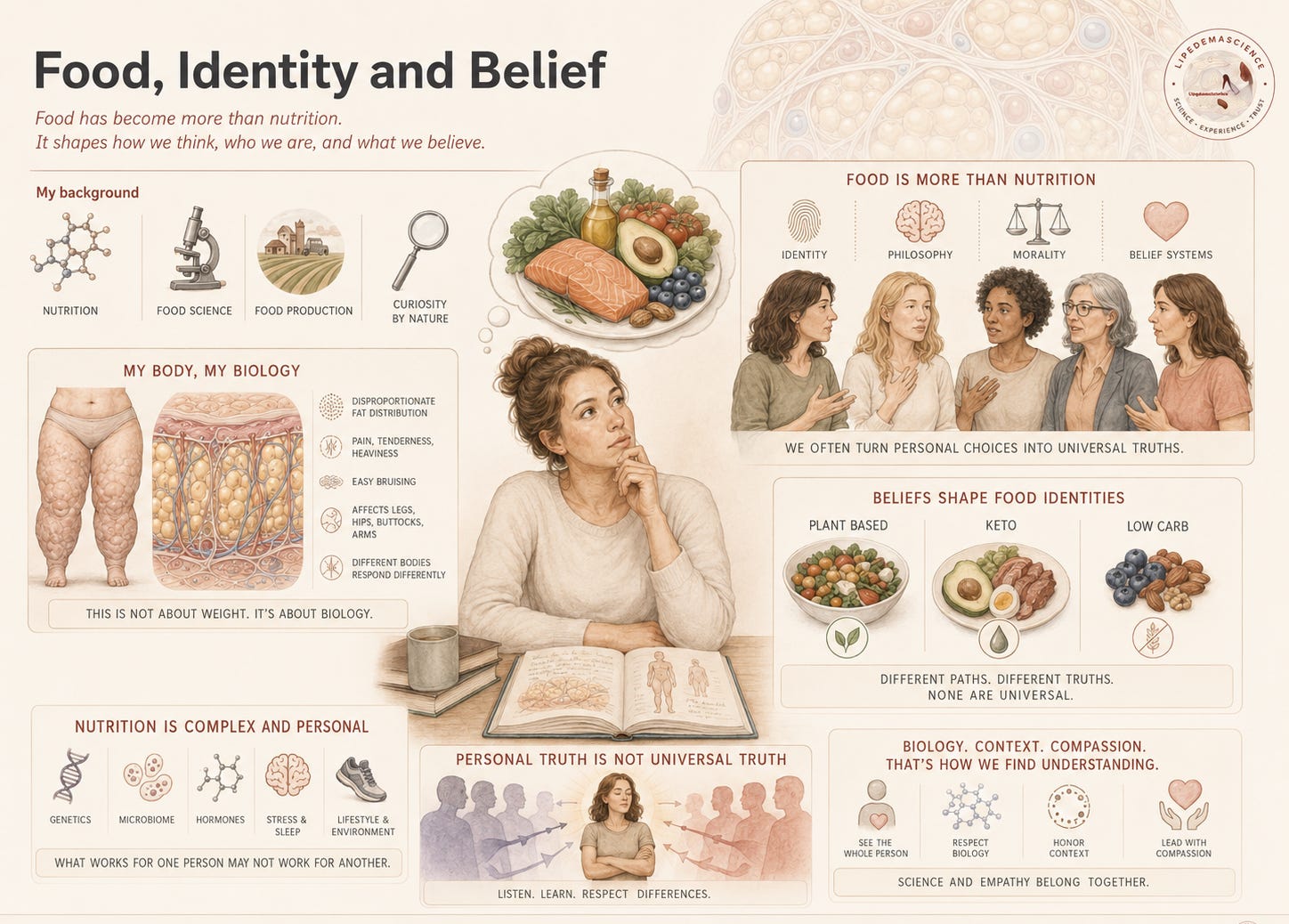
If you spend any amount of time in nutrition communities, it quickly becomes clear that almost every food imaginable has become controversial. Red meat is a perfect example. Some people see it as one of the most nutrient-dense foods available and believe it should form the foundation of a healthy diet. Others view it as something inherently harmful and avoid it entirely. The same pattern exists with vegetables, fruit, dairy products, eggs, grains, nuts, seeds, fish, soy, coffee, saturated fat, carbohydrates, and oils. It is remarkable how two people can look at exactly the same food and come away with completely opposite conclusions. One person looks at fruit and sees vitamins, minerals, fiber, polyphenols, and health benefits. Another sees fructose and sugar. One person sees dairy as a rich source of protein, calcium, and beneficial fermentation products, while another sees hormones, inflammation, and digestive problems. One person views bread as a staple food that humans have consumed for thousands of years, while another sees it as a major contributor to modern disease.
Become a member of LipedemaScience if you want thoughtful, science-based writing about lipedema, nutrition, hormones, metabolism, and the complexity of the human body. My background in nutrition and food science shapes how I write, with curiosity rather than dogma. I do not believe in simple answers where the biology is complex. Subscribe now if you want to explore these questions with more nuance.
What fascinates me most is not necessarily that these disagreements exist. Science has always evolved through disagreement and debate. What fascinates me is how absolute many of these beliefs have become. There is often very little room for uncertainty. Very little room for nuance. Very little room for the possibility that two people can have different experiences with the same food and both be telling the truth. Food discussions can sometimes resemble religious debates more than scientific discussions. People are not simply sharing what works for them. They are defending entire worldviews. If someone questions those worldviews, it can feel almost personal.
Perhaps this happens because food is one of the few things we interact with every single day. We eat multiple times per day for our entire lives. Unlike many other health interventions, food produces immediate experiences. We can feel energized after a meal, sluggish after another, satisfied by one food and hungry after another. We build stories around these experiences. Over time, those stories become beliefs, and those beliefs can become identities. The person who feels dramatically better after removing carbohydrates may naturally begin to view carbohydrates as the problem. The person who experiences improvements after adopting a plant-based diet may naturally begin to view plants as the solution. The challenge is that human biology is rarely that simple.
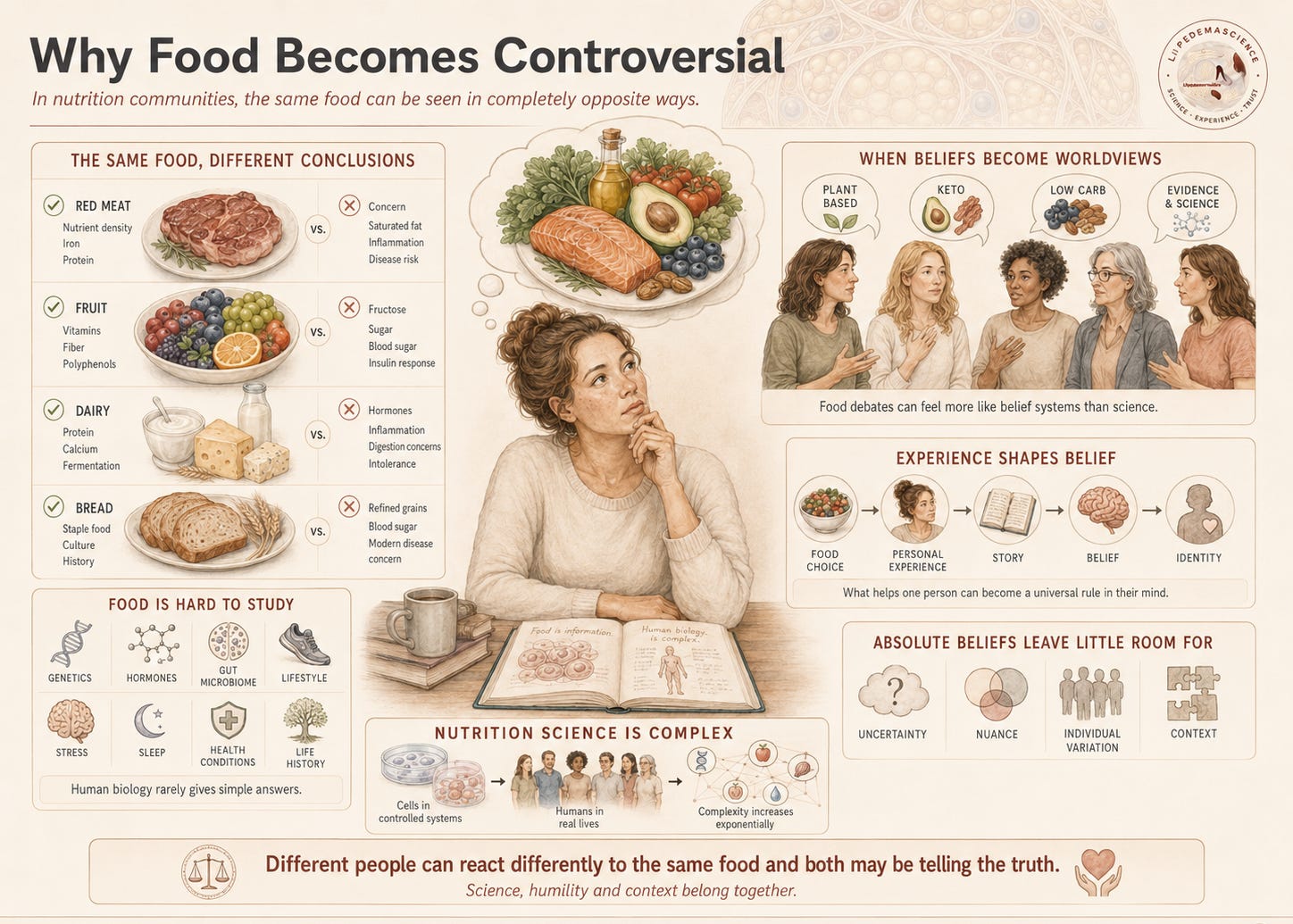
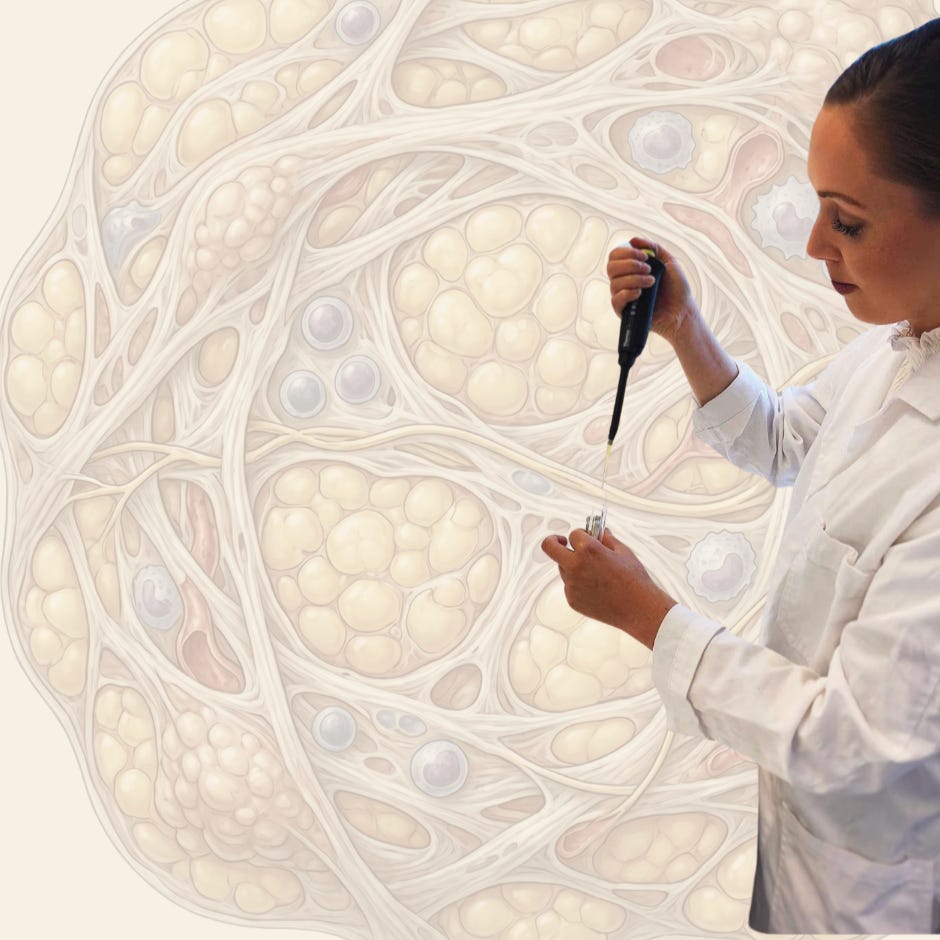
One of the things I learned during my education is that food is incredibly difficult to study. Many people imagine that nutrition science should provide straightforward answers, but the reality is often much messier. Human beings are not laboratory mice living in controlled environments. We have different genetics, different hormone levels, different gut microbiomes, different lifestyles, different stress exposures, different sleep patterns, different health conditions, and different life histories. Even when researchers try to isolate specific variables, the complexity of human biology creates enormous challenges. During my own studies, I worked with food components on a cellular level and saw firsthand how difficult it can be to interpret biological responses even under highly controlled conditions. Once you move from isolated cells to entire human beings living real lives, the complexity increases exponentially.
Subscribe to LipedemaScience if you are tired of black-and-white nutrition advice. I write from both personal experience with lipedema and a professional background in nutrition, food science, food safety, microbiology, and human metabolism. The goal is not to tell you what to eat, but to help you understand why bodies respond differently. Become a member if you want deeper, more reflective science writing.
This complexity becomes particularly relevant when discussing lipedema. One of the reasons I have become cautious about making broad dietary recommendations is because I have spent years observing how differently people with lipedema respond to food. Some people report significant improvements when reducing carbohydrates. Others do not. Some feel noticeably better when avoiding dairy. Others consume dairy daily without any apparent issues. Some find seed oils problematic. Others notice no difference whatsoever. Some thrive on higher-fat diets. Others feel better with more carbohydrates. The more people I speak with, the more convinced I become that there is no single dietary approach that explains every experience within the lipedema community.


My own experience reflects this reality. Over the years, I have learned that refined sugar is one of the clearest triggers for my symptoms. That relationship has been remarkably consistent. I have also found that I generally feel better when I minimize heavily fried foods, highly processed meat products, large amounts of candy, and certain ultra-processed foods. At the same time, I do not have major food intolerances or allergies. I eat fish, meat, vegetables, fruit, dairy products, nuts, seeds, eggs, and many other foods. I do not feel compelled to eliminate entire food groups because I have never seen convincing evidence in my own body that doing so improves my health. What I have learned is not that certain foods are universally good or bad. What I have learned is that my body has specific triggers, and those triggers may not be identical to someone else’s.
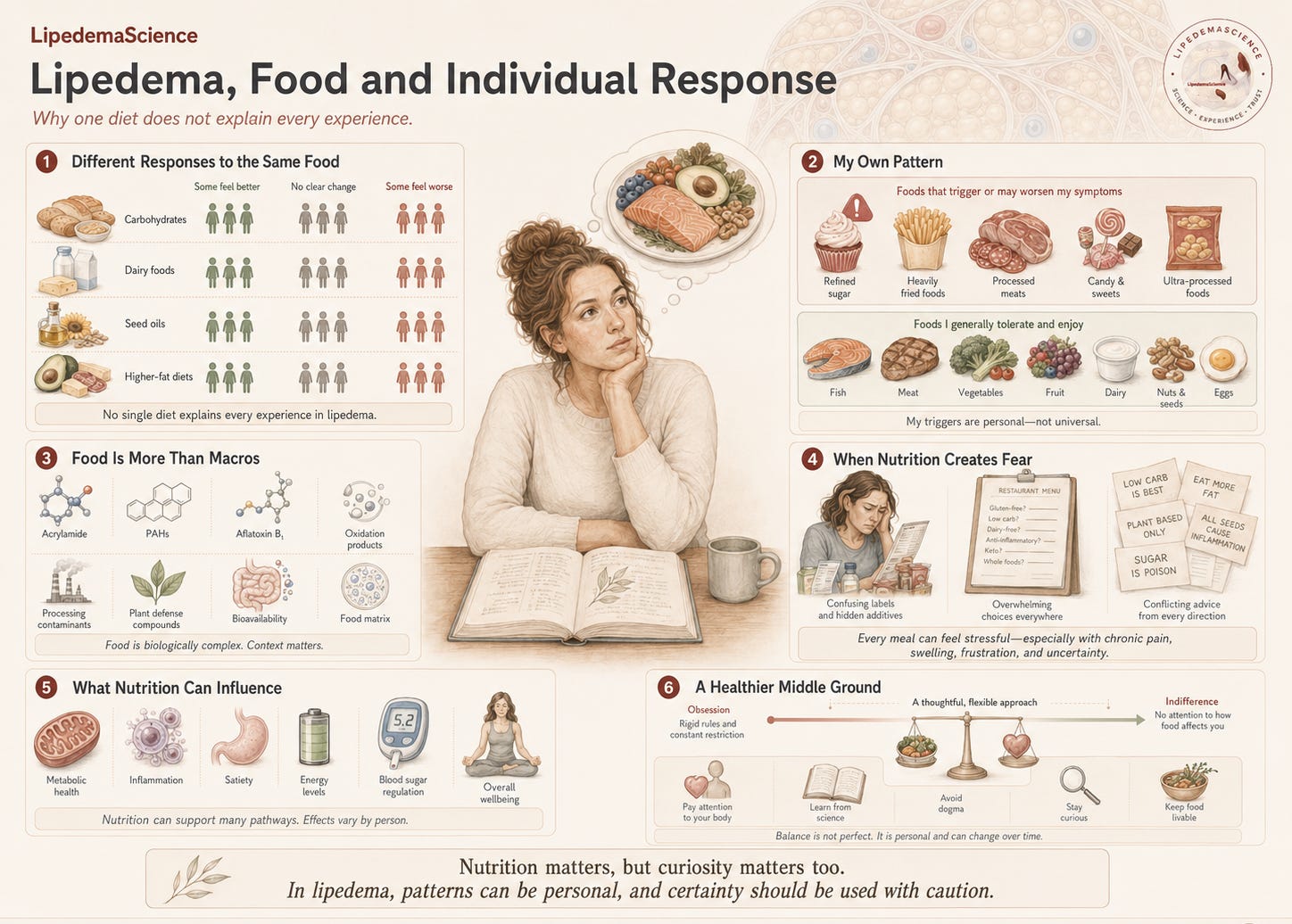
This is one of the reasons I have become increasingly uncomfortable with extreme certainty in nutrition discussions. The older I get, the more I realize how much we still do not know. Food is not simply calories, protein, fat, and carbohydrates. Food contains thousands of biologically active compounds. As a food scientist, I am aware of considerations that rarely enter mainstream nutrition discussions. Acrylamide, polycyclic aromatic hydrocarbons, mycotoxins such as aflatoxin B1, oxidation products, food processing contaminants, naturally occurring plant defense compounds, bioavailability, food matrices, and countless other factors all influence how food interacts with the body. If I wanted to focus exclusively on potential risks, I could probably make almost every food sound frightening. But I do not believe that would help anyone.
In fact, one of my biggest concerns about modern nutrition culture is the amount of fear it creates. I have seen people become so overwhelmed by conflicting dietary advice that they lose trust in their ability to eat normally. Every meal becomes a source of anxiety. Every ingredient becomes something to investigate. Every restaurant menu becomes a puzzle. Food gradually transforms from something enjoyable and social into something stressful and exhausting. For people already navigating a chronic condition such as lipedema, that burden can become particularly heavy. Many are already managing pain, swelling, frustration, uncertainty, and years of feeling misunderstood. Adding another layer of fear around food is rarely productive.


That does not mean nutrition is unimportant. Quite the opposite. I believe nutrition matters enormously. I believe food can influence metabolic health, inflammation, satiety, energy levels, blood sugar regulation, and overall wellbeing. I believe some dietary patterns may genuinely help certain people with lipedema manage symptoms more effectively. But I also believe that the healthiest relationship with food often exists somewhere between obsession and indifference. It involves paying attention to your body without becoming consumed by every dietary trend. It involves learning from science without treating every new study as absolute truth. It involves remaining curious rather than dogmatic.
At LipedemaScience, I write for people who want more than quick answers and diet rules. Food, lipedema, hormones, inflammation, and metabolism are complex, and they deserve to be explored with honesty and depth. My aim is to make the science understandable without pretending it is simpler than it is. Subscribe now to support this work and become part of a more thoughtful conversation.
Perhaps that is why I have gradually moved toward a philosophy of dietary flexibility. I prefer diversity over restriction whenever possible. I prefer observing patterns over following rigid rules. I prefer asking questions over defending ideologies. Rather than searching for a perfect diet, I focus on understanding how my own body responds while recognizing that those observations remain incomplete. There are things I know with reasonable confidence, such as my response to refined sugar. There are many other things where uncertainty remains, and I am comfortable with that uncertainty.
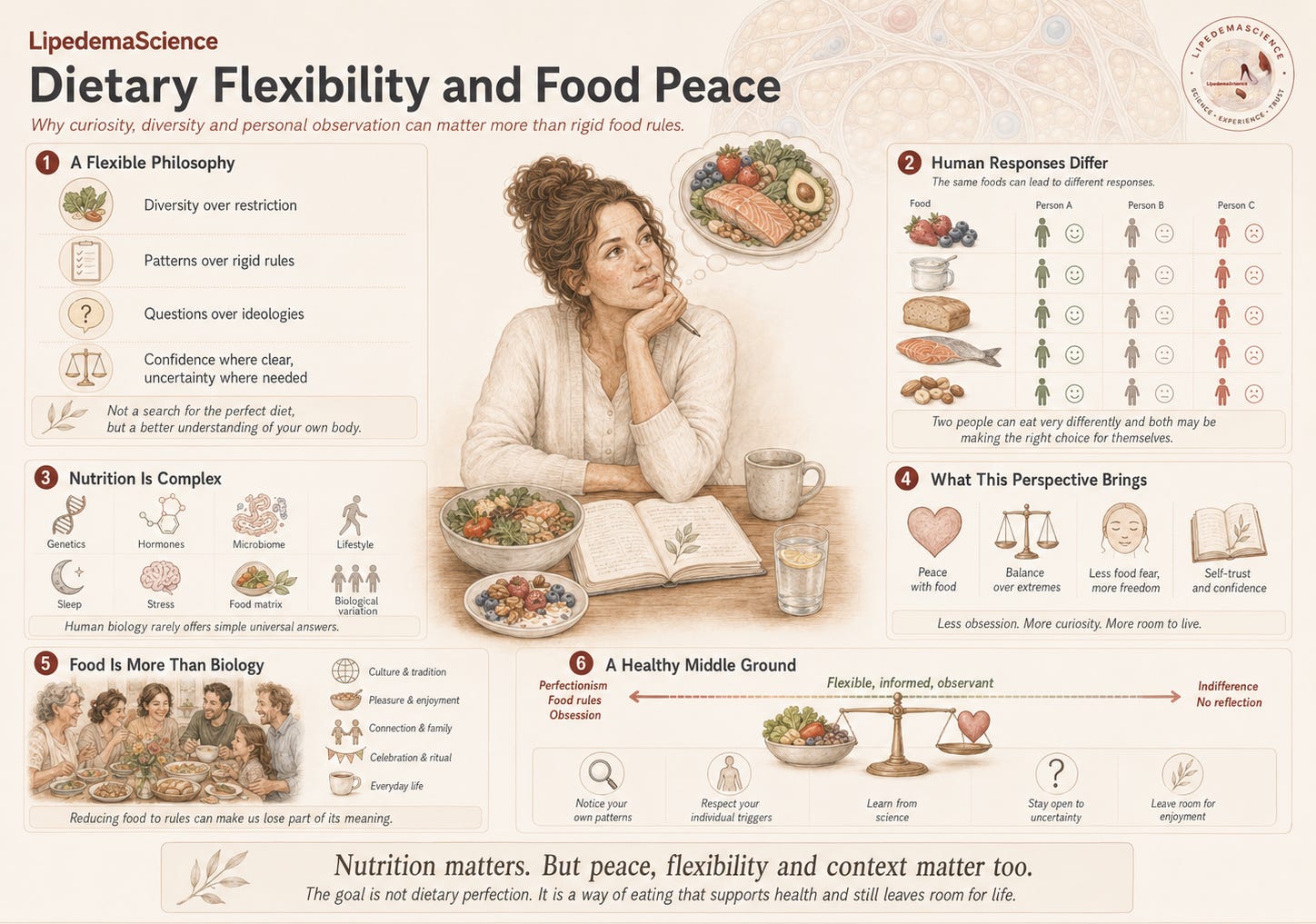
The longer I study nutrition, the more I find myself returning to a surprisingly simple conclusion. Human beings are different. Our biology is different. Our experiences are different. Our responses to food are different. That reality may not provide the satisfying certainty that many people are looking for, but it is probably closer to the truth. Food does not need to become a religion. It does not need to become an identity. It does not need to divide people into competing camps. Sometimes it is enough to acknowledge that nutrition is complex, that our understanding remains incomplete, and that two people can eat very differently while both making choices that are right for them.


That perspective has brought me a great deal of peace, both as someone who studied food professionally and as someone living with lipedema. Instead of constantly searching for dietary perfection, I focus on building a way of eating that supports my health, respects my individual triggers, allows flexibility, and still leaves room for enjoyment. Because at the end of the day, food is not only biology. It is culture, tradition, pleasure, connection, family, celebration, and everyday life. When we reduce it to a list of rules, we risk losing sight of everything that makes it meaningful in the first place.
At LipedemaScience, I believe nutrition deserves both curiosity and humility. Food influences health, but human biology is rarely black and white. My goal is not to tell you what to eat, but to explore the science, uncertainty, and individuality that make both nutrition and lipedema such fascinating subjects. Because sometimes the most honest answer is not certainty. It is complexity.