

In 2019 and 2020, I worked with a pea peptide in a research project called FoodProFuture. FoodProFuture was a comprehensive Norwegian research initiative aimed at increasing the production and use of Norwegian plant proteins in food. The main objective was to create a knowledge platform that would enable the Norwegian food industry to develop healthy, sustainable, and attractive products based on crops such as peas, faba beans, and oats.
Here you can see photos from those lab days..


This work led to my master’s thesis in food science.
So what did I do for my master’s thesis?
I investigated how protein fragments, so called peptides, from peas can affect our health, with a particular focus on the gut and immune system.
Using a lab model of the human gut, I tested whether these small protein building blocks could help reduce inflammation. I found that these pea peptides helped calm inflammatory signals in the cells.
I also looked at how these peptides affect the gut barrier, the wall that controls what enters our body from food. My results showed that the pea peptides could influence how tightly this barrier holds together, which matters for nutrient absorption and for the body’s protective function.
Overall, my work suggests that common peas contain bioactive components that may help regulate immune responses and support gut health.
At the same time, this project also made me reflect on how complex food really is. In this work, I tested only one single peptide out of many pea peptides. I also tested it in isolation, and in vitro rather than in vivo. In vivo (Latin for “in the living”) studies take place within a living organism, such as animals or humans, while in vitro (Latin for “in glass”) studies are performed in controlled environments like petri dishes or test tubes. In vivo research captures systemic, real world complexity, while in vitro studies allow for precise, controlled, and typically faster and less expensive experimentation.
This is why food science often makes it difficult to predict the full effect of a food component in the human body. Real life biology includes interactions we cannot fully replicate in a dish. One key concept here is synergy. A synergistic effect occurs when the interaction of two or more agents, such as nutrients, foods, or drugs, produces a combined effect greater than the sum of their individual effects. Synergy can be beneficial, but it can also be negative and lead to unintended outcomes.
That is important to keep in mind when discussing peptides, especially when claims are made about the effects of a specific peptide supplement.
At all times, the human body is exposed to potentially harmful substances and physiological imbalances. Under normal conditions, these pressures are kept in check through homeostasis, the body’s ability to regulate itself and maintain internal stability. What we eat can influence these regulatory systems, not only through essential nutrients, but also through a wide range of non nutrient compounds. This is one reason why food based functional components have been studied for their potential role in preventing disease and supporting health.
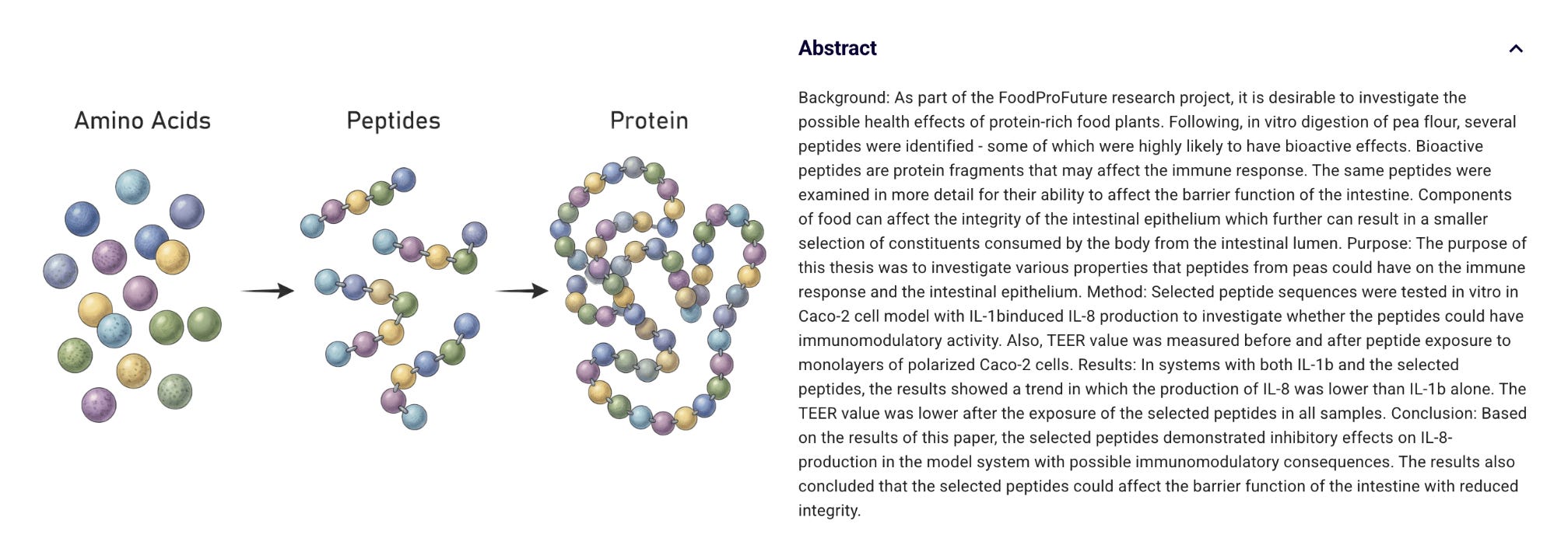
Proteins are a good example. Beyond their role as energy providing nutrients and building material for tissue, proteins can be broken down into smaller fragments that may have biological effects of their own. These fragments are called peptides, and when a peptide has a measurable effect on biological processes, it is often described as a bioactive peptide. Research suggests that certain bioactive peptides can influence systems such as immunity, digestion, circulation, and even endocrine and nervous system signaling. In some cases, the observed effects resemble what we typically associate with medicinal or hormone like activity, which is why there is growing interest in identifying and developing peptides with calming, protective, or preventive potential.
Bioactive peptides are often grouped by their primary mode of action. Common categories include mineral binding peptides, antioxidative peptides, antimicrobial peptides, antihypertensive peptides, and immunomodulatory peptides. While the details vary across peptide families, many share structural characteristics that seem to matter for function. Bioactive peptides are frequently short, often in the range of two to twenty amino acids, and they tend to contain a higher proportion of hydrophobic amino acids. Specific residues, such as proline, also appear frequently in sequences associated with certain bioactivities.
This perspective fits well with the main takeaway from my own work. Peptides can be biologically meaningful, but their real world impact depends on far more than a predicted function in a database. Stability, absorption, and the broader dietary context determine whether a promising sequence can actually influence physiology in a living system.
CarinaW shares the evidence based lipedema knowledge you wish you had earlier and the insights you did not know you needed. She is dedicated to helping you navigate lipedema management with facts and science. Subscribe to support her work, suggest topics, share experiences, and join a learning community.
As a food scientist and someone who lives with lipedema, I’m naturally curious about peptides. So let’s dive deeper into the peptide conversation in the context of lipedema..
Across lipedema communities, the word peptide is often used as a shorthand for everything from prescription peptide based medicines to experimental compounds sold through grey markets. That mix is exactly why we need a balanced lens that is both curious and critical. The most realistic near term opportunity sits with regulated medicines that happen to be peptides, because they have known manufacturing standards, known dosing, and large safety datasets, even if lipedema specific studies are still limited. The more speculative end of the spectrum includes regenerative and performance peptides where the mechanisms can sound very relevant to lipedema themes like inflammation, pain, microcirculation, and fibrosis, but where human evidence is thin and product quality can be uncertain.
Exenatide
Exenatide is a peptide based prescription drug in the GLP 1 receptor agonist family, originally developed for type 2 diabetes, and it is based on exendin 4, a peptide found in Gila monster saliva. In the body it activates GLP 1 receptors to improve glucose control, reduce appetite, slow gastric emptying, and indirectly reduce inflammatory tone, which is why it has become interesting for some people with lipedema, especially when insulin resistance is part of the picture. The current lipedema discussion is driven by early clinical observations and case based reports suggesting potential symptom improvement such as reduced pain or reduced tissue thickness, but it is not yet backed by large controlled lipedema trials, so it belongs in the category of medically supervised off label exploration rather than established lipedema therapy.
Semaglutide
Semaglutide is also a peptide based GLP 1 receptor agonist, designed to be long acting, and it is widely studied for obesity and diabetes. Its core effects are appetite reduction and improved metabolic signalling, with downstream benefits on systemic inflammation and cardiometabolic risk, which can matter for overall health in people who also live with lipedema. The realistic upside is not that semaglutide is proven to remodel lipedema fat specifically, but that it can improve metabolic drivers that sometimes sit alongside lipedema, while the realistic limitation is that lipedema fat distribution can be resistant and outcomes may be uneven. It is well studied for its approved indications, but lipedema specific evidence remains limited.
Tirzepatide
Tirzepatide is a peptide based dual agonist that targets both GIP and GLP 1 pathways, and it has shown very strong effects on weight loss and metabolic improvement in large trials for obesity and diabetes. Mechanistically, its relevance to lipedema is indirect but plausible, through improved insulin sensitivity, reduced low grade inflammation, and potentially more pronounced changes in adipose tissue biology compared with GLP 1 alone. The opportunity is that a stronger metabolic reset could translate into symptom support for some patients, while the constraint is the same as above, we do not yet have robust lipedema specific trials showing consistent effects on pain, fibrosis, or limb tissue patterns.
BPC 157
BPC 157 is a synthetic peptide originally described as a fragment related to gastric protective proteins, and it is popular in biohacking circles for claims around tissue repair, inflammation modulation, and microvascular support. In theory, those themes overlap with lipedema concerns like tenderness, microcirculatory issues, and fibrotic change, which is why it circulates in community discussions. The reality check is that most supportive data are preclinical, human clinical evidence is limited, and the compound is often obtained outside regulated pharmaceutical channels, which raises questions about purity, dosing, and long term safety, so any consideration should be approached with extra caution and a clear understanding of uncertainty.
Thymosin beta 4
Thymosin beta 4 is a naturally occurring peptide involved in actin dynamics, cell migration, angiogenesis, and wound repair, and it has been studied in experimental settings for tissue regeneration and anti fibrotic signalling. That makes it conceptually attractive for lipedema narratives that include fibrosis and altered microvasculature, especially in later stage tissue changes where stiffness and remodeling are prominent. The critical point is that while the biology can look promising on paper and in models, lipedema specific human evidence is not established, and regenerative peptides sit in a space where formulation, dosing, and clinical oversight matter greatly.
CJC 1295
CJC 1295 is a synthetic peptide designed to stimulate growth hormone release by mimicking GHRH signalling, and it is discussed mainly in performance and anti ageing communities as a way to influence body composition and recovery. In a lipedema context, the appeal is usually framed as fat loss support and improved tissue repair, but the realism is that growth hormone and IGF 1 pathways affect many tissues and can carry trade offs, including fluid shifts and complex interactions with connective tissue biology. Evidence quality varies depending on formulation and study design, and it is not a lipedema studied intervention, so it should be viewed as speculative and potentially hormonally disruptive.
Ipamorelin
Ipamorelin is a growth hormone secretagogue that acts through ghrelin related signalling to increase growth hormone pulses, and it is often marketed as a gentler option within that category. The lipedema conversation tends to link it to recovery, sleep, and body composition, but the same realism applies, these endocrine pathways are systemic and not lipedema specific, and benefits reported in forums do not substitute for controlled outcomes on lipedema pain, fibrosis, or limb tissue behaviour. If lipedema is strongly hormone sensitive, any intervention that pushes hormonal axes deserves careful medical consideration.
ARA 290
ARA 290, also known as cibinetide, is a small peptide derived from erythropoietin related biology but engineered to target tissue protective pathways without stimulating red blood cell production. It has been explored in clinical research contexts for neuropathic pain and inflammation modulation, which is interesting because lipedema pain can have neurogenic and inflammatory features in some patients. It is not a standard lipedema therapy and availability is not like conventional obesity medicines, but it represents the kind of targeted immune and nerve axis approach that could be genuinely relevant if future studies connect the mechanism to lipedema symptom clusters.
CGRP
CGRP is an endogenous neuropeptide heavily involved in vasodilation and pain signalling, and it is often discussed in the context of migraine biology and neurogenic inflammation. In lipedema conversations it tends to appear because pain, hypersensitivity, and vascular dysregulation are common themes, and CGRP is a plausible biomarker or pathway contributor rather than a supplement to take. The practical translation today is that CGRP is more useful as a lens for understanding pain biology and as a reminder that some approved migraine therapies target this pathway, but it is not itself a peptide treatment for lipedema.
NGF
NGF, nerve growth factor, is a neurotrophin that supports nerve growth and sensitization, and it is widely studied in pain biology and inflammatory conditions. Lipedema communities sometimes mention NGF because it fits the story of amplified pain signalling and tissue hypersensitivity, but like CGRP it is best understood as a biological signal that may be elevated or relevant in affected tissue rather than a do it yourself therapeutic peptide. The forward looking angle is that better mapping of NGF related signalling in lipedema could eventually inform pain targeted trials, but we are not there yet.
Collagen peptides
Collagen peptides are small protein fragments produced by hydrolysing collagen, sold as oral supplements, and commonly discussed for skin, connective tissue, and joint support. For lipedema, the appeal is usually framed around fascia, tissue texture, and general connective tissue resilience, with a relatively low risk profile compared with injectable experimental peptides. The reality is that any effect on lipedema fibrosis or adipose remodeling is unproven, and benefits are more likely to be modest and supportive rather than disease modifying, but they remain one of the more practical options when someone wants to explore peptides through nutrition rather than pharmacology.
MOTS c
MOTS c is a mitochondria derived peptide encoded by mitochondrial DNA and released as a systemic signal during metabolic stress. It is often described as a metabolic regulator that can influence insulin sensitivity, cellular stress responses, and energy homeostasis, which makes it attractive in communities discussing fat dysfunction and fatigue. The opportunity for lipedema management is theoretical and indirect, through potential effects on metabolic flexibility and inflammatory tone rather than direct remodeling of lipedema tissue. It is not well established as a therapy in humans, access is typically outside standard medical channels, and the evidence base is still emerging, so it should be framed as experimental with unclear long term safety and unclear relevance to lipedema specific pain or fibrosis.
KPV
KPV is a short tripeptide derived from the alpha MSH pathway and is best known for local anti inflammatory effects, particularly in skin and gut related inflammation models. Mechanistically it is thought to downshift inflammatory signalling pathways in immune cells, which is why it is sometimes discussed for inflammatory symptoms and barrier issues rather than for fat disorders directly. In a lipedema context, the most realistic angle is not fat reduction, but the possibility of supporting inflammatory balance, especially for people who experience skin irritation, barrier disruption, or gut related inflammatory symptoms alongside lipedema. The evidence base is mostly preclinical and topical oriented, with limited high quality human data, so it belongs in the category of plausible biology, limited proof, and best viewed as supportive rather than disease specific.
LL 37
LL 37 is an endogenous antimicrobial peptide that plays a key role in innate immunity, wound defence, and immune signalling, and it can act like a double edged sword by both protecting against pathogens and amplifying inflammation depending on context and dose. People bring it up because it sits at the intersection of inflammation, tissue remodelling, and immune activation, themes that overlap with how some describe lipedema progression. The realism is that LL 37 is primarily a biomarker and immune effector molecule, not a straightforward supplement strategy, and immune activation is not automatically beneficial in a chronic inflammatory condition. Human therapeutic use is not established for lipedema, and indiscriminate use would be difficult to justify without specialist guidance and a very clear indication.
Oxytocin
Oxytocin is a peptide hormone produced in the hypothalamus and released by the posterior pituitary, best known for its roles in social bonding, stress modulation, childbirth, and lactation, but it also has metabolic and anti stress effects that are increasingly studied. In the body it can influence appetite, stress related eating, autonomic balance, and potentially inflammatory signalling, which is why it sometimes appears in discussions about chronic pain and body composition. For lipedema, the most realistic value is as a stress and pain modulation hypothesis rather than a direct tissue treatment, because stress physiology can amplify pain perception and inflammation. Human research exists in several domains, including intranasal delivery, but it is not established for lipedema and responses can be context dependent, so it should be discussed as an interesting neuroendocrine angle rather than a proven intervention.
TB 500
TB 500 is a synthetic peptide often marketed as a thymosin beta 4 related fragment, promoted for tissue repair, recovery, and inflammation modulation. The reason it gains attention is that lipedema discussions frequently circle around fascia tightness, micro injury, pain, and fibrosis, and a repair oriented narrative can feel compelling. The reality check is that TB 500 is frequently sold in unregulated markets, human clinical evidence is limited, and product identity can vary, which introduces real uncertainty around what is being taken and what the risks might be. In a lipedema context, it should be described as highly experimental, with theoretical overlap but insufficient evidence to treat it as a credible management tool today.
DSIP
DSIP, delta sleep inducing peptide, is a small peptide historically linked to sleep regulation, stress response, and possibly pain sensitivity, and it appears in some biohacking circles as a sleep support compound. For lipedema, the relevance would be secondary, because better sleep can improve pain tolerance, metabolic regulation, and inflammatory balance, which can influence symptom experience even when it does not change the underlying tissue biology. The evidence for DSIP as a reliable sleep therapy in humans is mixed and not comparable to established sleep interventions, and the peptide is not a standard medical treatment. If it is discussed at all, it is best framed as a sleep and recovery hypothesis with uncertain efficacy rather than a lipedema specific strategy.
GHRP 2
GHRP 2 is a growth hormone releasing peptide that activates ghrelin receptors to stimulate growth hormone secretion, and it is often used in performance contexts to influence body composition and recovery. The core mechanism is endocrine manipulation, which can affect fat metabolism and muscle maintenance, but it also comes with trade offs such as appetite increases, water retention, and broader hormonal shifts. For lipedema, the appeal is usually fat loss, but the realism is that lipedema fat is not simply an energy storage problem and hormonal sensitivity is a core feature for many, so pushing the GH IGF 1 axis can be unpredictable. Human evidence relevant to lipedema is lacking, and given the systemic hormonal impact, this category generally deserves a higher caution threshold.
Kisspeptin
Kisspeptin is a family of peptides that regulate the reproductive axis by stimulating GnRH release, thereby influencing LH and FSH and downstream sex hormone production. It is clinically relevant in reproductive endocrinology and increasingly studied in fertility and hypothalamic function. Because lipedema is often hormone sensitive, kisspeptin can sound relevant, but that is also exactly why it is risky to discuss as a do it yourself peptide, since it can shift sex hormone dynamics in meaningful ways. It is studied in humans in clinical settings, but not as a lipedema intervention, so its role here is mainly as a lens that highlights how strongly endocrine control points can shape symptoms, and why medical supervision matters when peptides target hormone axes.
This is an open access article. If you’d like to support my work and help this community grow, please share it with a friend who also lives with lipedema. Your support truly matters and makes it possible for me to keep writing thoughtful, evidence based articles for our lipedema management community. Thank you!
What are your thoughts on peptides? Have you tried any, or considered it? Leave a comment below.
I belive my mom has lipedema. Would love to find some things to help her! I am curently on peptides btw. Bcp and TB500. Trying it for neck damage and for ME. Are you also Norwegian ?😀 First one I have seen here so far.
Also—consider FOX04-DRI please.
Pre-Note: I have been taking Tirzepatide at a conservative dose since about 5 months before the FOX04-DRI. While I had lost about 10 lbs before the FOX04 and about the same DURING FOX04 dosing, the Tirz alone did not at all affect the fibrosis.
I took FOX04-DRI and had a fairly immediate and dramatic decrease in apparent fibrosis after just one 2.5mg injection. The result was objectively, undeniably apparent 4 days later, and has been maintained independent of other body factors.
I had forgotten I took the injection (bc I thought it was an underdose (long story) so expected nothing). But then, when running my hand firmly along my low-back-butt—as I sometimes do bc it’s a place where I feel Lipedema “ledges”—I spontaneously noticed an unprecedented decrease and softening in those ledges. I THEN had to think about why this change could possibly have happened. It took me a few moments to remember I’d taken the FOX04.
I don’t know how to properly emphasize: I am fairly scientifically-minded. It’s rare to really know, under normal-life circumstances—that a correlation you see is real, especially bc results are often subtle, etc. This was one of those rare circumstances where the result was not subtle or confounded in any way. I feel very confident in the validity of this observation, and I am NOT selling anything.
Since then, beginning a couple months later, I have taken a 3-“dose” course where each “dose” is 5mg injected (half in each low hip) on day 0 and 3, then wait a week before the next dose.
I would subjectively say there was some add’l softening over this course, but maybe 1/8th that produced by the first 2.5mg dose.
It may be that the FOX did most of what it could in that first dose, which makes some sense given its mechanism of action.
Curiously, however: Since beginning dosing, my legs and butt DO seem to actually be changing SHAPE relative to my body—becoming more proportionate, not just losing generalized weight. This has never happened in my personal history of (moderate) weight fluctuations. I do not observe the same shift in my arms, which are also (less) affected by Lipedema. It IS possible this is due only to generalized weight loss—perhaps I am not remembering my former body shape perfectly as it’s been about 10 years since I was last this weight. But I do think the FOX had an effect. My Hume scale seems to corroborate greater fat loss in my legs than in my arms or belly (another shift I’d not previously seen.)
In my arms, if anything, the fibrosis has become EASIER to find/feel, probably bc I’ve lost a little weight so there is less fat hiding them.
So I have opposite subjective experiences in two different areas of my body. Softening (and shape change?) in the limbs that received the FOX04 injections and no change in the limbs that didn’t.
Now, FOX04 theoretically works systemically as I understand it, but per my experience anyway it seems the effect is at least more pronounced closer to the injection spot. Just reporting my observations, that’s all I know.
So, next I’m going to try some dosing into my arms and see what happens.
I also suspect the FOX04 may have made the Tirz a little more effective, as the weight loss became a little more reliable with less attention. But I’m not sure.
I’d love to hear others’ observations if they’ve also tried FOX04.