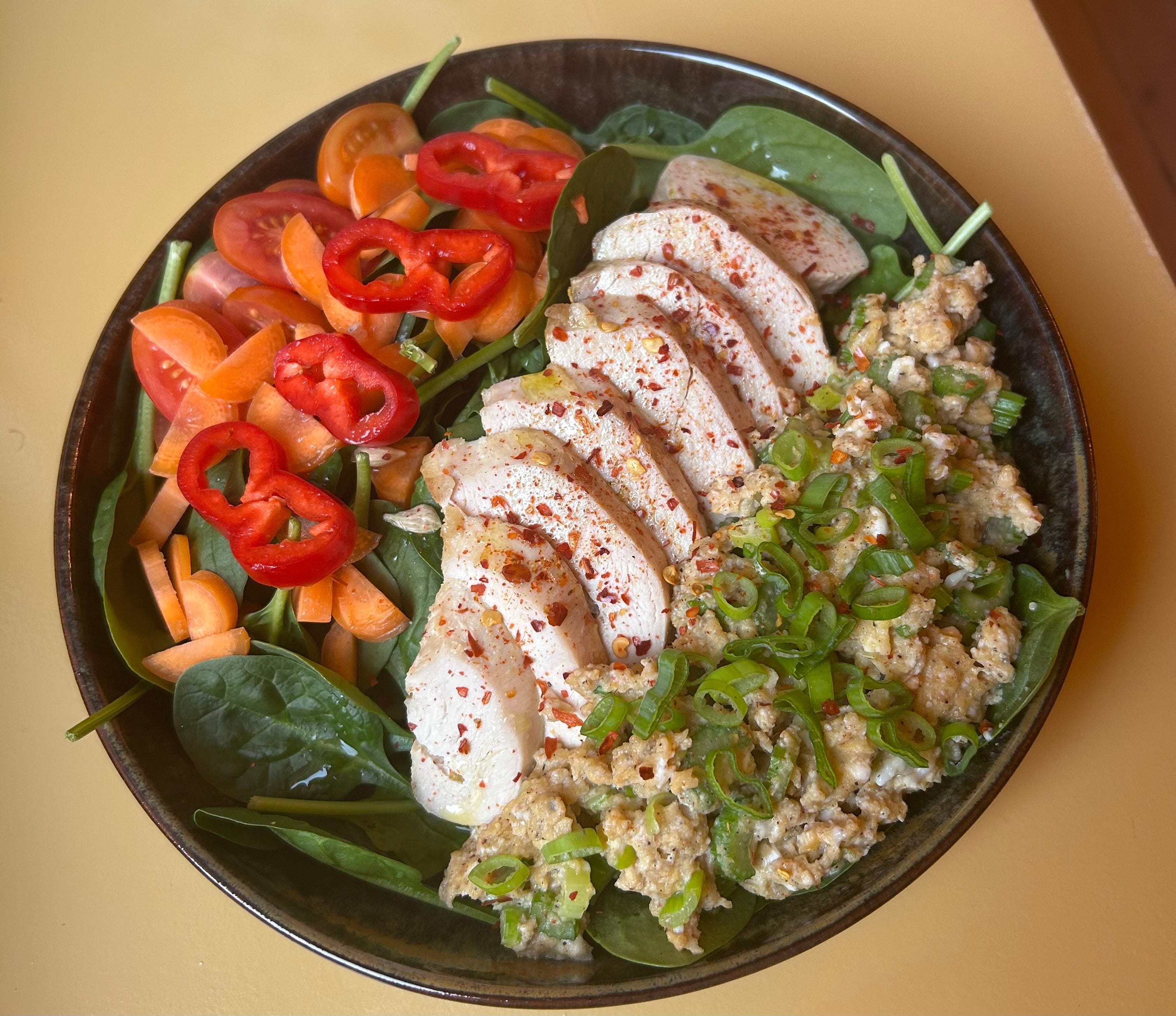
I’ve spent a surprisingly large portion of my life thinking about food. My interest began when I was around 15, long before I started learning about nutrition and food science. In the roughly 20 years since, I’ve experimented with many of the dietary trends that have come and gone in the health conversation. I’ve eaten raw food. I’ve tried low-carb and ketogenic diets. I’ve dabbled in superfoods, anti-inflammatory diets, and organic eating. At one point, after reading about research on calorie restriction in primates, I even tried eating a very large volume of low-calorie foods, like vegetables, salads, and berries. Today, I eat very differently. Or, perhaps more accurately, I think about food in a very different way.
I don’t count carbs. I don’t meticulously calculate how much of everything I’m eating. I don’t have a long list of foods I’m not allowed to eat. A large portion of what I eat is based on relatively unprocessed foods, and I tend to eat fewer refined carbs without actively trying to follow a low-carb diet. I probably eat something close to an 80/20 split when I look at my overall diet. A large portion of what I eat contributes to my health, but there’s also enough flexibility for eating out, travel, holidays, and simply eating something because I enjoy it. It took me many years to get here. And, having tried other approaches myself, I’m wary of judging those who choose a more restrictive diet.
Why can clear rules sometimes be easier to implement than monitoring what people do?
Often, we assume that it is easier to follow an average diet than to follow a very strict diet. However, this is not necessarily true when considering behavior.
“Eat this, but only occasionally” requires making repeated decisions. How often is “occasionally”? How much is “advisable”? Does today count? What about tomorrow? If a particular food is strongly associated with the habit in question, allowing a small amount of it may cause some people to think about it more, rather than less. A strict rule eliminates some of these decisions.
The ketogenic diet is a good example. The restrictions can be significant, but they are relatively clear. For an individual who previously struggled with hunger or certain eating habits, meals that are rich in protein and fat can also be enjoyable. Therefore, an individual may experience a very restrictive diet as psychologically simpler than constantly negotiating with themselves about moderation. This does not automatically make a restrictive diet biologically better. It simply makes it easier for that individual to adhere to it.
This analysis sparks my interest, as there is often talk about nutrition as if adhering to a planned diet is unpleasant and hinders “real” biological interventions. In reality, following the diet is part of the intervention. Although a diet may be a great idea, it has limited benefit for an individual if they cannot adhere to it.


Restrictions and adherence to them are not the same.
A diet can be restrictive, but still easier for certain individuals to follow. Clear rules reduce the number of food decisions that need to be made repeatedly. Whether this helps or hinders depends on the individual and the circumstances.
We are not starting from the same place.
There is another problem with general dietary advice: people differ in their metabolism and health.
Someone with insulin resistance or type 2 diabetes may not necessarily make dietary decisions based on the same assumptions as someone with normal glucose control. Someone with celiac disease needs restrictions that would be completely unnecessary for most people. Lactose intolerance changes which types of foods are tolerable. Symptoms related to histamine may require individualized assessment. Gastrointestinal issues can change an individual’s attitude toward fiber, fermentable carbohydrates, and certain food groups.
Even among people who have not been diagnosed with any disease, glucose metabolism, appetite, energy expenditure, body composition, physical activity, medication, genetics, age, and hormone levels vary.
It doesn’t mean that everyone needs a completely personalized diet plan, nor does it mean that the basic principles of nutrition no longer apply. It simply means that the same advice can have different effects on different individuals.
The same applies to medical treatment. Some people can achieve significant and positive changes in their metabolism simply by changing their diet and behavior. Other people may need medication, including drugs based on GLP-1 or other treatments. The need for medication is not proof that an individual is not disciplined enough, and being able to live without medication does not make a person’s lifestyle morally superior.
Different doesn’t mean everything is permissible
Individual variability is real, but that doesn’t mean all dietary claims are equally credible. A personalized approach should still be based on biology, nutritional value, medical needs, and the quality of the available information.
What exactly is a “low-carb diet”?
Even the information on food packaging can provide more certainty than science allows. I remember being shown food from a Norwegian study on low-carbohydrate diets, and I was struck by how familiar it seemed. The participants had achieved ketosis, but even so, the diet was not as strict as the “keto” diet I had come to associate with the term. When I looked at the food itself, I remember thinking:“This is quite similar to what I usually eat.”


This highlights a larger problem in nutrition. “Low-carb craze” describes a broad range. Keto describes a metabolic state. “Keto craze,” meanwhile, has evolved and now has a much narrower cultural meaning, especially online. These terms have converged, but they are not necessarily interchangeable.
We often categorize common biological phenomena into different groups, as categories make it easier to communicate information. Over time, a category can gradually become a self-image: keto, carnivore, vegetarian, low-carb, anti-inflammatory...
When that happens, defending this dietary habit can become almost as important as questioning what it actually does.
I understand that inclination to seek certainty, because I have experienced it myself.
One example that comes to mind is from before I formally started studying nutrition. When my father was diagnosed with cancer in 2011, I desperately wanted to be able to do something helpful with food. His cancer was very serious, and we knew that his prognosis was extremely poor. He only lived for a few months after the diagnosis.
At that time, I was very concerned that sugar was “feeding” the cancer. I wanted him to stop consuming sugar and he followed a very strict diet based on whole, unprocessed foods, with foods like cauliflower being a focus. At the same time, he was receiving cancer treatment within the Norwegian healthcare system, and he was offered cake and sugary drinks. At the time, I found this almost incomprehensible. When someone you love is dying and there is little you can control, strict rules can provide something incredibly powerful – something to do.I think we sometimes underestimate this when we talk about extreme health behaviors.


It is not always unconsciousness that drives them forward. Sometimes it is fear, hope, desperation, a need to make a difference, or simply a desire to take an active part in their own health.
The feeling of being in control of one’s life can be powerful.
Decisions about health are not based solely on biological information. Uncertainty, fear, hope, past experiences, and the desire to regain control of one’s life can all influence which treatments seem most appealing.
It doesn’t have to be the case that seeking solutions in this way leads to a permanent self-image.
This is where my thinking has changed significantly. Previously, I viewed dieting as something I needed to find the right one for. Today, I don’t believe there is necessarily one diet that an individual needs to find and then follow without changes for the rest of their life.
There may be times when a structured approach is beneficial. Someone might follow a fairly strict diet while trying to improve their health metrics or change ingrained habits. Someone suffering from digestive symptoms might temporarily limit certain types of food while trying to figure out what they can tolerate. Someone might find that a low-carb diet helps them achieve certain goals and then gradually add more carbs while continuing to improve their condition.
There can also be times when one’s own health requires flexibility. Grief is a good example. A serious illness in the family is another. The same goes for fatigue, fertility treatments, major life changes, caregiving, and periods of mental difficulty. Sometimes, one has the capacity to maximize performance. Sometimes, it’s enough just to get through the day. I don’t think these periods reflect moral success or failure. They reflect life.
This will be especially important when dealing with a chronic condition, such as lipedema. If you know that you may need to manage the condition for many years, it will be important to be able to maintain it. But that doesn’t necessarily mean you need to do exactly the same thing every day for many years. It may mean that you need to develop enough self-awareness to know when you benefit from more structure and when you need more flexibility.
What works in extreme cases might work, but we should still ask ourselves why.
I believe that what matters is not simply whether a particular approach “works.” Rather, I want to know why it works. Did reducing carbohydrates help improve glucose control in an individual with significant insulin resistance? Did increasing protein intake help increase the feeling of fullness? Did eliminating a specific food eliminate symptoms because the individual was actually intolerant? Did the diet indirectly reduce overall calorie intake? Did reducing highly processed foods affect the overall nutritional value of the diet? Or did a simple rule at the end make it possible to control changed behavior?
Many of these systems can lead to the same outcome, but they still provide us with very different information about what the individual actually needs in the long run.


This difference will be particularly important when personal success is transformed into general advice.
If someone loses a significant amount of body weight through a ketogenic diet, that experience is real for them. However, it doesn’t mean that everyone needs to be in ketosis. If someone feels much better after eliminating gluten from their diet because they have celiac disease, it doesn’t mean that gluten is harmful to everyone. If someone needs medication to manage their appetite or metabolism, it doesn’t mean that everyone who is overweight needs the same treatment. And even if I have success with the 80/20 method, that doesn’t mean that everyone else should eat the same way I do.
The results do not always reveal what the effects are.
If people feel better after eliminating a particular food, it suggests that something has changed. But it doesn’t automatically tell us why. Energy intake, nutrient composition, symptoms, expectations, other changes that occur at the same time, and underlying health conditions can all have an impact.
Maybe we should stop trying to find the one right way to eat.
After having an interest in nutrition for about 20 years, including the years I formally studied nutrition and dietetics, I have decreased my interest in categorizing food into different groups, but rather become more interested in what is more than just food. That doesn’t mean I think nutrition is irrelevant. Quite the opposite. Food is one of the things that matters most to me. But I have become increasingly interested in the bigger picture, the context, and the person sitting in front of me.
Today, I’m all about simple food, good ingredients, nutrient-rich and varied meals, and something versatile enough that my diet doesn’t dictate my entire life. I want my food to support my metabolic health, gut health, overall health, and help me manage my lipedema. I also want to eat dinner with my partner, eat with friends, travel, and experience food as more than just a biological necessity. This balance works well for me now. It might not have worked for me at all times in my life. And maybe that’s what I want to convey with this article. Why are we so eager to change what has helped us into something that everyone should be doing?
Sometimes, certain measures can be effective. Sometimes, it is difficult to find a middle ground, but it is easier to set limits. Sometimes, it is necessary to use medication. Sometimes, an individual’s illness requires a truly specific diet that would not be necessary for others. And sometimes, the measure that helps us in one phase of life does not need to follow us into the next.
We can learn from each other’s experiences without turning them into universal truths. And perhaps we could become a little less interested in asking what dietary ideology a person adheres to and a little more interested in asking what they need, what they can sustain, what their health requires right now, and what kind of life they ultimately want to live.