

Bacteria and gut health are areas I know particularly well, both from my academic background and from my work in the laboratory.
When I worked as a laboratory manager, my team was responsible for microbiological testing. As a food scientist, microbiology is also a major part of what we study. We learn about bacteria from many different perspectives, like how microorganisms can be used to produce foods such as cheese and fermented products, how pathogenic bacteria can cause foodborne illness, and how other microorganisms and parasites can affect human health.
For four years, I was also a co-author on a scientific research project together with a food safety research group at a veterinary university. We studied Bacillus cereus, a bacterium with some particularly interesting and potentially dangerous characteristics. Part of the work involved whole-genome sequencing, which allowed us to study the bacterium at a much deeper level and better understand the genetic features behind its behaviour.
My master’s research brought me even closer to the intestine itself. I worked with intestinal cell models and studied how peptides could be transported across the intestinal barrier. That experience gave me a much deeper interest in what happens at the interface between food, the gut and the rest of the body.
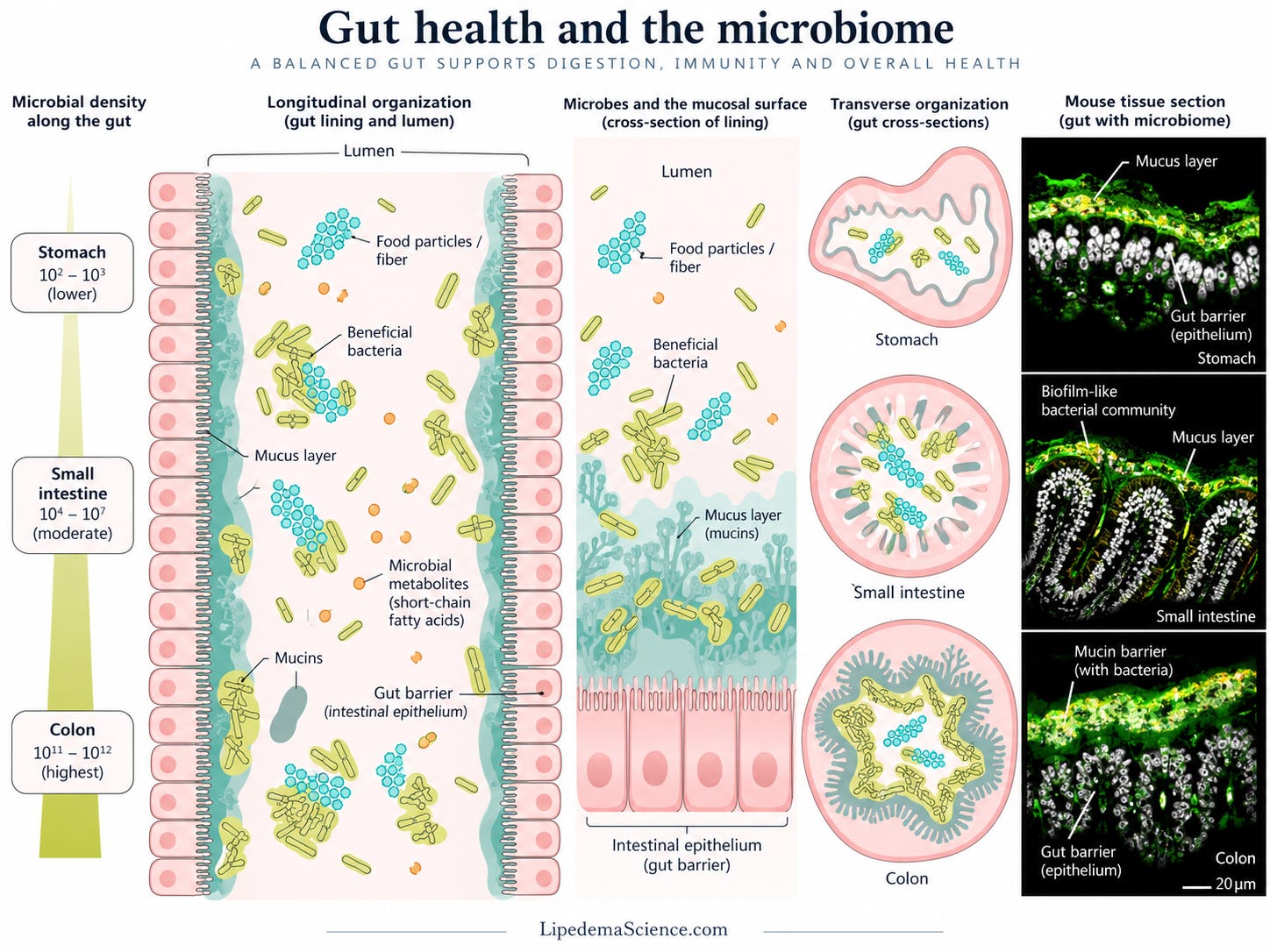
Gut health is therefore something I care about both scientifically and personally. The gut is closely connected with immune function, metabolism and communication between the gut and the brain. But one important thing to understand is that there is no single scientific definition of a “healthy gut.” Researchers instead look at features such as microbial diversity and resilience, the production of compounds such as short-chain fatty acids, the intestinal barrier and how the immune system interacts with the microbiome.
The gut microbiome has also been linked to inflammation, metabolic disease and aspects of mental health. However, this is an area where popular claims often go much further than the human evidence. Much of what we know about the underlying mechanisms comes from animal and cell studies, while the effects demonstrated in humans are generally more modest.
This is particularly important when we talk about lipedema. At the moment, we do not have evidence showing that an unhealthy gut causes lipedema or that changing the microbiome can treat it. There has only been very limited human research on the microbiome in lipedema, so the gut–lipedema connection should currently be considered a hypothesis rather than an established finding.
Still, I think gut health matters. Not because I believe that every disease starts in the gut, but because the gut is one important part of our overall health. Supporting good gastrointestinal, metabolic and nutritional health makes sense regardless, and for people with lipedema, taking care of the whole body is an important part of long-term health and disease management.
So in this article, I want to look at what we actually know about gut health, the microbiome and the intestinal barrier, what is still uncertain, and what may be relevant for people living with lipedema.
