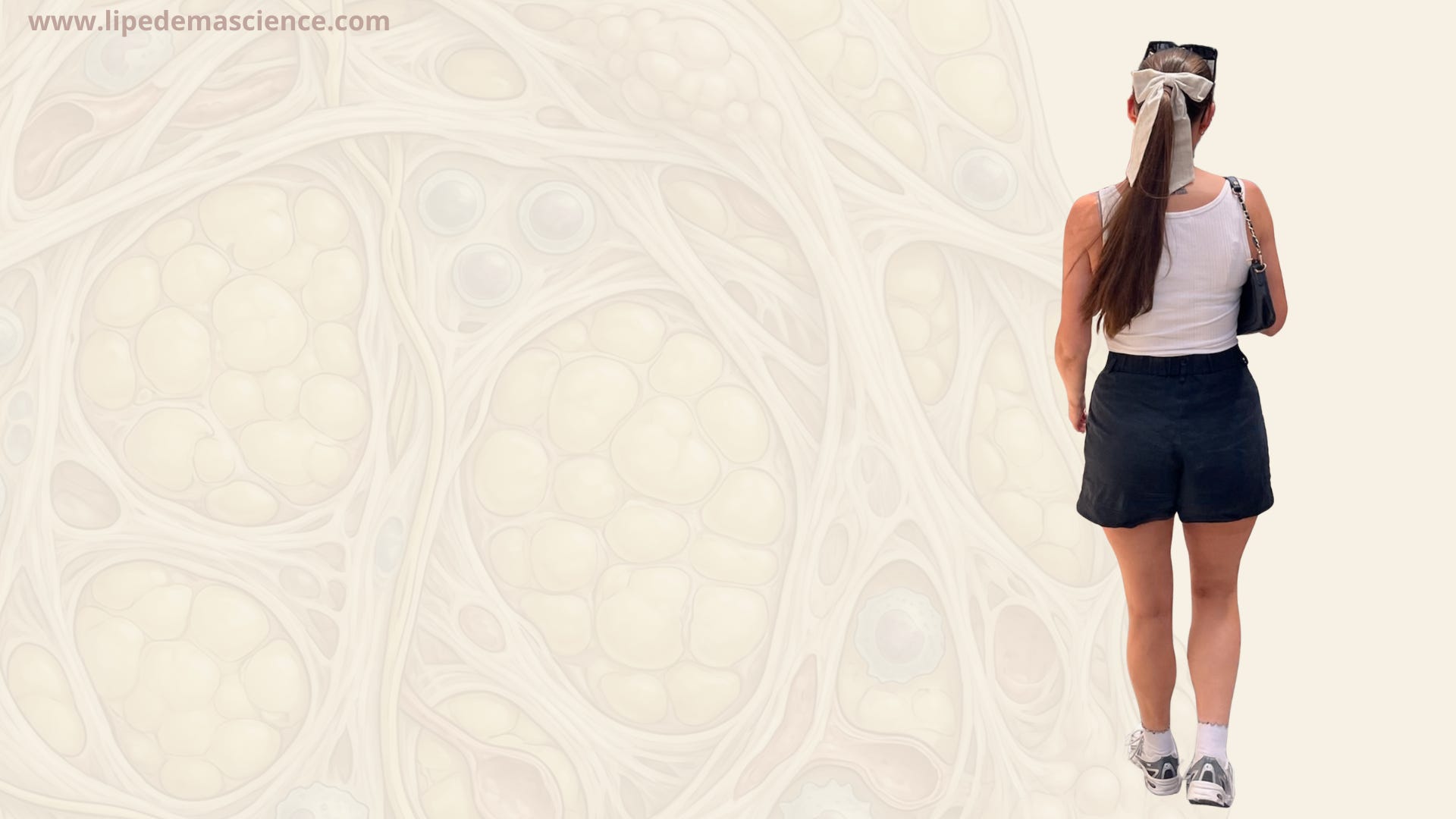
For the past three weeks, Portugal has been my home. What started as a simple trip became something much bigger than that. It became a reminder of why I have spent so many years trying to find balance between living with lipedema and actually living my life.


My partner and I rented a house outside Peniche and spent more than two weeks there before meeting friends in Lisbon. We both work a lot, perhaps more than most people would consider healthy. We genuinely enjoy building things, learning, creating, and solving problems, but being driven also comes with a responsibility. If work is allowed to consume everything, life eventually becomes very small. For us, travel is one of the ways we create balance. We need new impressions, new cultures, different food, beautiful surroundings, and experiences that stimulate us in ways that work never can. Portugal turned out to be exactly what we needed.
I had never visited Portugal before, and I quickly understood why so many people fall in love with the country. During our stay we explored Porto, Nazaré, Óbidos, Sintra, Lisbon, and countless smaller places in between. What struck me most was how much history seemed to be woven into everyday life. Ancient buildings stood next to local cafés. Narrow streets opened into beautiful squares. Fishermen worked along the coastline while tourists wandered through medieval towns. There was a calmness to Portugal that I found incredibly appealing. It felt authentic rather than curated.


Food is always an important part of travel for me. As both a nutritionist and a food scientist, I have always been fascinated by how food reflects culture, geography, history, and lifestyle. Portugal was a dream in that regard. Fresh seafood was available everywhere. Fish, shellfish, vegetables, fruit, olive oil, and locally produced ingredients formed the foundation of many meals. This aligns closely with how I naturally prefer to eat. Even when I am travelling, I tend to gravitate towards simple meals built around fresh ingredients rather than heavily processed foods. Breakfast might consist of salmon, avocado, poached eggs, fruit, and a green smoothie. Dinner might be fresh sardines caught locally. At wine bars, oysters often accompanied a glass of Portuguese wine. For me, this is not dieting. It is simply food that makes me feel good.
At the same time, I no longer believe that perfect eating is the goal of lipedema management. That is probably one of the biggest lessons I have learned since receiving my diagnosis 14 years ago. When I was first diagnosed, I approached lipedema much like many people do. I wanted to find the perfect solution. The perfect diet. The perfect strategy. The perfect way to eliminate symptoms. What I eventually learned was that life becomes very small when every decision revolves around avoiding potential triggers. Today I think very differently.


LipedemaScience was created because I wished something like it had existed when I was first diagnosed. Over the past 14 years, I have spent countless hours reading research papers, speaking with clinicians, testing different management strategies, and trying to understand what lipedema actually is. Through LipedemaScience, I share that journey by connecting the latest research with real-life experiences, reflections, and practical questions that many women living with lipedema face every day.
When my friends arrived in Lisbon, I found myself standing in a local grocery store preparing for a weekend together. I filled the basket with things I knew they would enjoy. Chips, snacks, sweet treats, and foods associated with celebration and social gatherings. At the same time, I bought blueberries, raspberries, walnuts, Brazil nuts, olives, and other foods that I personally enjoy and know make my body feel good. Looking back, that grocery basket was probably the perfect illustration of how I think about lipedema today. It was not about restriction. It was about balance.
For me, sustainable lipedema management has become an 80-20 approach. Most of the time I focus on habits that support my health. I prioritise exercise, sleep, recovery, nutritious food, and stress management. However, I also make room for experiences. Sitting at a small wine bar in Lisbon with close friends while sharing oysters and Portuguese wine is part of life. Trying a local pastry that generations of Portuguese families have enjoyed is part of life. Laughing with friends until midnight in a city you have never visited before is part of life. Those moments matter too.


One reason I can approach travel this way today is that I know my body extremely well. I have lived with lipedema symptoms since my teenage years. I was diagnosed when I was 20 years old, and I am turning 35 next month. That means I have spent almost 15 years actively learning how my body responds to different foods, stressors, hormones, environments, and lifestyle choices. I know many of my triggers. I know which choices tend to increase pain, heaviness, swelling, or fatigue. Equally important, I know which choices make me feel strong, energetic, and resilient.
My body also responds very differently today than it did before surgery. Before lipedema surgery, certain foods could trigger immediate reactions. The relationship between sugar and my symptoms was particularly obvious. Today many of those reactions are significantly reduced. However, surgery did not cure my lipedema. The disease is still present. I simply have less affected tissue than before. That distinction is important because it influences how I think about long-term management. I do not live as though lipedema disappeared. I still wear compression garments during long flights. I still pay attention to recovery. I still prioritise movement. I still think carefully about nutrition. The difference is that I no longer allow lipedema to become the centre of every decision.


This past year has added another layer to that equation. Alongside managing lipedema, I have been going through multiple egg retrieval cycles. Anyone who has undergone fertility treatment understands how profoundly hormones can influence the body. I have seen very clearly that my lipedema tissue responds to hormonal changes. The effects are not necessarily immediate, but they are noticeable. Looking back, I think it has often taken two or three months after treatment cycles before I feel that my body has returned to its previous baseline. The experience has reinforced something that many women with lipedema already suspect. Hormones matter.
Interestingly, fertility treatment has also introduced me to concepts that may be relevant for lipedema in ways I had not previously considered. During fertility treatment, you quickly learn that the eggs retrieved several months from now are influenced by the choices you make today. Exercise, nutrition, sleep, stress, and metabolic health all contribute to the environment in which those eggs mature. That has led me down a fascinating path of learning about mitochondria, energy production, and cellular health. Resistance training has become an increasingly important part of my routine, not only because of its benefits for overall health but because of its potential influence on mitochondrial function. The more I learn, the more interested I become in the possible connections between mitochondrial health, fertility, and lipedema. It is a topic I plan to explore in a future article.
Perhaps the most important thing I want readers to take away from this story is that my journey is exactly that. My journey. One of the challenges within the lipedema community is the temptation to compare ourselves with others. Someone reads about a person who improved on a particular diet, underwent surgery, started a specific exercise programme, or lost weight, and immediately begins comparing their own experience. I understand that instinct because I have done the same thing myself. However, after almost 15 years with this diagnosis, I have become increasingly convinced that comparison is often unhelpful.
We share a diagnosis, but we do not share identical bodies. We do not share identical hormones, genetics, lifestyles, stress levels, medical histories, or symptom profiles. What works beautifully for one person may be ineffective for another. What feels sustainable for one person may feel impossible for someone else. There is no single lipedema journey. There are thousands of individual journeys unfolding simultaneously.


As I flew home from Lisbon today wearing my compression garments, I found myself reflecting on how much my relationship with lipedema has changed over the years. When I was younger, I often felt as though life would begin once I had solved the problem. Once I had found the right treatment. Once my symptoms improved. Once my body changed. What I eventually realised is that life does not wait for those things to happen. Life is happening now.
It is happening during fertility treatment. It is happening while living with a chronic disease. It is happening while trying to build a career, maintain relationships, travel, exercise, and pursue goals. Portugal reminded me of that. It reminded me that good health is not the same thing as perfect health. It reminded me that balance is often more sustainable than perfection. Most importantly, it reminded me that while lipedema will always be part of my story, it does not have to be the entire story.
For now, Portugal is behind me, but only temporarily. I already know I will return. Next, I will spend some time in Norway before heading towards Italy, where another chapter of this journey awaits. There will be new places to explore, new foods to taste, new experiences to collect, and undoubtedly new lessons to learn along the way. Wherever those adventures take me, one thing remains unchanged. Lipedema comes with me. But it does not decide where I go.
If you enjoy articles like this, I would love for you to become a subscriber to LipedemaScience. When I was diagnosed with lipedema at the age of 20, reliable information was incredibly difficult to find. Much of what existed was fragmented, anecdotal, or focused solely on symptoms and treatment options. Over the years, I developed a habit of reading scientific papers myself, trying to understand the biology behind the condition and how new discoveries might translate into everyday life. LipedemaScience grew out of that curiosity.
Today, LipedemaScience is where I share both the science and the lived experience of lipedema. Some articles explore newly published research on topics such as hormones, inflammation, lymphatic function, adipose tissue biology, pain, surgery, and genetics. Others, like this one, explore what it actually means to live with a chronic condition while building a career, travelling, exercising, navigating fertility treatment, maintaining relationships, and trying to live a full and meaningful life. My goal is not only to explain the science, but also to place it into a real-world context that readers can relate to.
By subscribing, you support independent science communication dedicated entirely to lipedema. More importantly, you become part of a community of curious, thoughtful women who want to understand their condition more deeply and make informed decisions about their own health. Whether you are newly diagnosed or have been living with lipedema for decades, my hope is that these articles help you feel both better informed and a little less alone on your journey.