
What Science Reveals About Strength, Fatigue, and Function
Moving with Lipedema: Research shows that lipedema changes how the body moves and feels — but also that small, steady steps can help women regain control and confidence.

A Condition That Affects More Than Appearance
For years, lipedema was described as a cosmetic issue or simply “uneven fat.” But modern research tells a different story — one of pain, heaviness, and loss of mobility that reaches far beyond the skin.
Scientists now know that lipedema alters how fat, muscle, and connective tissue work together. These changes affect how women walk, stand, and even how their legs carry weight. This makes physical function — not just appearance — a crucial part of understanding the disease.
When the Legs Feel Heavy
In a large Czech study, most women with lipedema described a constant sense of heaviness and tiredness in their legs. Over two-thirds reported moderate to severe fatigue and swelling. Even though many exercised regularly — walking, cycling, or swimming — pain and stiffness remained a daily reality.
Researchers found that leg heaviness, pressure pain, and swelling were among the strongest predictors of reduced mobility. These symptoms weren’t linked to weight or BMI, showing that lipedema is a functional disorder, not a result of lifestyle.
Fatigue: The Silent Symptom
Fatigue in lipedema isn’t just feeling “a bit tired.” One study measuring sleep quality and daytime energy found that women with lipedema slept worse and felt more exhausted than healthy women, even when their body weights were similar.
This fatigue often worsens with pain and disturbed sleep, creating a cycle that affects both the body and the mind. Researchers suggest that addressing sleep — through pain management, gentle stretching, and relaxation routines — could help break this loop and improve daily energy.
How Movement Changes Everything
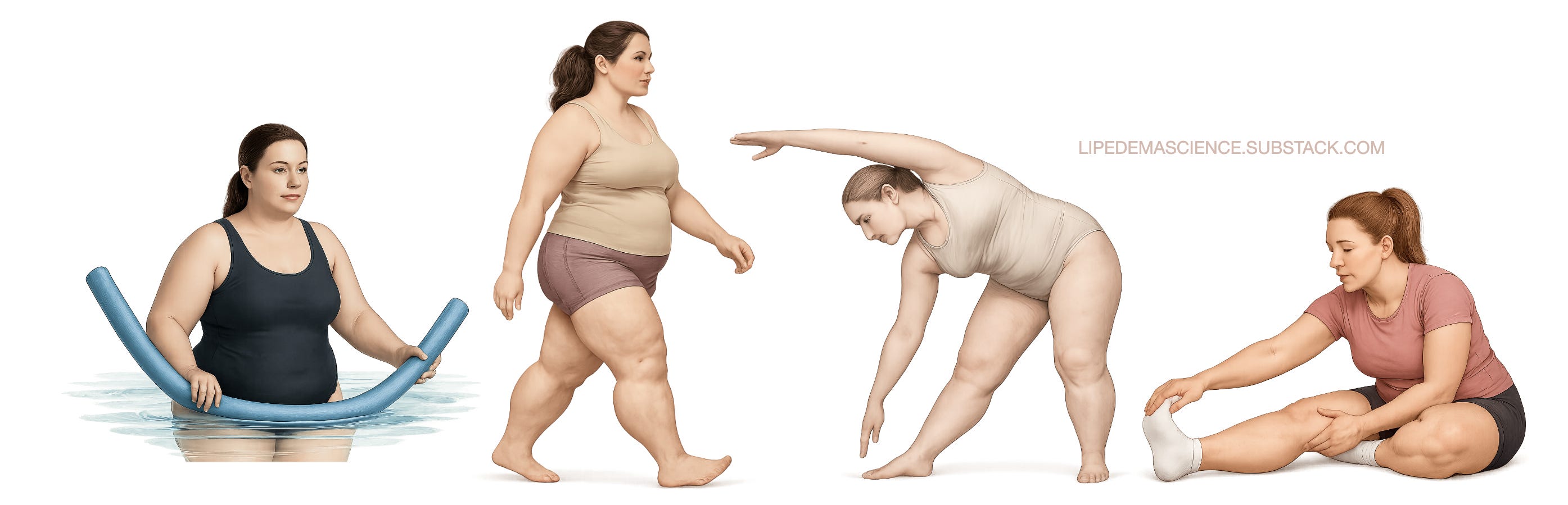
While exercise can be challenging when the body hurts, studies show that gentle, consistent movement plays a key role in lipedema management. Walking, swimming, and low-impact strength training not only improve circulation and mobility but also support mental well-being.
In research comparing women with lipedema and those with lymphedema, both groups had reduced mobility — but women with lipedema often reported longer disease duration and more muscle stiffness. This highlights the importance of early intervention, before pain and immobility become severe.
Measuring the Body’s Capabilities
Scientists have started using physical performance tools to understand lipedema’s impact. The Lower Extremity Functional Scale (LEFS) helps measure how easily someone can perform everyday tasks like standing, climbing stairs, or walking a few blocks.
In several studies, LEFS scores were consistently lower in women with lipedema, even when compared to people with obesity. This means that function and comfort, not body size, tell the real story of the condition.
Researchers are also using new imaging tools — ultrasound, bioimpedance, and MRI — to measure how fat and fluid behave inside the tissue. These tools are helping explain why the legs can feel heavy and stiff even when no swelling is visible.
Pain and Movement: A Two-Way Relationship
One striking finding from multiple studies is how pain and mobility feed into each other. The more pain a woman feels, the less she moves — and the less she moves, the more stiffness and swelling occur. Over time, this can lead to disability, especially in daily activities like work, cleaning, or social life.
A study comparing women with lipedema to those with obesity showed that even with a lower BMI, women with lipedema were more disabled in daily functioning. This shows that it’s not the weight, but the disease itself, that limits the body’s freedom.
What the Research Teaches Us
The science on movement and function in lipedema is clear:
The body is not weak — it is weighed down by inflammation and tissue pain.
Mobility problems stem from biological changes in the fat and lymphatic systems, not lack of effort.
Early, gentle movement can improve strength, circulation, and mood.
Researchers emphasize that even small steps — a short walk, gentle stretching, or water exercise — can help maintain joint movement, muscle tone, and mental resilience. It’s not about pushing harder, but about moving smarter.
Reclaiming the Body Through Motion
Movement with lipedema is an act of self-care, not punishment. The studies show that when women move at their own pace, listen to their body, and receive the right support, both pain and stiffness improve.
Science is now catching up to what many women have discovered on their own: healing begins not in the mirror, but in motion.
Every step — no matter how small — is proof of strength.
The Relationship Between Sleep Quality, Fatigue, and Quality of Life in Women with Lipedema (DOI: 10.1177/15578585251387100)
Mental and physical health burden and quality of life in Czech women with lipedema (DOI: 10.3389/fgwh.2025.1629077)
Assessment Tools to Quantify the Physical Aspects of Lipedema: A Systematic Review (DOI: 10.1089/lrb.2024.0102)
Beyond the physical: The interplay of experienced weight stigma, internalised weight bias and depression in lipoedema (DOI: 10.1111/cob.12727)
Objective Assessment of the Cardiorespiratory Fitness Among Individuals With Lymphedema and Lipedema: A Systematic Review and Meta-Analysis (DOI: 10.1155/ijvm/8627520)
The Comparative Evaluation of Depression, Life Satisfaction, and Quality of Life Between Female Patients with Lipedema and Lymphedema (DOI: 10.1089/lrb.2024.0117)
Health-related quality of life and psychological abnormalities in patients with lipedema compared to healthy and chronically ill populations (DOI: 10.1055/a-2541-7595)
Improvement in Health-Related Quality of Life and Symptoms Following Lipedema Liposuction: A Longitudinal Study (DOI: 10.1097/SAP.0000000000004124)
Depression and appearance-related distress in functioning with lipedema (DOI: 10.1080/13548506.2018.1459750)
Disability and emotional symptoms in women with lipedema: A comparison with overweight/obese women (DOI: 10.17219/acem/181146)
A great read to reinforce JFDI for daily movement. There's definitely more energy and less puff in the day when I do!
dette - Kroppen er ikke svak – den er tynget av betennelse og vevssmerter!! <3
Eg trudde alltid eg var svak og dårlig trent, sjølv kor mykje eg gjorde og alt kroppen gjorde var å straffe meg i dagesvis med invalidiserende smerter!
Heldigvis har forskninga lært både meg og andre at det ikkje er å vere svak! Skulle ønske eg visste på eit tidligare tidspunkt.. :(