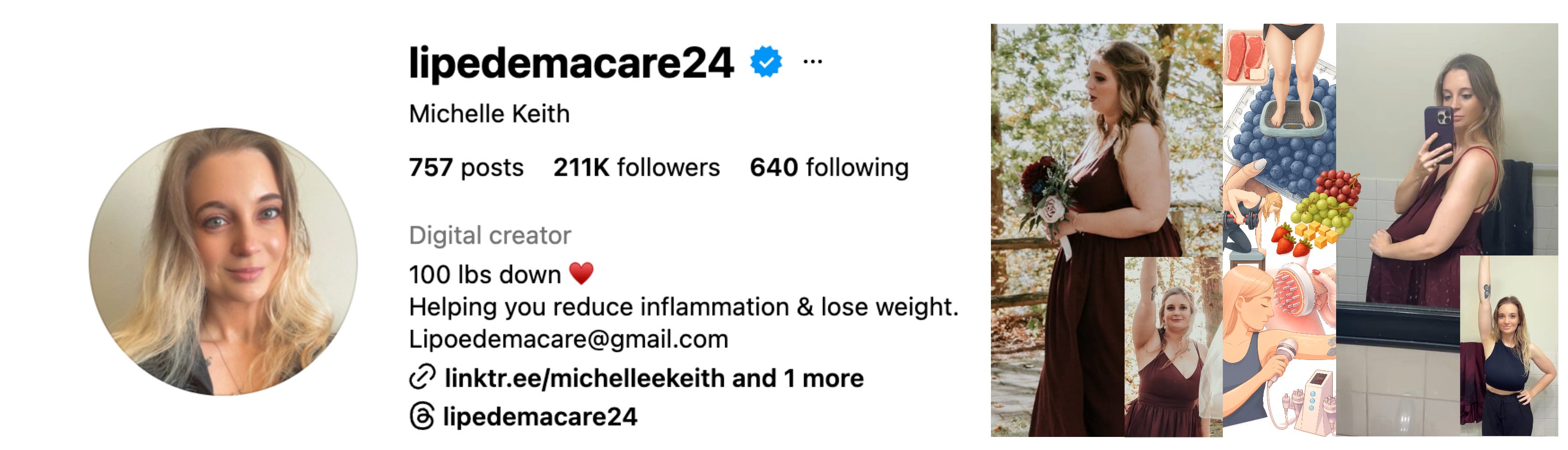
Who Michelle Is Beyond a Diagnosis
Michelle Keith lives in Minnesota, but her story reaches far beyond state lines. Offline, she is a mother, a partner, and a woman who cares deeply about helping other women feel less alone in their bodies. Online, through her platform @lipedemacare24, she has become a powerful voice for lipedema, obesity, trauma, and nervous-system–based healing.
Her life today is built very differently from the one she knew for years. She now lives with more clarity and purpose, openly showing her belly, her nodules, her swelling and her tools for healing. She talks not only about food and movement, but also about the emotional, spiritual and nervous-system layers that many people are afraid to name.
Michelle never imagined she would lead a community. Yet that is exactly what she does every day: guiding women through education, vulnerability and the lessons she has learned while reshaping her own life from the inside out.
When Stress, Pregnancy and Pain Were the First Red Flags
Looking back, Michelle can see that her lipedema story began long before she had a name for it. The earliest signs showed up during the most stressful chapters of her life—times when her nervous system was locked in fight-or-flight.
During these periods, her body felt like it was under attack. Inflammation would spike quickly. Her legs, stomach and arms became heavier, more painful and more swollen than made sense for her eating or movement.
Pregnancy was a turning point. Her body reacted intensely:
noticeable swelling in her legs, stomach and arms
nodules becoming more defined and painful
a deep pressure and heaviness that never fully went away
She kept asking herself why her body was responding so dramatically and why it did not behave like other people’s bodies. Without the concept of lipedema, she explained it away as “normal pregnancy weight,” even though nothing about it felt normal.
In truth, a mix of hormonal shifts, stored trauma and a constantly activated nervous system caused her early lipedema symptoms to explode. But for years she had no language for it—only the persistent feeling that something inside her body was different.
Living in Pain, Self-Blame and Confusion
Before diagnosis, Michelle lived in a constant state of confusion about her own body. Physically, there was daily pain: heavy legs, swelling that did not match her food intake, deep aching nodules that felt like invisible bruises, and waking up tired as if her body had been fighting all night.
Emotionally, the weight was even heavier. She blamed herself for everything. If she struggled to lose weight, she saw it as a character flaw, not a medical condition. She believed she lacked discipline, that she was “failing” where others succeeded.
This self-blame changed how she moved in the world. She avoided social events, withdrew from photos, skipped walks with friends and chose clothes to hide rather than to express herself. She constantly compared herself to people who ate more, moved less and still appeared smaller. The result was isolation and a deep sense of being misunderstood.
Her inner voice was harsh. She pushed herself harder and harder, believing discipline would fix what was actually inflammation and connective tissue disease. Compassion for herself never seemed like an option because she did not yet know she deserved it.
A Facebook Post, a Vascular Specialist and a Name: Lipedema
The word “lipedema” entered Michelle’s life almost by accident. One day, while scrolling on Facebook, she saw an image of a woman with arrows pointing to lipedema in her arms and legs. Fear rose first—but so did recognition.
She began to research and quickly realized how closely her own symptoms matched what she was reading. The difficulty losing weight in certain areas, the pain, the nodules, the swelling—it all started to line up.
In 2023, her aunt connected her with a vascular doctor she had trusted for over a decade. At first glance, the doctor told Michelle that she did not have the “typical” lipedema body and should not worry. But as the examination continued and the doctor felt the grainy, painful texture in Michelle’s arms and thighs, the picture changed. Based on the tissue, symptoms and history, the doctor diagnosed lipedema and prescribed compression.
Michelle did not have to fight for years to be believed, as many women do. Still, she understood that this diagnosis was only the beginning. She has since continued her medical journey and is following up with specialist Dr. Karen Herbst to deepen her understanding and care.
Connecting Lipedema, Dercum’s Disease, Trauma and the Nervous System
For a long time, Michelle saw her symptoms as separate pieces: nodules here, swelling there, sudden flares of pain, random inflammation after stress. Learning about Dercum’s disease and connective tissue disorders changed this perspective.
She began to understand that her symptoms were connected through fascia and the nervous system. Whenever she went into fight-or-flight, her inflammation rose sharply: tissues swelled, nodules became more painful and her body felt like it was on high alert. Even small triggers could set off full-body reactions.
A major turning point came when she learned how trauma can live in the body, especially in the fascia and connective tissue. For someone with lipedema or Dercum’s tendencies, unresolved trauma can shape how the body holds fluid, fat and inflammation.
Once this clicked, her mindset shifted. She stopped seeing her body as a problem to be fixed and began to ask what it had been protecting her from. Her healing approach expanded to include nervous-system regulation, fascia work, histamine reduction and emotional support.
Seeing Old Photos with New Eyes
When Michelle looks at old photos now, she no longer sees failure or “just obesity.” She sees a woman who was profoundly inflamed, exhausted and silently fighting battles that no one around her could see.
What she once labeled as lack of willpower now reads as lymphatic congestion, hormonal shifts, unresolved trauma and nervous-system overload. The expression in her face tells a story of pain and survival, not laziness or lack of discipline.
Those images used to bring shame. Now they bring compassion. They remind her how misunderstood lipedema and connective tissue disorders are, and how far she has come. They also show that healing is never only physical; it is emotional, nervous-system and spiritual work as well.
Five Phases of Transformation: From Survival Mode to Partnership with Her Body
Michelle describes her healing as unfolding in distinct phases, each teaching her something new about her body and nervous system.
Phase 1 – Keto: Survival and Control
In the beginning, keto gave her a sense of control. Cutting carbs reduced some swelling and brought the first visible changes. She learned discipline and structure, but also discovered that extreme restriction was not sustainable and did not address the deeper causes of her inflammation.
Phase 2 – Anti-inflammatory Eating: Understanding the Body
The real shift came when she moved from pure weight loss to calming her body. She focused on reducing histamine triggers, supporting her lymphatic system and opting for whole, anti-inflammatory meals instead of restriction. This phase taught her that her body was not fighting her—it was protecting her. When she cared for her inflammation, her body softened and responded.
Phase 3 – Walking and Water: Regulating the Nervous System
Simple daily habits became powerful medicine. Regular walking helped regulate cortisol and improve lymphatic flow. Drinking enough water reduced fluid retention. Gentle, consistent movement eased her out of fight-or-flight. This phase showed her that healing did not have to be extreme; it had to be consistent.
Phase 4 – GLP-1 Medication: Support, Not a Shortcut
Michelle chose a GLP-1 medication, tirzepatide, after thorough research. She did not see it as a quick fix, but as an additional tool. The most meaningful change was not only in appetite, but in inflammation: calmer swelling, more predictable hunger, better blood sugar stability and a quieter nervous system. It did not “cure” lipedema, but it reduced internal stress enough that her body could continue healing.
Phase 5 – Strength Training: Rebuilding Instead of Shrinking
In this phase, her focus shifted from losing weight to building strength. Strength training helped her remember that she is allowed to take up space, that her body deserves stability and resilience. Muscle, not thinness, became the goal.
Across all five phases, the core lesson stayed the same: healing lipedema is not about shrinking a body—it is about understanding it and creating safety inside it.
Moving from Diet Culture to Nervous-System–Informed Nutrition
Like many women, Michelle spent years in diet culture without realizing it. She restrained herself, starved herself, obsessed over calories and forced her body into patterns that actually worsened her inflammation.
Today, her approach is very different. She eats to calm her body, not to punish it. Anti-inflammatory nutrition, for her, means supporting the lymphatic system, hormones, fascia and nervous system. She pays attention to how food feels in her body instead of how little she can eat.
A typical day of eating is simple and grounded: protein, vegetables, healthy fats, anti-inflammatory spices and low-histamine choices during flares. Instead of chasing “perfect” eating, she listens to hunger, respects days when she needs more food and allows her body to lead without guilt.
In her words, the shift is clear: harmful dieting is driven by fear; her current nutrition is driven by understanding.
The Daily Tools That Keep Her Body Moving
Michelle’s routine is built on tools that are accessible and sustainable.
Walking for 20–30 minutes a day is one of her strongest regulators. It reduces swelling, supports lymphatic flow and calms her nervous system. Dry brushing and lymphatic brushing are simple but impactful practices she uses regularly to reduce pressure in her legs and stomach, soften nodules and prevent tissue from feeling congested.
Strength training a few times a week supports circulation, metabolism and joint stability. Other modalities—like red light therapy, cupping and fascia release—are used as needed, especially during flares or phases of tight, swollen tissue.
The common thread is not perfection; it is consistency and listening to what her body needs.
Nervous-System Regulation as Non-Negotiable
Over time, Michelle has learned that nervous-system regulation is just as important as nutrition and movement. When she is calm, inflammation drops, swelling is lower and nodules feel softer. When she is stressed, symptoms worsen quickly.
Several practices help her stay grounded.
Prayer is her deepest anchor, giving her a sense of safety and support. Gentle movement—walking, stretching, or lifting light weights—brings her out of fight-or-flight. Quality sleep makes a visible difference in her swelling, digestion and reactivity. And journaling helps her release mental pressure that used to fuel flare-ups.
Nervous-system work is no longer optional for her; it is central to how she manages lipedema and connective tissue symptoms.
Identity Shift: From Shame and Survival to Trust and Alignment
Before her healing journey, Michelle’s identity was tightly tied to pain, shame and a sense of never being “enough.” She did not trust her body or herself. She felt she had to work twice as hard to deserve half as much, and she apologized constantly—for her body, her feelings, even her presence.
Today, she describes herself as a completely different woman in many ways. She trusts her body’s signals. She listens instead of fighting. She offers herself compassion where there used to be criticism. She no longer lives to shrink—physically or emotionally. She lives to feel aligned, supported and safe.
This identity shift is not just about size or weight. It is about reclaiming self-worth from under years of trauma, inflammation and misunderstanding.
Going Public: Vulnerability, Community and Responsibility
Posting her first vulnerable photos—showing legs, stomach and nodules—was a terrifying step. For years she had hidden those parts of her body. Sharing them publicly felt like exposing a piece of herself she had spent a lifetime protecting.
But something powerful happened after she pressed “post”. Messages began to pour in from women who recognized themselves in her images and words. “This is my body too.” “I finally feel understood.”
That feedback shifted everything. She realized that her story was no longer just about her—it was a pathway for other women to name their symptoms, feel less alone and seek proper care. Her account became more than a page; it became a platform and a responsibility.
The most rewarding moments for her are the messages from women who say she helped them realize they have lipedema, showed her videos to their doctors or finally stopped feeling “crazy.” For Michelle, these are reminders that social media can be more than noise; it can be a lifeline.
Facing Criticism and Misconceptions
With visibility also comes criticism. Michelle has faced comments about her body, her weight loss, her diagnosis and her use of medication. Some people have questioned whether she “really” has lipedema or criticized her choice to use GLP-1 medication, often without understanding inflammation, history or context.
Early on, these comments hurt. They echoed old wounds of not being believed or being blamed for her condition. Over time, she has learned to see them differently.
Now she recognizes that many negative reactions come from misunderstanding, projection or limited information. She protects her mental health by not internalizing strangers’ opinions and reminding herself that they do not know her pain, her medical history or her healing.
Translating Complex Science into Lived Experience
One reason so many women connect with Michelle’s content is how she communicates. She does not try to sound like a scientist. Instead, she explains things the way she wishes someone had explained them to her when she was desperately searching online for answers.
When she learns something new about lipedema, hormones, fascia or the nervous system, she asks herself how it shows up in her own body and how she would describe it to a friend. She translates medical language into everyday terms like swelling, pressure, nodules, hormone shifts, stress and inflammation spikes.
Her goal is simple: to help women say, “That finally explains my pain.”
Building a Zero-Shame Community
Through her Facebook group, email list and content, Michelle is building a culture around lipedema that is honest, compassionate and free from shame. She knows that many women spent years being dismissed, blamed or ignored, so she wants her spaces to feel like the opposite of that.
Her hope is that women who join her community feel safe, supported and informed. She wants them to find real education, practical tools and other women who truly understand. Perfection is not required; being real is.
At the heart of her work is a simple message: your body is not the enemy. It is asking for the right support.
Her Message to Women Who Are Just Discovering Lipedema
For anyone who has just discovered lipedema and recognizes themselves in Michelle’s old photos, her first message is clear: you are not broken, and this is not your fault.
For the early weeks and months, she suggests keeping things simple and gentle:
start walking a little every day
drink enough water
add gentle lymphatic care
focus on calming inflammation with basic, whole foods
Medically, she encourages women to book an appointment with a provider who understands lipedema, even if the wait is long. That step alone can give direction and validation.
Mentally and emotionally, she invites women to stop blaming themselves. Lipedema is a connective tissue condition, not a lack of willpower. And no one needs to walk this path alone—community and guidance from others who have lived it can ease the burden.
Hopes for Her Own Future and for the Lipedema Community
Looking ahead, Michelle’s personal goals are simple but profound. She wants a calm body, a regulated nervous system and a life where she feels strong, present and connected to her family. She is not chasing perfection; she is chasing peace.
For the global lipedema community, she hopes for recognition, education and compassion. She wants women to be believed when they first describe their symptoms, not after years of struggle. She wants diagnosis and treatment to be accessible, not something each woman has to fight for alone.
Her core message is this: symptoms are real, stories matter and healing is possible even when the journey is messy and non-linear. Lipedema, obesity, trauma and inflammation are parts of a story—but they do not define the whole person.
Three Things We Can Learn from Michelle’s Experience
Your body is not a moral failure.
Michelle’s story shows how easily inflammation, trauma and connective tissue disorders can be misread as laziness or lack of discipline. Her journey reminds us that unexplained pain, swelling and weight changes deserve medical curiosity, not self-blame.Healing is multi-layered and rarely linear.
From keto to anti-inflammatory eating, walking, GLP-1 medication and strength training, her phases of change illustrate that healing lipedema is about calming inflammation and the nervous system, not just losing weight. Progress can be softer nodules, less pain and a calmer body, even when the scale does not move.Vulnerability can change lives—both yours and others’.
By sharing vulnerable photos and honest reflections, Michelle helped thousands of women recognize their own symptoms and seek help. Her experience shows that speaking openly about lipedema, obesity, trauma and medication can turn shame into connection, and confusion into clarity—for herself and for the community watching.