

What if your pain is not about how much fat you have… but about how your tissue has changed?
For years, lipedema pain has been dismissed, misunderstood, or explained away. But new research is starting to show something different. Your pain may not only be real. It may be measurable. And it may be rooted deep inside the structure of your tissue.
Pain is one of the most defining features of lipedema. Not just occasional discomfort, but a persistent, deep, and often unexplained pain that can affect daily life in ways that are difficult to communicate to others. Many women describe the same experience: the body hurts, even when nothing obvious seems wrong on the outside.
A new study published in the International Journal of Obesity in 2026 takes a step closer to understanding this. Instead of focusing on fat alone, the researchers asked a different and more precise question:
What if the pain is connected to how the tissue itself is structured?
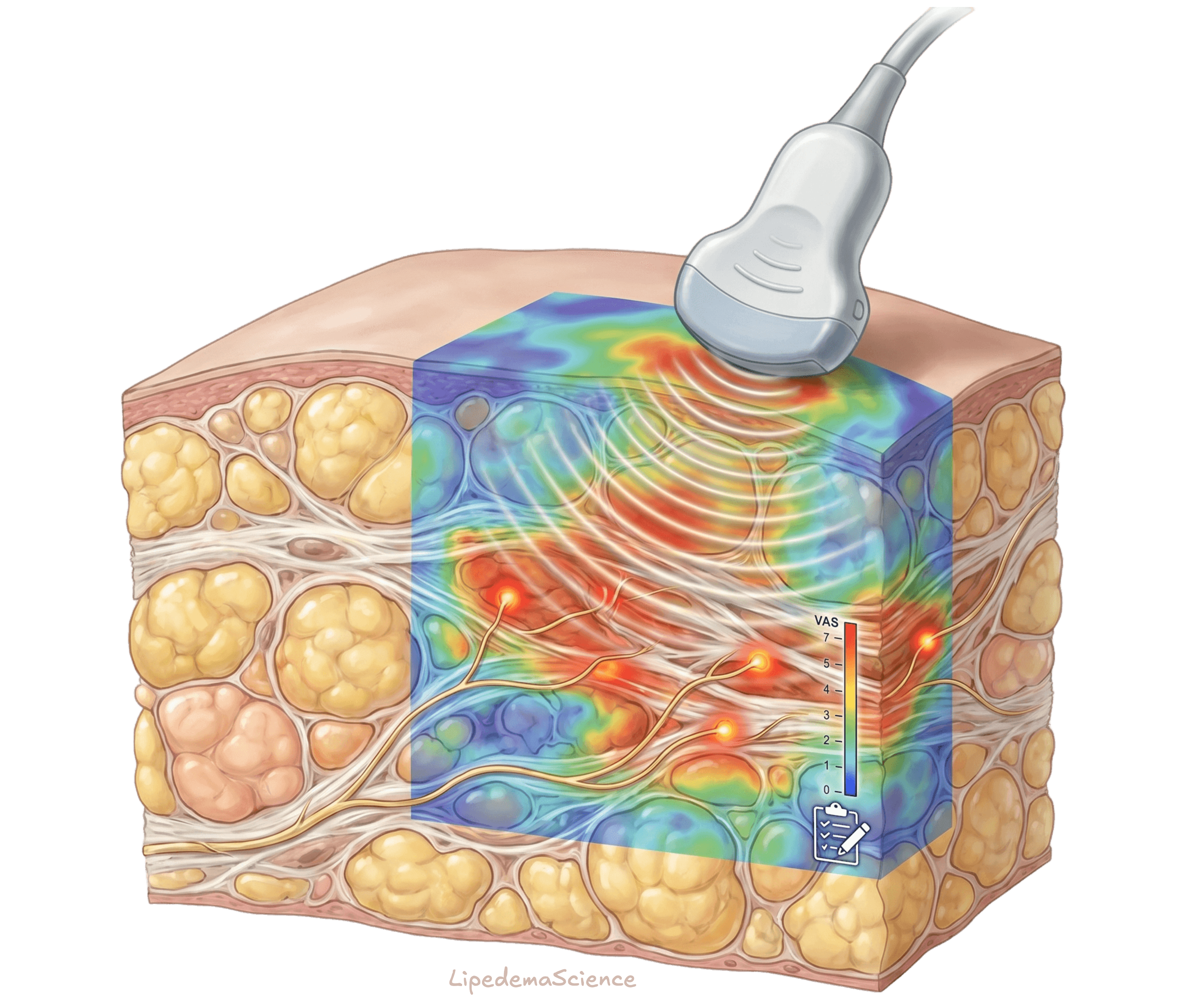
Looking beyond fat
For years, lipedema has often been reduced to a question of fat accumulation. But this study shifts the focus away from “how much” tissue there is, and toward “what kind” of tissue it is.
The researchers used a technique called shear-wave elastography, a specialized form of ultrasound that measures how stiff or elastic tissue is. This matters because stiffness can reflect underlying changes such as fibrosis, where the tissue becomes more rigid due to structural remodeling.
At the same time, they measured pain in two ways. One scale captured overall pain intensity, while another specifically assessed nerve-related, or neuropathic, pain. This distinction is important, because many women with lipedema describe pain that feels sharp, burning, or unusually sensitive—features often linked to nerve involvement.
A measurable link between tissue and pain
The findings are not dramatic at first glance, but they are meaningful.
The researchers found that increased tissue stiffness in the thighs was associated with higher levels of pain. This applied both to general pain and to neuropathic pain. The relationship was moderate, not strong, but consistent enough to suggest that something real is happening at the tissue level.
Equally important is what they did not find. Tissue stiffness was not linked to fat measurements, body mass index, or age in the same way. In other words, more fat did not necessarily mean more stiffness, and more stiffness—not more fat—was what related to pain.
This challenges a deeply rooted assumption. Pain in lipedema is often dismissed as a consequence of weight or pressure from fat tissue. This study suggests a different explanation:
It may not be the amount of tissue that matters most, but the condition of that tissue.
A quick note before you continue
Hey there! You are reading LipedemaScience, founded by Carina W — a nutritionist (BSc), food scientist (MSc), and diagnosed with lipedema since 2012.
She brings a background in cell studies, inflammation, peptides, and DNA from laboratory research, combined with lived experience. Her goal is to use this unique combination to make lipedema science more understandable, relevant, and accessible.
By supporting her work as a member, you are helping make more research on lipedema available for everyone — including yourself.
Why the thighs
One of the more specific findings in the study is that the relationship between stiffness and pain was most clearly seen in the thighs.
For many women, this will feel familiar. The thighs are often one of the most affected and most painful areas in lipedema. They can feel dense, tender, and resistant in a way that is difficult to describe but very easy to recognize.
This study does not explain why the thighs are particularly affected, but it reinforces the idea that different areas of the body may behave differently at a tissue level.
What is happening inside the tissue
Although this study does not directly examine microscopic changes, its findings align with a growing body of research on lipedema biology.
Several mechanisms are increasingly being discussed:
The development of fibrosis, where connective tissue becomes thicker and less flexible
Changes in the extracellular matrix, which alters how cells are supported and interact
Disruptions in microcirculation, affecting oxygen and nutrient flow
Irritation or compression of small nerve fibers within the tissue
Low-grade inflammation that can amplify pain signaling
When tissue becomes stiffer, it does not simply feel different. It may also behave differently. Nerves embedded in that tissue may become more sensitive, more easily triggered, or less able to regulate pain signals effectively.
This could help explain why lipedema pain is often described as disproportionate, unpredictable, or resistant to typical approaches.
A small study with meaningful implications
It is important to be precise about what this study represents.
The study included 35 participants and was observational, meaning it captures a snapshot in time rather than cause and effect. The correlations found were moderate, not strong, and limited primarily to the thigh region.
This means the study does not provide definitive answers. It does not prove that stiffness causes pain, nor does it offer immediate solutions for treatment. What it does offer is something else, and something valuable. It provides measurable evidence that pain in lipedema is linked to physical properties of the tissue itself.
A shift in how we understand lipedema
Taken together with other recent studies, a more complex picture of lipedema is beginning to emerge.
Lipedema is not simply a condition of fat accumulation. It appears to involve a combination of changes in fat cells, connective tissue, blood vessels, immune signaling, and nerve function.
This study adds an important piece to that puzzle by connecting tissue stiffness and pain. It suggests that the experience many women describe—of painful, dense, resistant tissue—is not just subjective. It may reflect underlying structural changes that can now be measured.
What this means for you
For women living with lipedema, the significance of this kind of research goes beyond statistics and correlations. It speaks to recognition. It supports the idea that the pain is not imagined, not exaggerated, and not simply a result of body weight. It is connected to real, physical changes in the body.
At the same time, it highlights how much we still have to learn. The tools to measure these changes are improving, but they are not yet widely used in clinical practice. Larger studies are needed. Better models are needed. And more attention must be given to how these findings can translate into meaningful care.
Moving forward
This study does not change everything, but it moves the field in a direction that feels more aligned with lived experience.
It shifts the conversation from surface to structure, from quantity to quality, from assumption to measurement..
And perhaps most importantly, it brings us one step closer to understanding why lipedema hurts the way it does.

If this gave you a new way of understanding your body, you are not alone. The more we connect lived experience with research, the closer we get to real answers.
Take a moment to reflect on what resonated with you, and share this with someone who needs to hear that lipedema pain is real and deserves to be taken seriously.
If you want more science explained in a way that actually makes sense for your life, you are always welcome to follow along.
Before you move on, take a moment to explore some of my other articles on lipedema. I cover a wide range of topics—from biology and hormones to pain, treatment, and lived experience—always grounded in research and explained in a way that makes sense.
If you find value in this work, your support truly makes a difference. By becoming a member of my Substack, you help make lipedema knowledge more accessible, more nuanced, and more rooted in science.


Assessment of the elasticity of lipedematous tissue and the examination of the relationship between pain and fibrosis in lipedema (DOI: 10.1038/s41366-026-02049-8)
where would you suggest liposuction? I train, eat and everything and when you see me you would say that I never went to gym, because of my swollen, painful legs.
I tough I was crazy, doctors saying im imagine things, that tests are perfect and that I will die healthy🥺
Mine smerter er heilt klart mest utprega ved bruk og ved berøring. Voldsome smerter ved normal berøring. Ekstremt tunge bein og armer, og veldig sure når eg bruker dei, ikkje plass til oksygen til musklene. Dette kom seg med ein gang eg opererte beina. Håper på å operere armer også!