

When you live with lipedema, a paper about physical therapy immediately feels relevant. Many of us use compression, movement, manual lymphatic drainage or pneumatic compression in real life. These treatments require time, money and energy. Some are uncomfortable. Some depend on regular clinic visits. We therefore need more than a list of therapies that might help. We need to know what has actually been tested, what outcomes improved, and how confident we can be that the treatment caused the improvement.
I am a food scientist, nutritionist, and former laboratory researcher who also lives with lipedema. LipedemaScience brings these parts of my life together.
A new integrative review from a Brazilian physiotherapy group tries to bring this literature together. Published in Jornal Vascular Brasileiro in July 2026, it asks which physiotherapy strategies have been described for assessing and treating lipedema.
The review is helpful, but not quite in the way its evidence labels suggest.
Three key takeaways
Intermittent pneumatic compression has the strongest direct treatment evidence in this review. It is still a small evidence base, but it includes randomized and controlled studies in women with lipedema.
Compression and exercise remain reasonable parts of symptom management, but much of their support comes from small studies, indirect physiology and expert consensus. That is not the same as strong proof that they alter the disease itself or prevent progression.
Use this review as a map to the primary studies, not as the final authority on them. Its evidence grading is inconsistent, some numbers contradict each other, and one treatment section makes a favorable lipedema recommendation without including any lipedema data.
That does not make the paper useless. It means we must use it for the job it can actually do.
What the review says
Modena, Baiocchi and Guirro searched five databases between March and August 2025. They identified 745 records and included 28 studies. Instead of organizing the results around outcomes such as pain, function or quality of life, they organized them by assessment method and treatment modality.
The assessment section reads almost like a clinical primer. It covers medical history, including the timing of symptoms around hormonal changes, and physical examination findings commonly associated with lipedema. These include symmetrical disproportion, pain or tenderness, easy bruising, sparing of the feet and usually negative Godet and Stemmer signs. It also presents the familiar three-stage skin classification and Schingale’s five anatomical types.
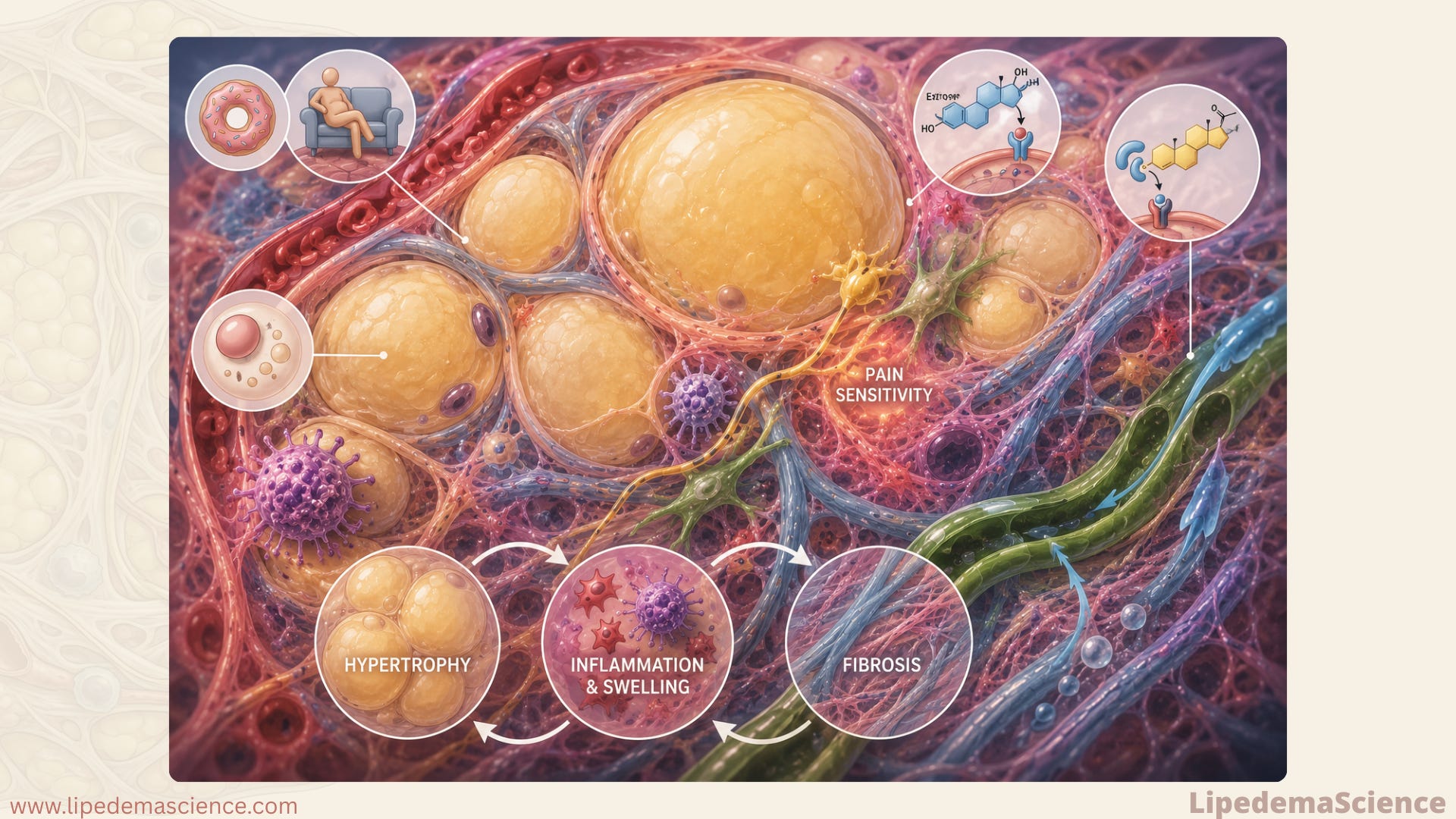
The authors list several ways clinicians and researchers can follow symptoms and tissue changes over time: circumference and volume measurements, visual analogue scales for pain, the QuASiL symptom questionnaire, WOMAC, SF-36, bioimpedance, standardized photographs and soft-tissue ultrasound. They also discuss differential diagnosis against lymphedema, obesity, chronic venous insufficiency, lipohypertrophy and edema caused by systemic disease.
This is one of the paper’s more useful sections. It gathers many of the tools used in lipedema practice and research into one place. Still, a checklist is not a validated diagnostic standard. Negative Godet and Stemmer signs can support the clinical picture, but they do not diagnose lipedema on their own or cleanly exclude every overlapping condition.
The treatment section covers eight broad approaches:
complete decongestive therapy, or CDT
compression
exercise and musculoskeletal physiotherapy
manual treatments, including subcutaneous adipose tissue therapy
extracorporeal shock wave therapy
photobiomodulation
intermittent pneumatic compression
mechanical vibrotherapy
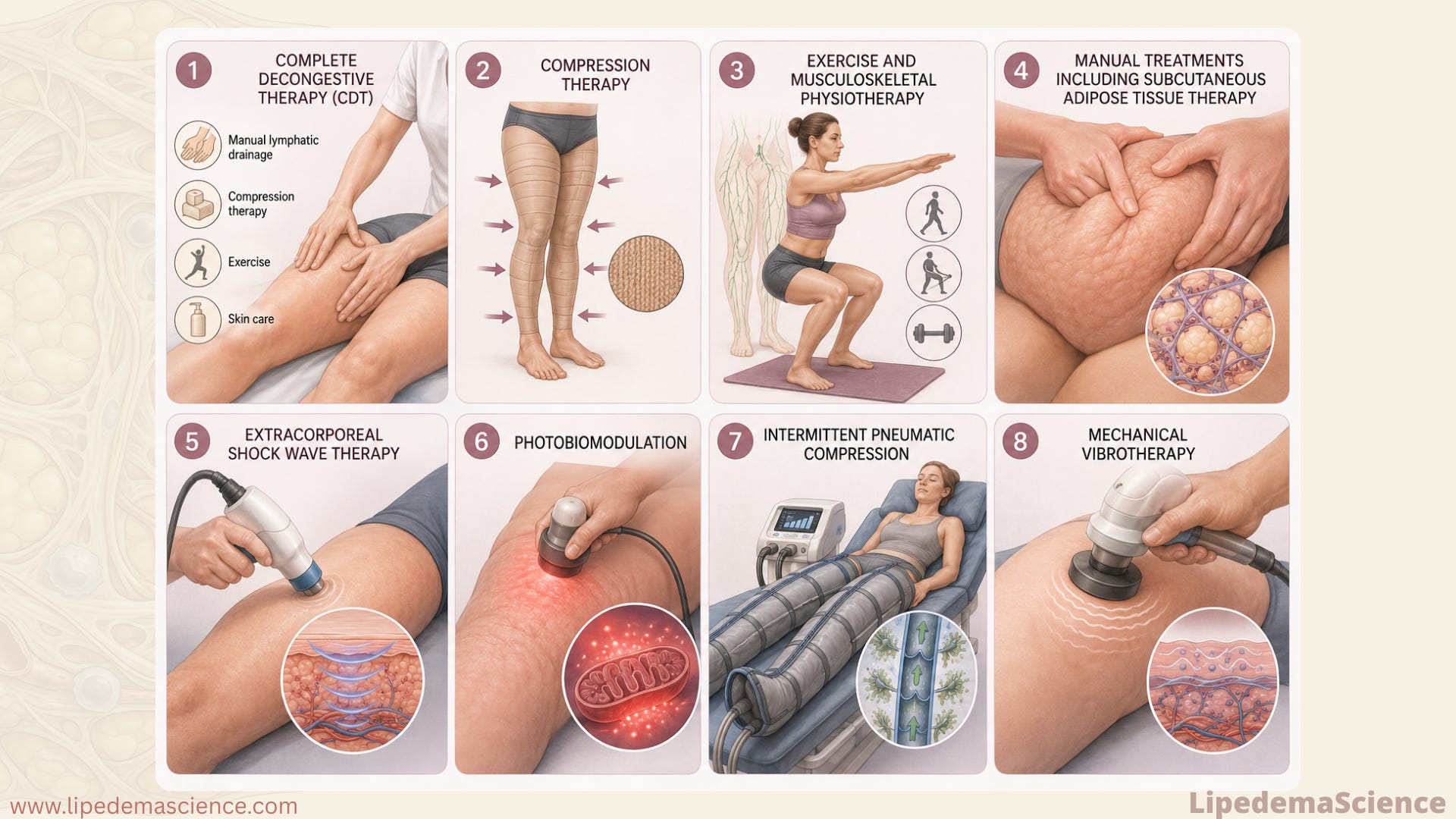
The review’s general message is that conservative physiotherapy may reduce pain, improve mobility, help manage fluid-related symptoms and support quality of life. It also acknowledges that the literature is limited and that more robust trials are needed.
At that level, the conclusion is fair. The problems begin when the paper tries to tell us how strong the evidence is.
My background combines human nutrition, food science, and laboratory research. My perspective also comes from living with lipedema myself.
An evidence level is not the same as trustworthy evidence
The authors use a hierarchy that classifies studies mainly according to design. In their own description, Level 1 is a meta-analysis of randomized controlled trials, while Level 2 is an individual randomized controlled trial.
Yet the paper labels both a single vibrotherapy trial and a single intermittent pneumatic compression trial as Level 1. The Brazilian QuASiL validation study is listed as Level 4 in the evidence table, then described as having Level 1 to 2 support in the text.
These are not merely cosmetic errors. Readers may see “Level 1” and reasonably assume that the intervention is supported by the highest-quality evidence. In this paper, the label may tell us little more than that a study was randomized, and sometimes the label does not even follow the paper’s own definition.
Study design is only the beginning of quality assessment. A randomized trial can still be weakened by poor allocation methods, lack of blinding, attrition, selective reporting, very small groups or inappropriate outcome measures. The review does not formally assess these risks for the included studies. It has no registered protocol, no risk-of-bias tool and no formal appraisal of certainty across outcomes. It reports that two reviewers assessed studies independently, which is a strength, but it does not show an agreement statistic.
This matters because an unblinded trial of thirty participants with subjective outcomes should not be interpreted as if randomization alone settles the question.


There are also basic inconsistencies. The flow diagram reports that 217 records remained after duplicate removal and that 155 were excluded during screening. That should leave 62 records, yet only 44 full texts were assessed. Eighteen records disappear without explanation. The table and discussion give different sample sizes for the Szolnoky intermittent pneumatic compression study and the Ibarra manual therapy pilot. The paper describes three stages, then recommends compression for “stage 4,” even though lipo-lymphedema is not consistently defined as a fourth stage in the classification it has just presented.
Individually, these errors might be minor. Together, they mean that numbers and evidence labels should be checked against the original papers before being repeated.
When plausibility is promoted into evidence
The photobiomodulation section shows the deeper reasoning problem.
The review cites four studies and grades the evidence as Level 1 to 2. But none of the studies was conducted in people with lipedema. They concern breast cancer-related lymphedema. Evidence can be methodologically strong within one population and still be indirect for another condition. Lymphedema and lipedema can overlap, and lymphatic dysfunction may be relevant in some people with lipedema, but the two diagnoses are not interchangeable.
Two of the cited reviews also reported non-significant effects on volume-related outcomes. Even so, the section ends by calling photobiomodulation a “consistent, safe, and potentially valuable” approach for lipedema.
That conclusion moves too quickly. A plausible mechanism can justify a lipedema trial. It cannot replace one.
I want you to think critically. Learn new things, ask questions, and stay curious. Our understanding of lipedema is still far from complete, but the research is growing. At LipedemaScience, we want to follow that journey as it unfolds.
The same problem appears in softer forms elsewhere. A systematic review does not automatically provide strong evidence simply because it is a review. If its ten included studies are small pilots and quasi-experimental studies, the review inherits those weaknesses. Weak evidence does not become strong when it is wrapped in a higher-ranking study design.
Co-interventions make interpretation even harder. One shock wave study treated fifteen women with shock wave therapy, kinesio taping, compression and intradermal injections of Lymdiaral, described in the paper as a homeopathic preparation. There was no control group. If pain, circumference and tissue measures improve after four treatments are given together, we cannot identify which component caused the change. The review nevertheless presents the findings within its evidence for shock wave therapy without meaningfully confronting this problem.


There is also a recurring issue with what researchers choose to measure. Several interventions reduced limb volume or circumference over a period ranging from days to weeks. In lymphedema, fluid volume is a central outcome because accumulated fluid is part of the disease. In lipedema, the affected tissue is adipose tissue, even when fluid, microvascular changes and secondary lymphatic dysfunction also contribute to symptoms.
A 5.6 percent reduction in limb volume after five days is therefore much more likely to reflect fluid movement than loss of lipedema fat. That may still be valuable if a person feels less heavy or has less pain. But the biological meaning is different, and the review does not ask whether short-term volume change predicts better function, fewer symptoms or slower progression years later.
The follow-up periods are generally short in a lifelong condition. No synthesis of durability, harms, costs or access is provided. Adherence is mentioned, especially the discomfort, fit problems and difficulty putting on compression garments, but it is not allowed to influence how strongly compression is recommended. A treatment that works only when used, but is too painful or impractical to use consistently, has a real-world limitation that belongs in the evidence assessment.
What the individual treatment sections can really tell us
Complete decongestive therapy and compression are widely recommended, but much of that recommendation comes from clinical experience and consensus rather than large, high-quality lipedema trials. The randomized CDT study cited in the review included 33 women divided across three groups, leaving roughly eleven participants per arm. That can generate an important signal, but it cannot settle which component works best, for whom, or for how long.
The review also cites a five-person pilot using sodium MRI as evidence that multimodal physiotherapy reduced tissue inflammation. This deserves more caution. Tissue sodium is an interesting imaging signal, but a change in sodium after a combined program of CDT, exercise, compression and education does not directly demonstrate that inflammation was reduced. It certainly does not tell us which part of the program produced the change.
LipedemaScience is not about pretending that we already have all the answers. It is about examining what we know, questioning what we think we know, and staying open to what new research may reveal. Knowledge about lipedema is still developing, and I want us to follow that development with curiosity, honesty, and critical thinking.
Exercise is supported by modest lipedema-specific research, together with strong general knowledge about muscle strength, mobility, cardiovascular health and the muscle pump. It is reasonable to include movement in long-term care, especially when adapted to pain, joint stability and current capacity. The safest conclusion is that exercise can support function and general health and may improve symptoms. Claims that it prevents lipedema progression or meaningfully changes the diseased adipose tissue require stronger evidence.
Manual therapy may help some people with pain, tissue mobility or the feeling of tightness. But the SAT therapy evidence presented here comes mainly from two uncontrolled pilots with seven participants each. These studies are useful for generating hypotheses, not confirming effectiveness.
Shock wave therapy and vibrotherapy remain preliminary. The vibrotherapy section rests on one trial of thirty women, while the shock wave studies are small and complicated by combined treatments. Photobiomodulation has no direct lipedema evidence in this review and should not be presented as an established treatment for the condition.
Intermittent pneumatic compression is the modality that survives the review most clearly. It has several small studies pointing in the same direction, including a randomized study of 46 women with stage 2 lipedema. Participants using an advanced pneumatic compression device at home for thirty days were compared with a group continuing compression garments alone. The study reported improvements in several fluid, ultrasound and patient-reported measures.
Even here, caution is needed. The paper highlights a statistically significant reduction in the left leg volume. In a bilateral condition, a significant result on only one side raises questions about multiple testing, variability and why the other leg did not show the same result. The trial was also short. Still, among the interventions assembled by this review, intermittent pneumatic compression has the clearest direct trial support.
What this review leaves unresolved
The review gives no effect sizes or confidence intervals, does not pool comparable outcomes and does not systematically examine adverse events. Without effect sizes, it is difficult to know whether a statistically significant change was large enough to matter in daily life. Without confidence intervals, we cannot see how uncertain the estimate is.
The prevalence section is another warning sign. It gives a prevalence range of 0.06 to 11 percent, then mentions an estimate of 39 percent in Germany without explaining why it lies far outside that range. It also places an estimate of 8.8 million Brazilian women with symptoms suggestive of lipedema close to statements about diagnosed disease. Screening estimates and clinical diagnoses are not the same.
The paper notes that lipedema has no accepted biomarker or universal diagnostic standard. That should make us more cautious about prevalence estimates, not less. When estimates span several orders of magnitude, part of what we are seeing is likely variation in definitions, sampling and ascertainment.
The paper also states that a positive family history in up to 60 percent of cases supports autosomal dominant inheritance. Familial clustering can support a genetic contribution, but it does not by itself establish a specific inheritance pattern. Shared environments, referral patterns and the way family history is collected also matter.
I am a food scientist and nutritionist with a background in laboratory research, and I have lived with lipedema since long before I knew its name.
Finally, the same researchers recur across consensus documents and primary studies in this small field. Herbst is an author on the US consensus guideline, a SAT therapy pilot and the pneumatic compression trial included in the review. This is not evidence of misconduct. It is what a young and relatively small research field often looks like. But it means that guidelines and studies should not always be counted as independent layers of confirmation when they partly arise from the same research network.
How I would use this paper
I would keep it. The table is a useful index of conservative treatment studies, and the assessment section can help clinicians and readers see which symptoms, differential diagnoses and measurement tools are commonly discussed. If I wanted to learn more about compression, SAT therapy, shock wave therapy or intermittent pneumatic compression, this review would help me find the relevant primary papers.
I would not use it as proof that every listed treatment works. I would not quote its evidence levels without checking how they were assigned. I would not cite it for prevalence or for the effectiveness of photobiomodulation in lipedema. And I would verify every sample size and numerical result against the original study before publishing it.
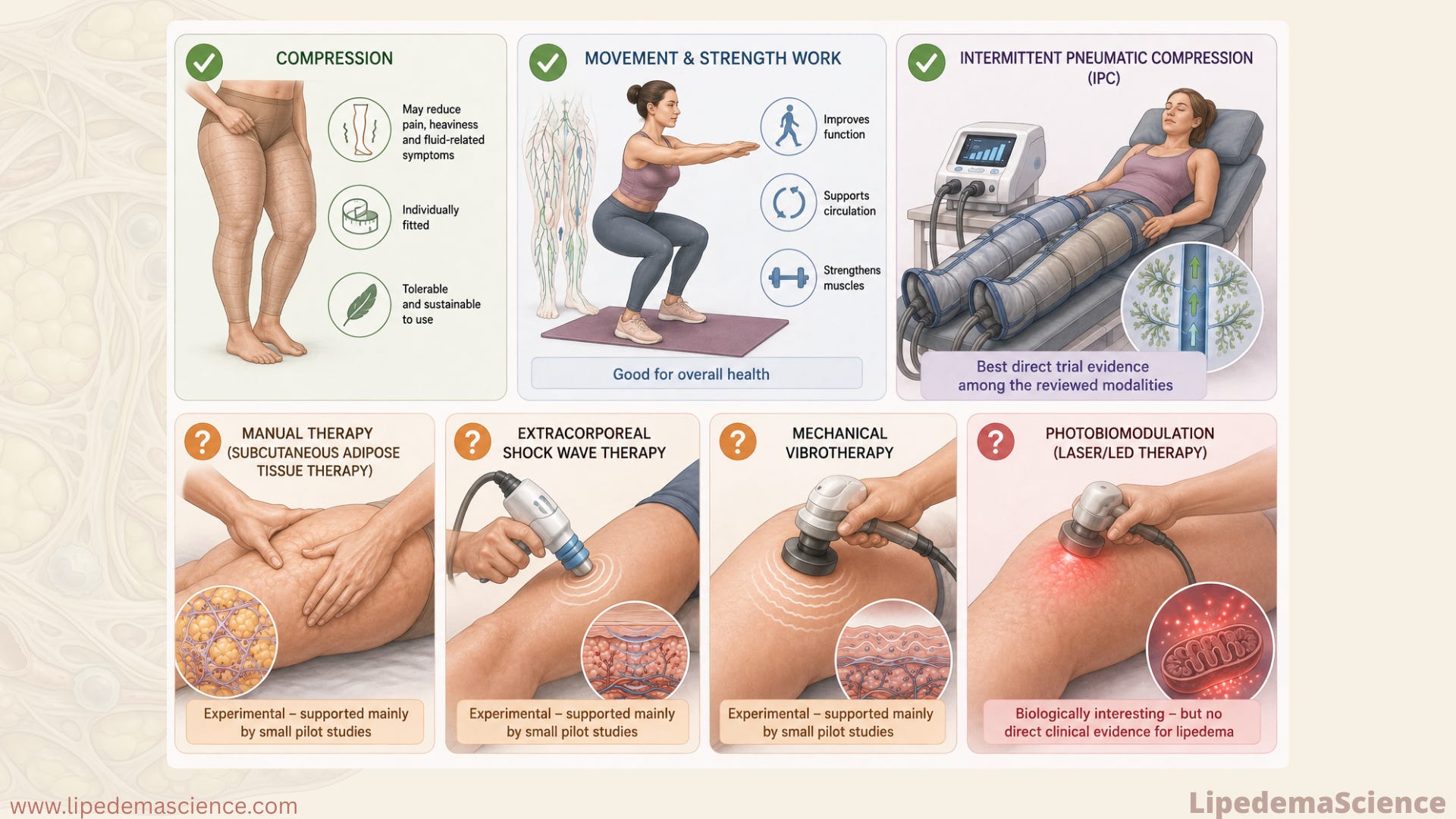
For someone living with lipedema, the practical message is narrower than the review’s treatment list:
Compression may help pain, heaviness and fluid-related symptoms, but it should be individually fitted and tolerable enough to use.
Movement and strength work are sensible for function, circulation and general health, even though lipedema-specific trials remain limited.
Intermittent pneumatic compression currently has the best direct trial evidence among the modalities reviewed and may be a useful addition for some people.
Manual therapy, shock wave therapy and vibrotherapy remain experimental or supported mainly by small pilots.
Photobiomodulation is biologically interesting, but this review does not provide direct clinical evidence that it works for lipedema.
Most importantly, symptom relief is not the same as removing lipedema tissue, and a short-term change in circumference is not proof that a treatment changes long-term disease progression. Those distinctions matter when people are deciding where to spend their money, effort and hope.
My verdict is simple: this is a useful inventory and a weak evidence synthesis. It tells us where the studies are. It is less reliable when it tells us how much confidence to place in them.
Use it as a bibliography, then read the primary research.
This article discusses research and is not individual medical advice. Treatment decisions should be adapted to symptoms, health status, contraindications and personal tolerance together with qualified healthcare professionals.
The role of physical therapy in the treatment of lipedema: an integrative review of therapeutic strategies and the current clinical landscape (DOI: 10.1590/1677-5449.202501962)