

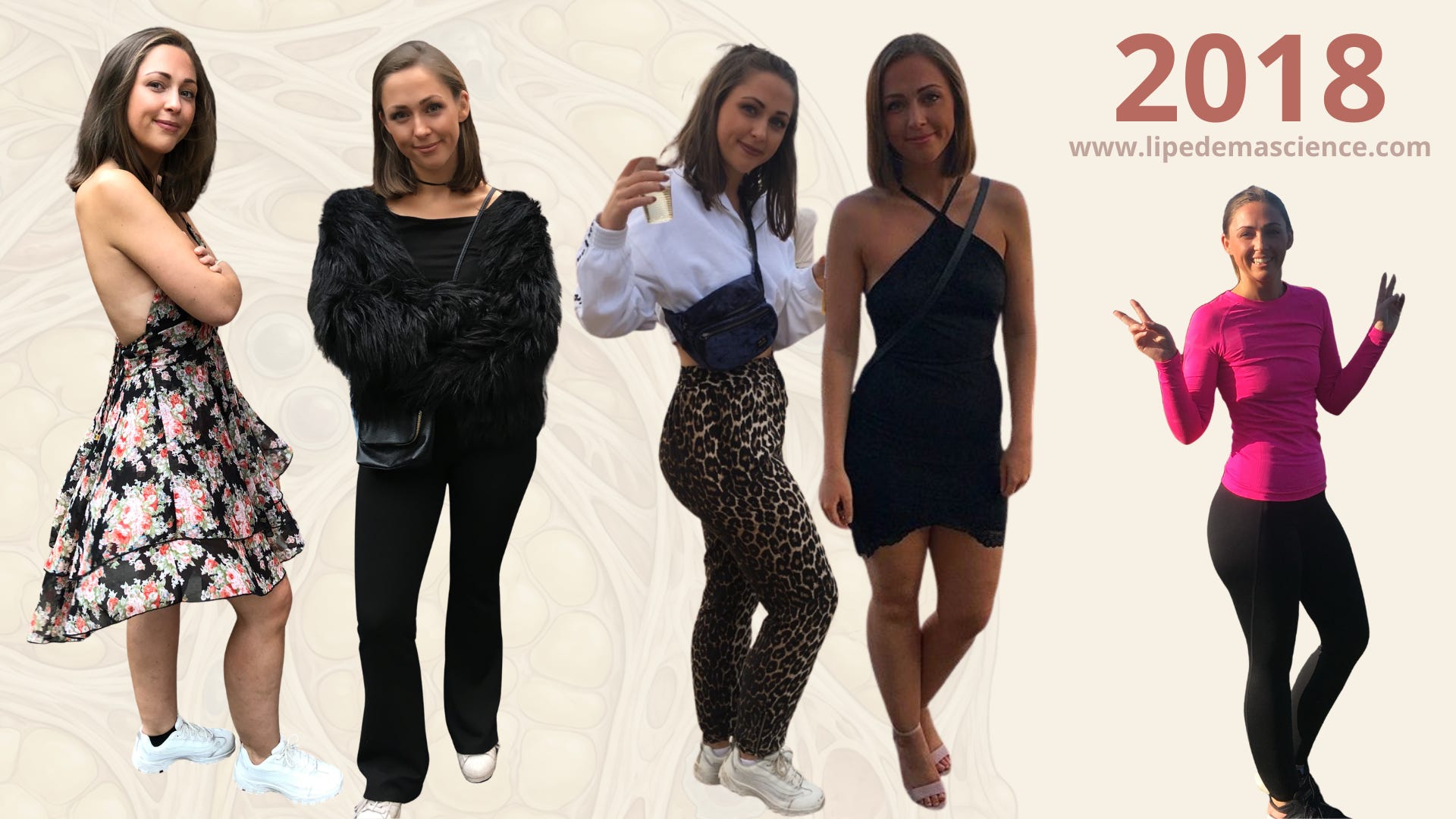
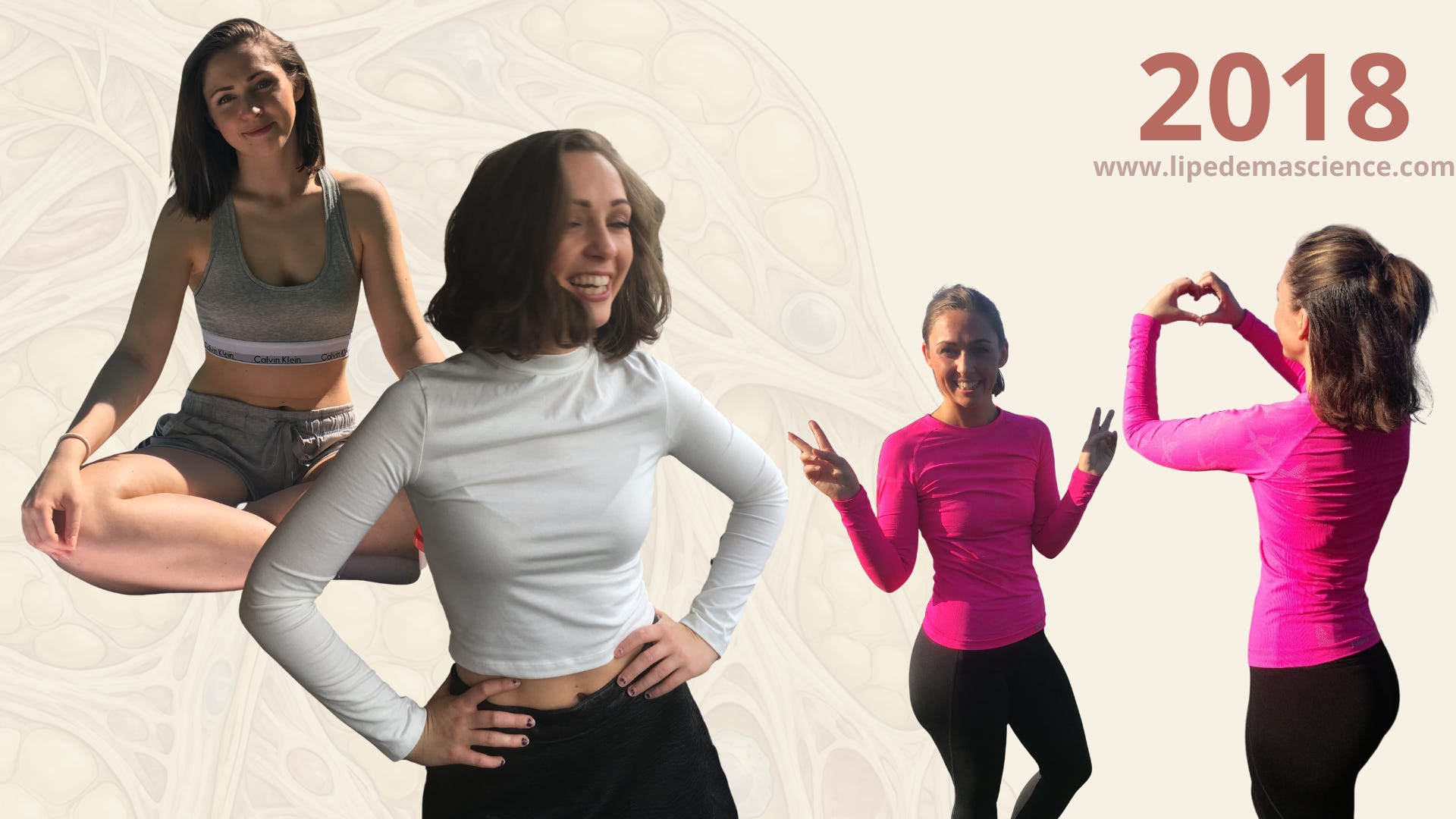
Eight years ago, in 2018, I had one of the worst lipedema years of my life.
By then, I already knew that I had lipedema. I had been diagnosed in 2012, after years of confusing symptoms that did not fit the body I was living in. My symptoms had started much earlier, around the age of fifteen, when my body changed dramatically after I started hormonal birth control. Within two months, the change was visible. Something had shifted in my lower body, and none of it made sense to me at the time.
In 2011 and 2012, I was often at my general practitioner’s office because of unexplained pain in my fat tissue. It was not normal soreness. It was not muscle pain. It felt deeper than that, almost like toothache inside the fat itself. Later, that pain finally got a name: lipedema.
But this story is not about 2012. It is about 2018.
That year, my body was living in constant stress. I had just moved from Oslo to Ås to study food science. I had finished my bachelor’s degree in human nutrition, and I wanted to continue into a master’s degree in food science. Five of us from human nutrition started together. On paper, the transition might sound natural because both fields involve food, but in reality, human nutrition and food science are very different disciplines. Nutrition is about the human body. Food science is chemistry, microbiology, processing, technology, quality systems, and the material behavior of food itself.
We were not simply accepted straight into the master’s programme. We had to prove that we could qualify. That meant taking an entire year filled with some of the most demanding subjects from the food science bachelor’s degree, and performing well enough to show that we belonged there. It was exciting, but it was also intense. I was ambitious, under pressure, and trying to rebuild myself academically in a new environment.
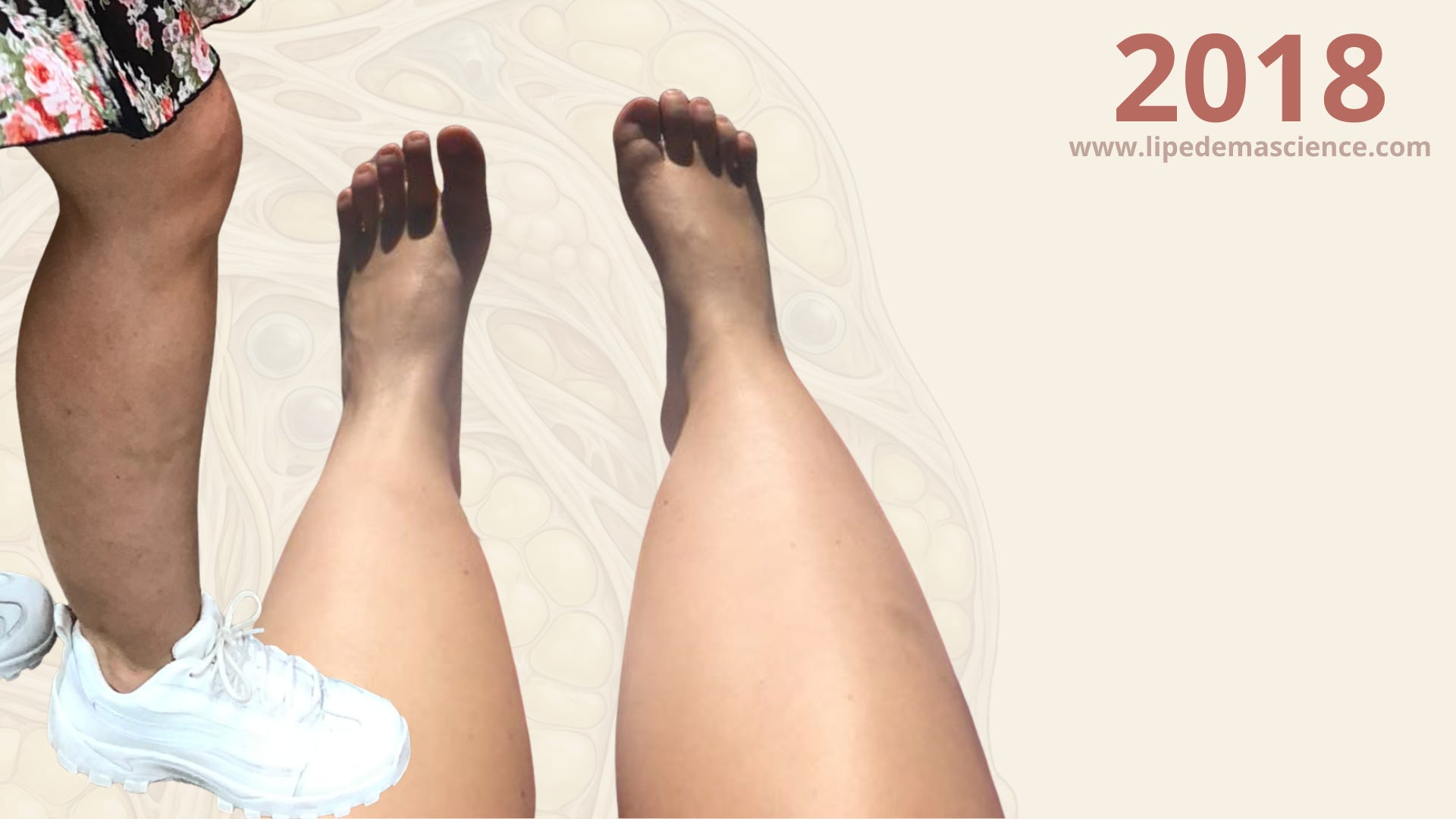
My lipedema body reacted. And I mean really, really badly. My calves did not just feel swollen. They felt balloon-level swollen, as if they could have lifted me straight to the moon.
I have always had several different lipedema symptoms. I have had the deep, toothache-like pain in the fat tissue, symmetrically on both sides. I have had swelling, always a little worse on my right side. I have had fibrotic nodules, the small hard fat lumps that make the tissue feel structurally different from normal fat. But in 2018, the swelling became something else. It felt as if my calves were turning into two balloons.
When I look back at photos from that year, I still feel shocked by them. My BMI was still low to normal. From a healthy physiological perspective, there was no obvious reason why my lower legs should look and feel like that. I was not living in a body that could be explained by the usual “eat less and move more” story. My upper body did not match my lower body. My feet did not swell in the same way. The swelling stopped around the ankles in that characteristic lipedema pattern, as if the disease had drawn its own anatomical border.
That is one of the reasons BMI is such a poor language for lipedema. BMI says something about total body mass relative to height. It says nothing about regional disease in the subcutaneous fat. A person can have a normal BMI and still have pathological tissue expansion, fibrosis, pain, fluid dysregulation, and vascular changes in the legs. Lipedema is not simply “more fat.” It is a different kind of fat tissue behaving differently in specific areas of the body.
In 2018, my legs often felt as if they were under pressure from the inside. The pain was not only aching. It was tight, heavy, and urgent. It felt like there was no room left for the swelling. I remember the sensation very clearly: as if the skin and tissue could not stretch any further, as if the legs were about to burst.
This type of pain is different from the toothache-like pain I had known for years. The toothache pain feels like it comes from inside the fat itself, deep and gnawing. The swelling pain feels more mechanical. It feels like too much volume inside tissue that cannot expand freely.
I did not have the vocabulary for this distinction back then, but I do now. Lipedema pain is not one single sensation. For me, there have been at least two patterns. One is the deep, internal, almost hormonal-feeling ache inside the fat tissue. The other is the bursting pressure pain that seems to arrive when fluid, inflammation, heat, stress, or stillness pushes the tissue past its limit.
What exactly happens inside lipedema tissue during these episodes is still not fully understood. That uncertainty matters. I do not want to pretend that science has answered everything. It has not. But research does point toward several mechanisms that make sense of what many of us experience.
Lipedema tissue is often described as hypertrophic, fibrotic, inflamed, and structurally altered. The fat cells may be enlarged. The extracellular matrix, the structural environment around the cells, can become stiffer and more fibrotic. There may be immune cell involvement, microvascular dysfunction, and changes in how fluid moves through the tissue. This is not just passive storage. It is active, biologically disturbed tissue.
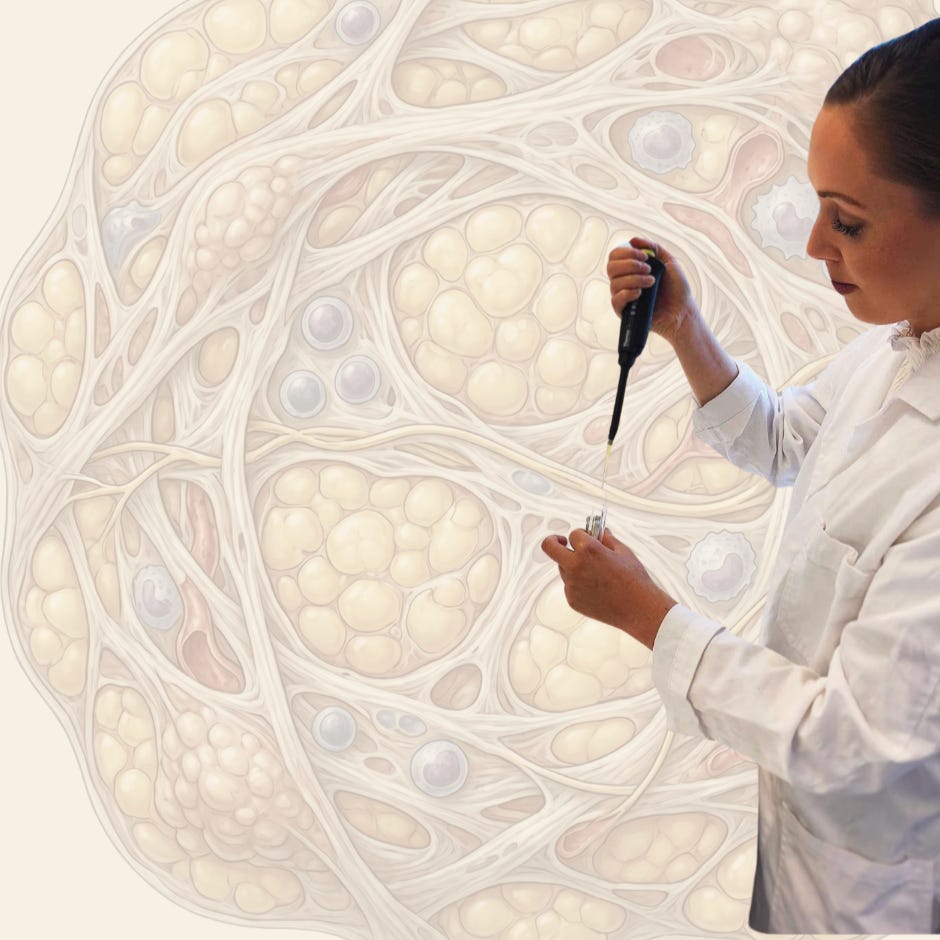
LipedemaScience is not only my learning journey. It is becoming a community of people who want to understand this disease more deeply, together.
When small blood vessels become fragile or more permeable, fluid can leak more easily into the space between cells. The lymphatic system then has to clear that extra fluid. Even if the main lymphatic vessels are not completely damaged, the system can still become relatively overloaded if the tissue produces more fluid burden than it can drain efficiently. Add fibrosis to that picture, and the tissue becomes less compliant. It cannot simply stretch and adapt. Pressure builds.
That is what I imagine when I think back to my 2018 legs. I imagine a tissue environment where fluid handling, vascular fragility, connective tissue stiffness, inflammation, and stress physiology were all interacting. Not in a simple line. Not one cause and one effect. More like a network, where several small disturbances could add up to a much larger physical sensation.
Stress is the part I keep coming back to.
I am not saying that stress “causes” lipedema. I am not interested in making women responsible for a disease they did not choose. But I do believe that stress can affect how lipedema feels in the body. Stress changes sleep, hormones, inflammation, fluid retention, blood flow, pain sensitivity, eating patterns, recovery capacity, and the nervous system. In a healthy body, that may be uncomfortable. In a lipedema body, it can feel like the tissue reacts with much more force.
In 2018, my body was not only studying food science. My body was surviving the pressure of change. New town, new studies, difficult subjects, high expectations, and the constant feeling that I had to prove myself. I was intellectually stimulated, but physiologically overwhelmed. My legs told the story before I was ready to hear it.

I have experienced similar swelling episodes in other stressful periods before surgery. The same tightness. The same heavy calves. The same feeling of tissue under pressure. But what is interesting to me is that this specific bursting sensation has not happened in the same way after my lipedema surgeries.
That does not mean surgery removed the disease. It did not. Liposuction removed diseased tissue and changed my mechanical baseline, but I still live in a lipedema-affected body. I still think about hormones, inflammation, lymphatic support, food quality, recovery, and stress. I still have to manage my body. But the extreme swelling pressure I had before surgery has not returned in the same way.
I find that fascinating.
Maybe reducing the amount of diseased, fibrotic tissue reduced the pressure dynamics. Maybe the lymphatic load changed. Maybe there is less tissue available to trap fluid. Maybe the mechanical environment of my legs became more forgiving. I do not know the full answer yet. But I know what I experienced, and I know that the before-and-after difference is real in my body.
This is why I keep reading. This is why I keep writing. Something is happening inside lipedema fat tissue that we still do not fully understand, and my mantra is to find out what. I want to understand it for myself, but also for my future children and for every other person living with this disease.
Because when your legs feel like they are about to burst, and your BMI is normal, and your blood tests look fine, and people still try to explain your body through ordinary weight logic, you need better language. You need biology. You need a framework that does not turn your symptoms into a character flaw.
You can read all LipedemaScience articles by becoming a member at LipedemaScience.com. This is where I share the full archive of personal science essays, research reflections, and deeper explanations about lipedema, hormones, inflammation, pain, nutrition, surgery, and the biology behind this disease.
For me, 2018 was one of the clearest examples of lipedema not being static. My body changed with stress. My symptoms intensified with pressure. My tissue behaved as if it had its own internal weather system, and I was living inside it without a map.
Today, stress management has become one of the most important tools in my lipedema management toolbox, together with nutrition, movement, surgery history, recovery, and listening carefully to my body. I do not see stress management as a soft lifestyle idea. I see it as tissue management. Nervous system management. Pain management. Fluid management. It is not always easy, and it does not solve everything, but ignoring stress is no longer an option for me.
I have learned to take my body seriously earlier. If I feel overloaded, I try to respond before my body has to shout. If my legs feel heavy, I ask what else is going on. Am I sleeping enough? Am I carrying too much mentally? Am I eating in a way that supports me? Am I recovering, or am I just pushing?
Looking back at 2018, I feel compassion for that version of myself. She was working so hard. She was trying to build a future. She was studying food science, trying to qualify, trying to keep up, and trying to live in a body that felt unpredictable. She did not yet know that one day she would write about lipedema not only from the inside of the pain, but also from the inside of the science.

Eight years later, I can see that year differently.
It was not just a hard year. It was data.
It showed me that my lipedema body is responsive. It showed me that swelling and pain are not random. It showed me that a low or normal BMI does not protect you from diseased fat tissue. It showed me that stress can amplify symptoms in ways that deserve serious biological attention. And it showed me that my body had been communicating long before I had the words to understand it.
I still do not have all the answers. But I know this: lipedema is not simply a body shape. It is not simply fat. It is not laziness, weakness, or poor discipline. It is a disease of tissue behavior, and we need to understand that tissue much better.
Do you recognize this bursting pressure feeling in your own legs? Or is your pain more like the deep toothache-like ache inside the fat itself? For me, learning to separate those two sensations changed how I understood my body. Both are real. Both are biological. And both deserve to be taken seriously.
I am building this space because I believe we deserve better knowledge about what is happening inside our bodies, not simplified explanations that make us blame ourselves. If there is a topic you want me to explore, a symptom you want explained, or a question you keep coming back to, please share it in the comments.