Gluten is one of the foods, or more accurately, one of the food proteins, I most often see people with lipedema removing from their diet.
What is gluten?
Gluten is a group of storage proteins found in wheat. Related proteins are found in rye and barley. In wheat, gliadins and glutenins form the elastic protein network that gives bread and dough their structure.
I personally do not avoid gluten. I do not have celiac disease, wheat allergy or a known gluten intolerance, and I tolerate foods containing gluten well. If anything, I am sometimes more skeptical of certain gluten-free replacement products than I am of the original food, simply because removing gluten can completely change how a product has to be formulated. But that does not mean gluten-free food is unhealthy either. Many naturally gluten-free foods are among the most nutritious foods we can eat. That distinction is important to me.
LipedemaScience is not about creating fear around foods that everyone should avoid. It is about understanding the biology, understanding the evidence, and having enough knowledge to make your own informed decisions. So in this article, we are going all the way back to the beginning.
What actually is gluten? Why is it so important in food science? What happens when we digest it? What does gluten mean from a nutrition perspective? Why do some people absolutely need to avoid it? Why do others believe they react to it even when gluten may not be responsible? And, most importantly for this community, what evidence do we actually have connecting gluten with lipedema?
First, what actually is gluten?
Gluten is not a carbohydrate, even though we often associate it with carbohydrate-rich foods such as bread and pasta.
Gluten is protein.
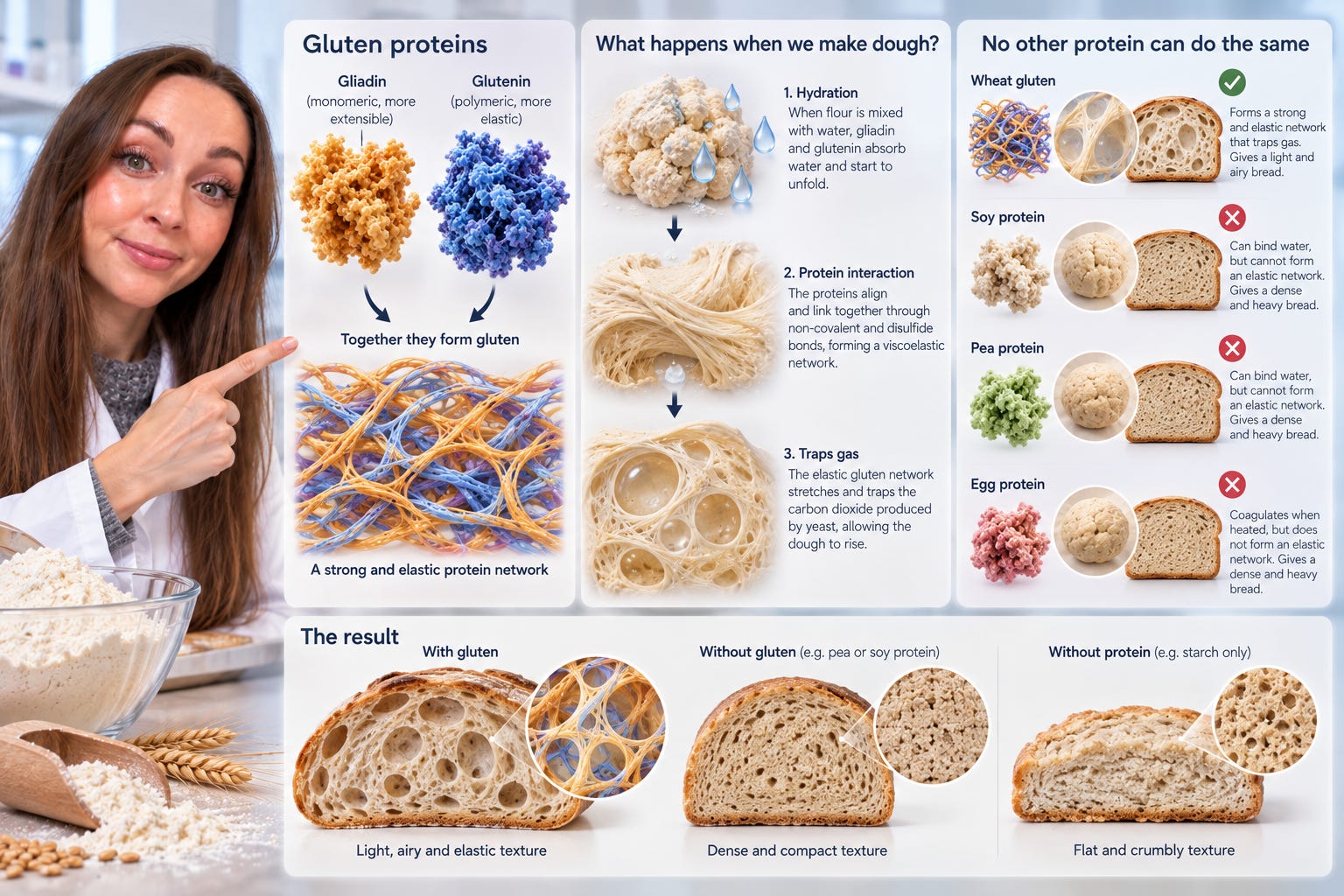
More specifically, gluten refers to storage proteins found in wheat and closely related cereals. In wheat, the two major groups involved in gluten formation are called gliadins and glutenins. This distinction becomes particularly interesting from a food science perspective.
When wheat flour is mixed with water and worked into a dough, these proteins interact and form a three-dimensional network. Gliadins contribute more to the viscosity and extensibility of the dough, allowing it to stretch, while glutenins contribute strength and elasticity.
Together, they create the gluten network.
If you have ever made bread, you have seen this network in action. Yeast produces carbon dioxide during fermentation. Instead of the gas simply escaping, the gluten network stretches around the gas bubbles and helps retain them. This is one reason wheat bread can become light and airy.
During baking, several things happen simultaneously. Proteins change structure, starch gelatinizes, water moves and evaporates, and the soft dough is transformed into a stable bread structure.
This is why gluten is so technologically useful.
It is not simply something food manufacturers add unnecessarily. Gluten performs an extraordinary structural function in foods such as bread, pizza dough and pasta.
Gluten is also interesting at the molecular level
Gluten proteins contain unusually high proportions of the amino acids proline and glutamine.
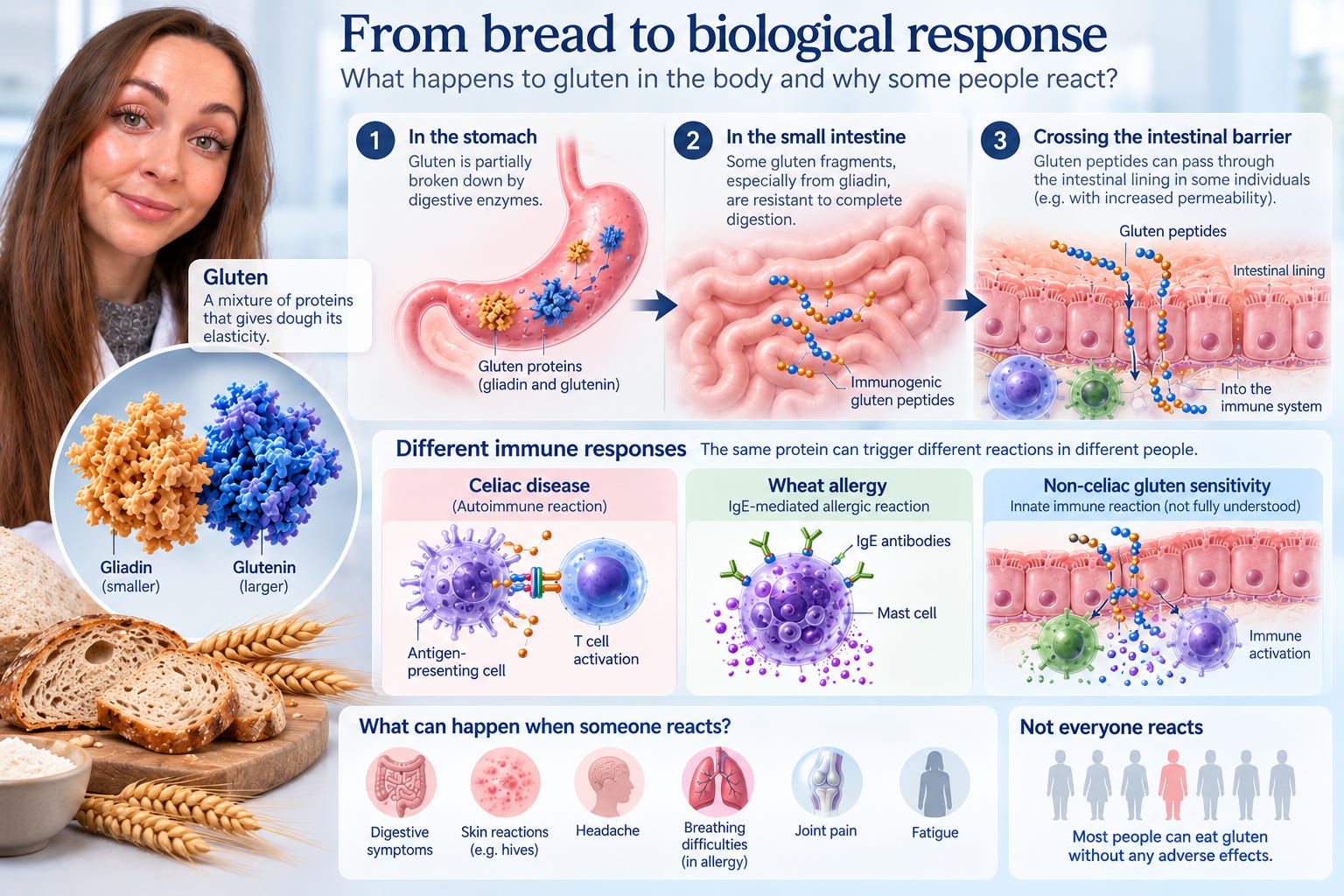
That matters because our digestive enzymes have difficulty completely breaking down some of the proline-rich sequences. Relatively long gluten-derived peptides can therefore remain after digestion. One of the best-known examples is the so-called 33-mer peptide from α-gliadin.
This resistance to digestion is biologically important in celiac disease. In genetically susceptible individuals, particular gluten peptides can participate in an immune response that ultimately damages the small intestine. But there is an important distinction here.
A protein being incompletely digested does not automatically mean that it causes disease.
The biological consequence depends on what happens next, including the immune system, genetics and intestinal environment of the person consuming it.
This is one of the places where a real piece of biochemistry can easily become distorted when translated into nutrition content online. “Humans cannot completely digest gluten” sounds alarming. But it does not follow that gluten therefore damages everyone who eats it.
For people with celiac disease, however, the situation is completely different.