

I’ve been thinking a lot about women’s health in general. Lipedema is one thing, but over the past couple of years, I’ve spoken to so many women from different parts of the world. Many of them seem to share similar patterns, even though their lives and health journeys are completely different.
Some of them may never speak to each other. Their paths may never cross. But perhaps they can cross here, in the comments. I also want to give space to the stories that are not my own.
I do not have endometriosis, but some of you do.
This is something I often notice in lipedema communities. People are trying to understand their bodies by asking questions like “Does anyone else experience this too?”
In a large community, you will often find someone who recognises your experience. But that does not automatically mean there is a biological connection. Sometimes two conditions simply exist in the same body. Sometimes they may share a mechanism. And sometimes we do not yet know.
Lipedema research is still young. We do not have strong consensus on how lipedema may be connected to many other conditions. We do know that lipedema often appears or changes during hormonal stages of life, including puberty, pregnancy and menopause. This is one of the reasons researchers suspect that hormones are involved in some way. But we do not yet know exactly how.
Some possible connections are still more interesting than others. One of them is the relationship between lipedema and other conditions that mainly affect women, such as endometriosis and PCOS.
These are not conditions I live with myself, so this article is not really written for “me”. But it may be written for you.
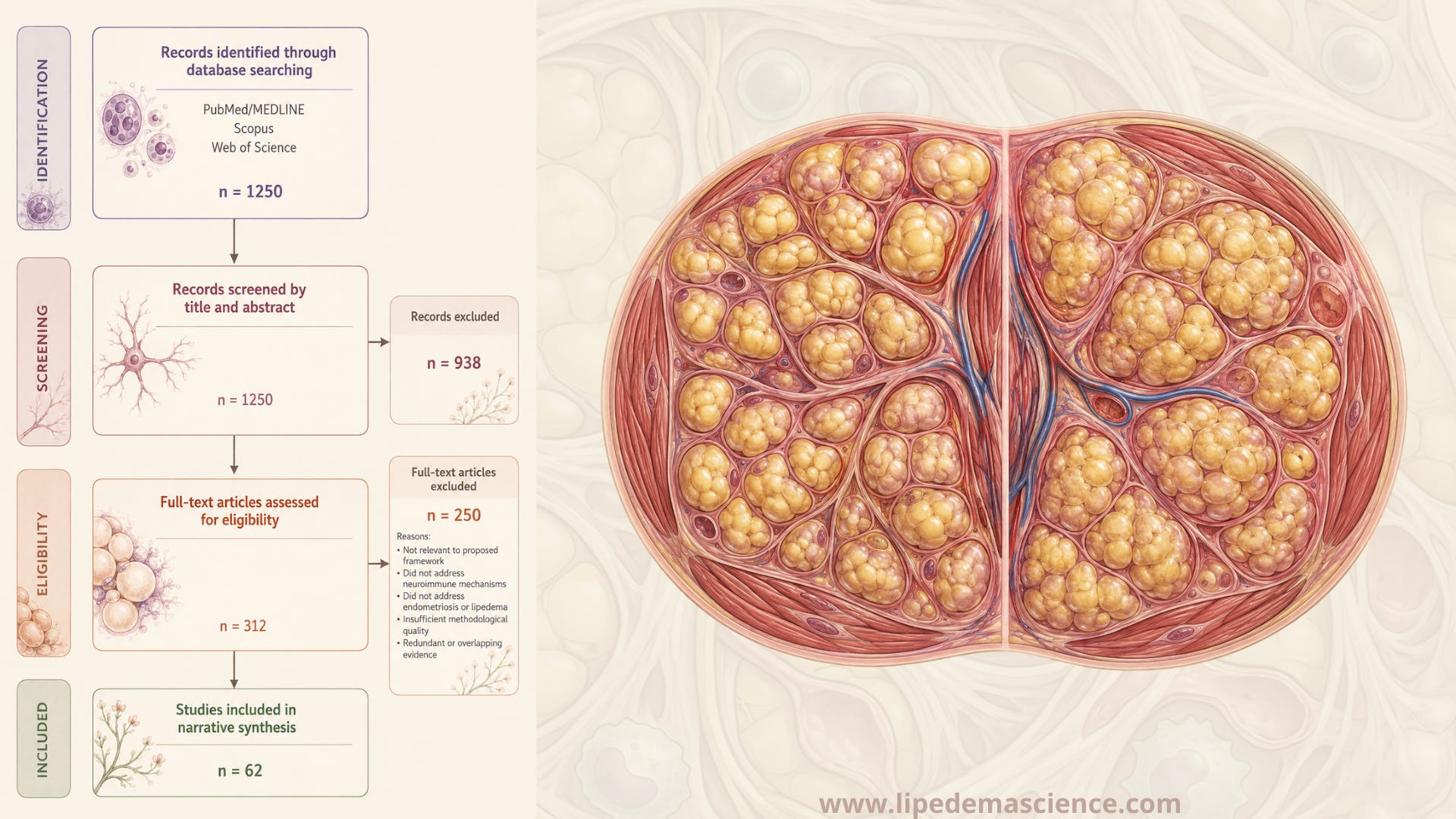
There is a new study that looks at endometriosis and lipedema side by side and asks whether some of the pain in both conditions may be driven by similar communication between hormones, immune cells and the nervous system. Become a LipedemaScience member to access every article in the library.
It is called From Endometriosis to Lipedema: Toward a Neuroimmune Framework for Pain Amplification in Hormone-Sensitive Disorders. It was published in July 2026.
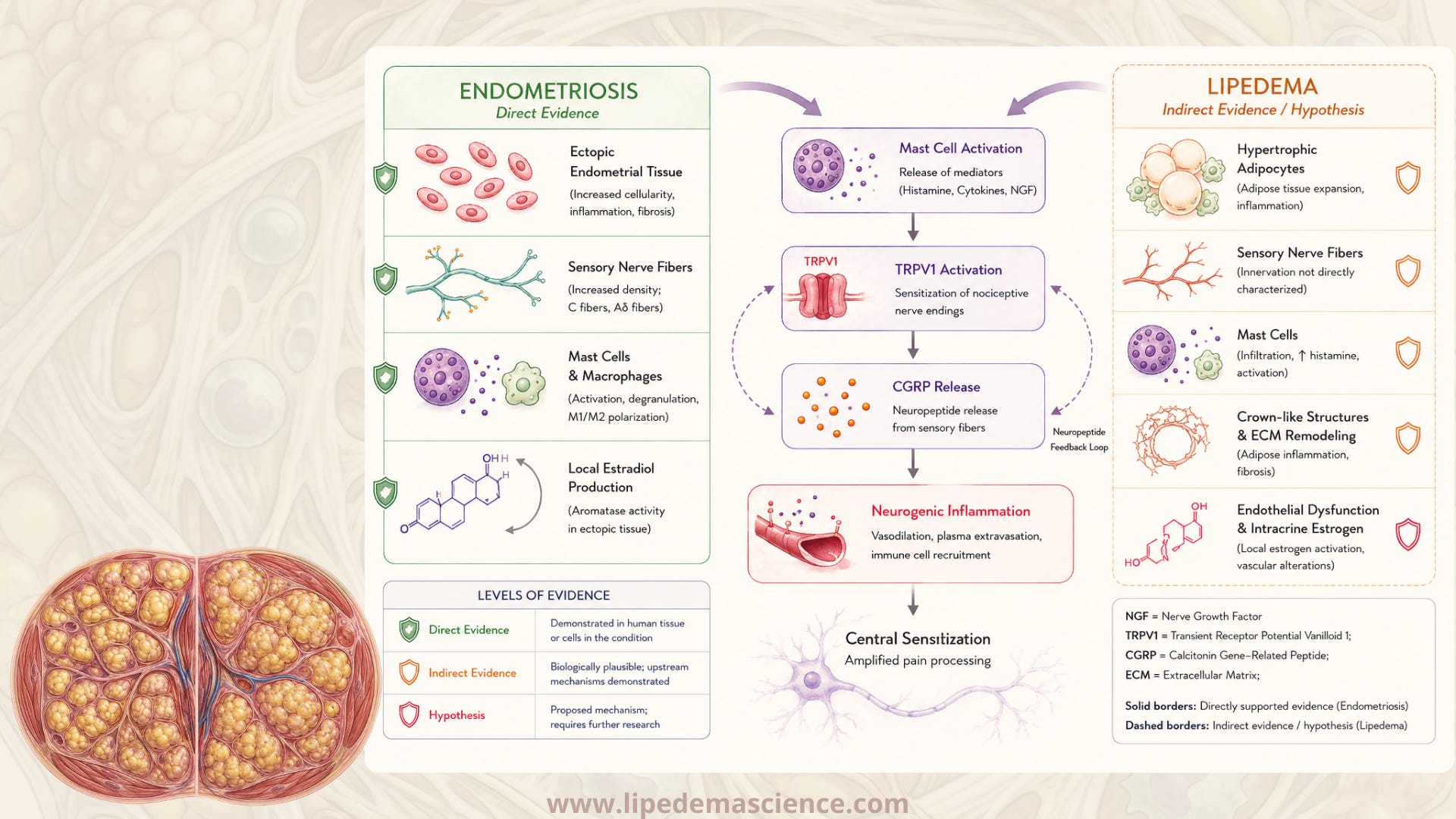
The authors are not saying that lipedema and endometriosis are the same disease, since they affect different tissues and have different symptoms. What they are asking and exploring is whether both may create a local environment where inflammation and pain signals start reinforcing each other, which could make symptoms worse in both conditions.
The interesting part here is that there is much stronger evidence for this in endometriosis than in lipedema. Researchers have found increased sensory nerves, mast cells close to nerve fibres, changes in pain receptors such as TRPV1, and CGRP-related signalling in endometriosis tissue. These findings may help explain why pain can sometimes be severe even when the visible extent of the disease is limited, and why pain can continue after surgery in some women. Personally, I have noticed that hormones, refined white sugar and periods of intense stress seem to trigger more pain and inflammation in my lipedema tissue. For you, the triggers might be something else.
In lipedema, the picture is much less complete, and this is something I really want you to be aware of, since social media can often give you the impression that the science is already bulletproof. It is not. We are not there at all. But we are on our way. We are still learning and still discovering, and this is why asking questions is so important. We do know that lipedema tissue can contain mast cells, higher histamine levels, macrophages, vascular changes, fibrosis and altered local estrogen metabolism. These findings are interesting because they are some of the same upstream conditions that could irritate or sensitise nerves. But the nerves themselves have not been studied well enough in lipedema. TRPV1, CGRP and nerve growth factor have not yet been properly mapped in the tissue, so this part of the model is still a hypothesis.
I think one of the most relevant parts for women living with either condition is the discussion about pain flares. The authors suggest that sleep loss, stress, hormonal changes, infection or gastrointestinal symptoms may sometimes add pressure to an already sensitive pain system. That may sound familiar to many people. Still, the proposed flare types have not been tested, and the study does not prove that histamine, food, the gut or hormones are causing an individual woman’s symptoms.
The study is therefore useful for some of us, including those of us who do not have endometriosis but may have other conditions also related to inflammation. But it is not useful because it gives us a new treatment. It gives researchers better questions. Are mast cells located close to nerves in lipedema tissue? Are the same pain receptors involved? Do women with both lipedema and endometriosis show more pain amplification? Those studies have not been done yet. For now, this paper gives us a possible explanation for why the pain can feel much bigger than what is visible from the outside. It is an interesting model, but it is still a model.
If you like what I do for the lipedema community, I would really appreciate it if you shared this article, recommended LipedemaScience to a friend with lipedema, or simply helped the community grow.
I love spending time building this, and I want it to become something unique that is not already out there. A place where you can ask questions and find more nuance in all the social media noise that is sometimes presented as hard science, but may also be more connected to a lipedema trend that gets more views and followers.
Maybe you simply prefer to learn and read lipedema news. I will never give you a black-and-white answer, because that would be too simple. I am not built that way, and my brain is very critical when it comes to strong claims. Some studies are given more weight than they deserve because of poor study design, serious weaknesses, too short a timeframe, too few participants, or because they are funded by companies selling the product being studied, as we have seen with some studies on lipedema and vibration plates.
Vibration plates are trending heavily on social media. They might work, but some of the effect could also be placebo. If it is something you feel motivated to try and it gives you energy, I say go for it. But if it adds more stress to your life, more guilt or a feeling of failure, then skip it and focus on the things that actually motivate you.

From Endometriosis to Lipedema: Toward a Neuroimmune Framework for Pain Amplification in Hormone-Sensitive Disorders (DOI: 10.3390/biomedicines14071510)