

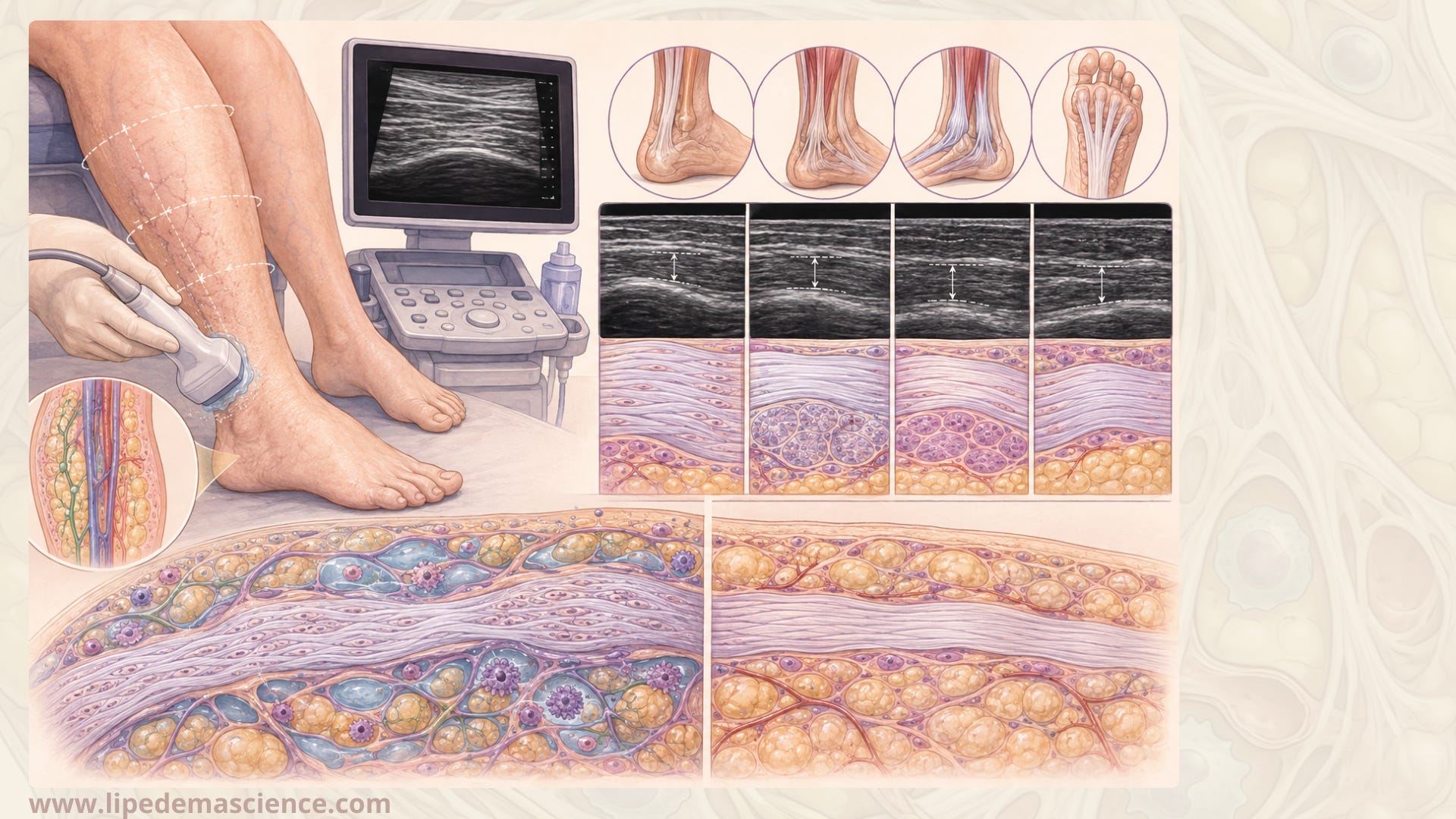
When we talk about lipedema, most of the attention is usually placed on fat tissue, pain, swelling, bruising, and the lymphatic system. But our legs are not made up of separate parts that work independently. Fat tissue, connective tissue, muscles, tendons, fascia, blood vessels, lymphatic vessels, nerves, and joints all have to work together every time we stand, walk, climb stairs, or exercise.
A new study titled Ultrasonographic Evaluations of Tendons/Fascia in Lower Limb Lymphedema and Lipedema looked at something that is discussed much less often: whether chronic swelling in the legs may also be linked to physical changes in tendons and fascia.
The researchers studied 53 people with chronic swelling in the lower legs and compared them with 55 people of similar age and sex who did not have chronic edema. They used ultrasound to examine several important structures in the legs and feet, including the Achilles tendon, the tibialis posterior tendon, the peroneal tendons, the patellar tendon, and the plantar fascia.
To understand why this matters, it helps to first understand what these structures actually do. Tendons are strong bands of connective tissue that connect muscles to bones. When a muscle contracts, the tendon transfers that force to the bone and helps create movement. The Achilles tendon, for example, connects the calf muscles to the heel. It is heavily involved every time you walk, run, climb stairs, or rise onto your toes.
The plantar fascia is slightly different. It is a strong band of connective tissue that runs along the bottom of the foot from the heel toward the toes. It helps support the arch of the foot and absorbs some of the forces created when we walk. When this tissue becomes irritated or changes structurally, it can contribute to plantar fasciitis, which often causes pain around the heel or underneath the foot.
The researchers wanted to know whether these tissues looked different in people who had chronic leg swelling. They did.
Most of the tendons they examined were thicker in the group with chronic edema than in the control group. The Achilles tendon, tibialis posterior tendon, peroneal tendons, and plantar fascia were all thicker. The patellar tendon, which is located around the knee, was the main exception.
At first, this might sound like a very small anatomical detail. But tendon thickness can tell us something about what is happening inside the tissue. A thicker tendon is not necessarily a stronger tendon. Tendons can become thicker when they are exposed to repeated mechanical stress, tissue remodeling, inflammation, degeneration, or other long-term changes.
The Achilles tendon and plantar fascia were particularly interesting because the differences remained even after the researchers adjusted for body mass index, or BMI.
This matters because body weight itself can affect the feet and lower legs. A person with a higher body weight may naturally place more mechanical load on structures such as the Achilles tendon and plantar fascia. If the people with chronic edema also had higher BMI, it would therefore be reasonable to ask whether body size alone explained the thicker tissues.
The researchers tried to account for this statistically. Even after adjusting for BMI, the Achilles tendon and plantar fascia were still significantly thicker in the edema group. That suggests that the difference may not simply be explained by body weight.
The researchers also found another important relationship: people with greater edema volume tended to have thicker Achilles tendons and thicker plantar fascia. In simple terms, the more swelling the participants had, the greater the changes in these particular tissues tended to be.
This is called a correlation. It tells us that two things appear to be related, but it does not tell us that one directly causes the other. The study cannot prove that swelling itself makes the Achilles tendon or plantar fascia thicker. There may be several explanations.
For example, chronic swelling could change the physical environment around these tissues. It could influence how forces are distributed through the foot and ankle. People with painful or heavy legs may also change the way they walk without even realizing it. Small changes in walking pattern, foot position, stride length, or weight distribution may not seem important during a single step, but over thousands of steps every day they may alter the load placed on tendons and fascia.
It is also possible that the same biological processes that contribute to swelling may affect connective tissue elsewhere in the leg. The study does not tell us which explanation is correct. What it does show is that chronic edema and changes in these musculoskeletal tissues appear to occur together.
The researchers also looked at actual tendon and foot problems, not only tissue thickness. They found that plantar fasciitis was present in 50.9% of the patients in the chronic edema group. In other words, about half of the patients had plantar fascia problems. Achilles tendinopathy was found in 22.6%, which is roughly one in five.
Both conditions were more common in the edema group than in the control group. That is an important finding because plantar fasciitis and Achilles tendinopathy can have a major effect on everyday movement.
Plantar fasciitis often causes pain underneath the heel or along the bottom of the foot. Some people notice it most strongly when taking their first steps in the morning or after sitting for a long time.
Achilles tendinopathy can cause pain, tenderness, stiffness, or discomfort at the back of the ankle. It may become noticeable when walking uphill, climbing stairs, running, standing on the toes, or increasing physical activity.
The researchers also asked the participants about pain, leg function, and quality of life. The people with chronic edema reported more pain, poorer lower-limb function, and worse quality of life than the control group. This is where the study becomes especially interesting for people living with lipedema.
Lipedema is often described mainly as a disorder of abnormal fat tissue. That is an important part of the condition, but it may not tell the whole story of why the legs can feel painful, heavy, weak, stiff, or difficult to use. The human body is a mechanical system as well as a biological one.
If the legs become heavier, swollen, tender, or painful, a person may gradually start moving differently. They may shorten their stride, shift more weight onto one side, avoid pushing strongly through the foot, rotate the leg differently, or reduce certain movements because they hurt. These changes can happen subconsciously.
Over time, altered movement can change which tissues carry the greatest load. The Achilles tendon and plantar fascia are especially important because they repeatedly absorb and transfer force during walking.
This could potentially help explain why some people with lipedema describe symptoms that do not seem to come directly from the fat tissue itself. Heel pain, pain beneath the foot, tightness around the calf, Achilles pain, ankle stiffness, difficulty standing for long periods, or pain during walking may sometimes have a musculoskeletal component.
That does not mean every person with lipedema has tendon disease. It also does not mean that lipedema directly causes plantar fasciitis or Achilles tendinopathy. The study cannot prove that.
There is also an important limitation that needs to be understood before applying these findings specifically to lipedema.
Although the title of the paper refers to both lymphedema and lipedema, the abstract describes the study group more broadly as patients with chronic lower-extremity edema. From the abstract alone, we cannot see exactly how many participants had lipedema, how many had lymphedema, whether some had both conditions, or whether the researchers analyzed the lipedema patients separately.
That means we should not take the figure of 50.9% and say that half of all people with lipedema have plantar fasciitis. The study does not establish that.
The correct interpretation is that plantar fasciitis and Achilles tendinopathy were more common among the patients with chronic lower-limb edema included in this study.
This distinction is important because good science is not only about finding interesting results. It is also about being careful not to claim more than the data actually show.
The study was also observational. The researchers compared people who already had chronic edema with people who did not. They did not follow healthy people for many years to see whether swelling developed first and tendon changes appeared afterwards. Because of that, they cannot prove cause and effect.
We therefore cannot say, based on this study, that chronic edema damages the Achilles tendon. What we can say is that people with chronic leg edema had measurable differences in several tendons and in the plantar fascia, and that greater edema volume was associated with greater thickness of the Achilles tendon and plantar fascia. That is still an interesting finding.
For people with lipedema, the study encourages a broader way of thinking about the condition. Pain and reduced function may not always come from one tissue or one biological process. Fat tissue, fluid balance, connective tissue, movement patterns, muscles, tendons, fascia, joints, and the nervous system may all contribute to how the legs feel and function. This may also have practical importance.
If someone with lipedema has persistent heel pain, Achilles pain, foot pain, or difficulty walking, it may be worth considering the musculoskeletal system rather than assuming every symptom is simply “the lipedema.” A clinician may need to look at tendon health, foot mechanics, strength, mobility, gait, and the way the person loads their legs during movement.
Ultrasound may also become useful in some cases because it allows clinicians to look directly at tendon and fascial structure without surgery or radiation.
The larger message from this study is therefore not that lipedema automatically damages tendons. It is that chronic swelling in the legs may be connected to changes in tissues that are essential for movement, especially the Achilles tendon and plantar fascia.
For people living with lipedema, that adds another piece to a much more complex picture. Lipedema may be visible in the fat tissue, but its effects on how a person feels and moves can involve the entire leg.
Ultrasonographic Evaluations of Tendons/Fascia in Lower Limb Lymphedema and Lipedema (DOI: 10.1097/PHM.0000000000003118.)
Oh this is useful - as my lipoedema 'blossomed' so did the pain under my foot and inner calf. Although to be fair my feet always ache after being on them a long time, but used to reset over night. Until it didn't... Anyway with blossoming lipoedema in pregnancy and peri, the radiating foot throb became grounding, as in seeking to not be on my feet, or means pushing through every step with pain and also working on movement to build and stretch foot muscles and calves. Finally after moving house and taking three nights of pain killers to do the daily basics, I broke out the MJ pen that had been in my fridge for 5 weeks, that the DR and I thought might help. Now this stuff has been magic - I felt crap and achy for 4 days, then from day 5 what I can on ly deceive as significant life change occurred - there was marked reduction in swelling and I came home from doing 1.5x my normal daily steps, with no foot pain and spritely. I went to the gym after work as I had energy (and no pain). Over 9 weeks I have noticed that I have not been getting swollen lower legs and subsequently had such reduced foot and inner calf pain and at times no pain (which used to increasesas lower legs would swell over the day). This has opened up accessing more movement naturally, actual motivation to move (when your legs are not heavy and you drag them around I guess this happens), and given me back joy, vitality and a lot more life quality as I never know legs could feel so good.
I cannot thank you enough for sharing this. I immediately subscribed to your substack as soon as I read your excellent summary of the academic study. I am a PhD-level researcher and retired academic and want to extend kudos for your efforts here.
I am 53yo, stage 3 (diagnosed in person by Karen Herbst), all types. A year ago, I had lipedema removal surgeries and brachioplasty. I am having more surgeries later this year. When Herbst did my ultrasound diagnosis, she noted that the lipedema tissue had eaten away at most of my fascia. That explained my chronic plantar fasciitis! I was shocked.
But after I had my surgeries (full 360 legs, trunk/abdomen 360, arms), I developed Achilles tendinopathy. I wasn't sure if it was because I was wearing compression so much or if it was just a side effect from the surgery. It's been making me crazy! It's bilateral and maddening.
Once I read this, though, I realized -- my chronic inflammation is probably the culprit. Damn you, lipedema! <shakes fist>
It's the gift that keeps on giving, right?
Thank you for posting your thoughts on the article and noting so carefully the limitations of the study and that correlation does not equal causation. Despite those things, it sure does help me better understand what's going on with my heels and tendons, and I am grateful. Sharing with my primary care doc and my podiatrist and with Dr. Herbst!