Tirzepatide, Inflammation, and Fibrosis
A science dive sparked by your questions.
One of the things I value most about running this platform is the quality of the questions you ask.
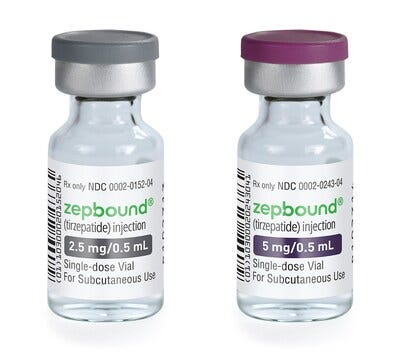
Many of them arrive in my inbox long before there are clear answers in the scientific literature. Sometimes there is no data at all, only lived experience, shared patterns, and recurring observations from people with lipedema. That is often how science actually begins. First as patient experience. Then as a hypothesis. And sometimes, if the signal is strong enough, as a pilot study or a small clinical investigation.
For me, this is the real value of this space. It keeps me on a continuous growth path. Learning new things. Diving into unfamiliar mechanisms. Challenging my own assumptions. And, importantly, refining how I understand my own lipedema journey.
One question that keeps returning is this….
What do you think about tirzepatide as an aid for inflammation and fibrosis?
This time, the situation is different from many other topics we discuss here. There are studies. Not large randomized trials in lipedema yet, but enough mechanistic, translational, and early clinical data to make the question worth a serious scientific dive.
So let us do exactly that.
Why inflammation and fibrosis matter in lipedema
Lipedema is not just about excess fat. The condition is increasingly understood as a complex disorder involving adipocyte dysfunction, chronic low-grade inflammation, microvascular changes, pain signaling, and progressive extracellular matrix remodeling.
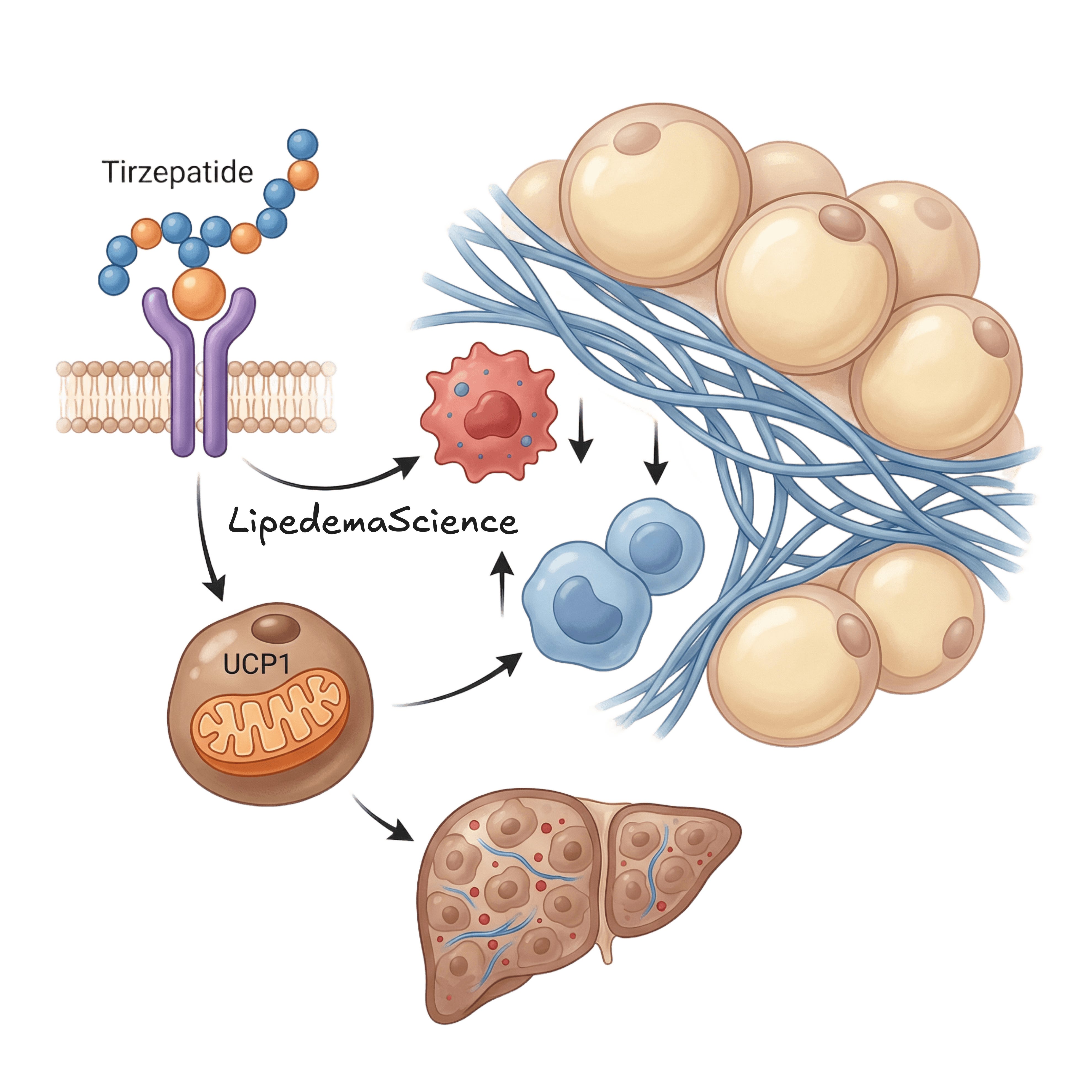
Inflammation and fibrosis are tightly linked in this process. Inflammatory immune cells within adipose tissue promote cytokine release, which in turn stimulates fibroblasts and extracellular matrix deposition. Over time, this can lead to stiff, painful, poorly perfused tissue that becomes increasingly resistant to both lifestyle interventions and surgical approaches.
Importantly, these processes are influenced by metabolic dysfunction and hormonal transitions, particularly estrogen changes across the female life course. This is one reason why lipedema often accelerates around puberty, pregnancy, and menopause.
If a therapy is to be considered disease-modifying in lipedema, it must meaningfully interact with these pathways, not just reduce body weight.
What makes tirzepatide different
Tirzepatide is a dual GIP and GLP-1 receptor agonist. Most people know it for its effects on glucose control and weight loss, but those outcomes are only part of the story.
At the tissue level, tirzepatide influences several processes that are directly relevant to lipedema biology.
It improves insulin sensitivity within adipose tissue, reducing lipotoxic stress. It modulates immune cell behavior, shifting macrophages away from a pro-inflammatory phenotype. It downregulates key fibrotic signaling pathways such as TGF-β, which are central drivers of extracellular matrix accumulation. It also affects mitochondrial function and thermogenic programming, mechanisms that are increasingly discussed in lipedema research.
This constellation of effects is why recent 2025 review papers have begun to frame tirzepatide not merely as a weight-loss drug, but as a potential metabolic and fibro-inflammatory modulator.
Evidence specific to lipedema, limited but important
A 2025 mechanistic review explicitly explored tirzepatide as a potential disease-modifying therapy in lipedema. While it does not present new clinical trial data, it systematically maps tirzepatide’s known biological effects onto established lipedema pathways involving inflammation, fibrosis, estrogen-related adipose dysfunction, and pain.
A complementary opinion paper addresses a long-standing treatment gap in lipedema. Diet and exercise often fail not because of poor adherence, but because they do not sufficiently target the underlying metabolic and inflammatory drivers. Tirzepatide is proposed as a therapy that could, at least in theory, operate upstream of symptom expression.
Most interestingly, a 2025 case report describes a woman with stage III lipedema who experienced reduced pain, leg heaviness, and improved quality of life on low-dose tirzepatide, despite previous unsuccessful interventions. A single case never proves efficacy, but it does something else that is crucial. It shows biological plausibility translating into lived experience.
That is often where the next research question begins.
Lessons from fibrosis research outside lipedema
Because lipedema-specific trials are still missing, it is informative to look at other fibro-inflammatory conditions where tirzepatide has been studied more extensively.
In metabolic liver disease models, including estrogen-deficient states, tirzepatide consistently reduces markers of inflammation and fibrosis. Studies published in 2025 show attenuation of steatosis progression, reduced fibrotic remodeling, and even decreased tumor burden in advanced fibrotic mouse models. Importantly, some of these antifibrotic effects appear only partially explained by weight loss, suggesting direct tissue-level signaling effects.
These findings matter because fibrosis follows conserved biological pathways across tissues. While adipose tissue is not the liver, the molecular drivers of fibro-inflammatory remodeling overlap more than we once believed.
So, can tirzepatide help with inflammation and fibrosis in lipedema
Based on the current evidence, the most scientifically honest answer is this
Tirzepatide shows strong mechanistic potential and early supportive signals, but definitive clinical proof in lipedema is still missing.
That may sound cautious, but it is also encouraging.
We are no longer talking purely in hypotheticals. We have converging data from mechanistic reviews, metabolic disease models, biomarker studies, and early human observations that all point in the same direction. Anti-inflammatory effects. Antifibrotic signaling. Improved adipose tissue function.
At the same time, this is not a universal solution, nor a replacement for other aspects of lipedema care. Gastrointestinal side effects exist. Long-term outcomes are unknown. And individual responses will vary widely depending on disease stage, hormonal context, and metabolic health.
Why your questions matter more than you think
What excites me most about this topic is not just tirzepatide itself.
It is the process.
Patient questions identify gaps long before funding calls do. Shared experiences generate hypotheses that eventually shape research agendas. And platforms like this create a feedback loop between lived biology and laboratory biology.
This is how fields move forward.
So keep asking. Even when the answer is not there yet. Especially then.
Because sometimes, as with tirzepatide and lipedema, the science is finally beginning to catch up.
Here’s the list of all 6 key sources I used for the tirzepatide response, with direct links:
Tirzepatide as a Potential Disease-Modifying Therapy in Lipedema: A Narrative Review on Bridging Metabolism, Inflammation, and Fibrosis (DOI: 10.3390/ijms262110741)
Metabolic Therapy for Lipedema: Can Tirzepatide Overcome the Treatment Gap? (DOI: 10.9734/jpri/2025/v37i37664)
SAT-685 Low-dose Tirzepatide For The Treatment Of Patient With Lipedema: A Case Report (DOI: 10.1210/jendso/bvaf149.119)
Tirzepatide attenuates estrogen deficiency-induced metabolic dysfunction-associated steatotic liver disease progression by reducing steatosis, inflammation, and fibrosis in obese-diabetic mice (DOI: 10.1097/GME.0000000000002683)
2170-LB: Tirzepatide Reduces Tumor Burden in the GAN Diet-Induced Obese and Biopsy-Confirmed Mouse Model of MASH-HCC with Advanced Fibrosis (DOI: 10.2337/db25-2170-LB)
Effects of Novel Dual GIP and GLP-1 Receptor Agonist Tirzepatide on Biomarkers of Nonalcoholic Steatohepatitis in Patients With Type 2 Diabetes (DOI: 10.2337/dc19-1892)


Takk for god informasjon. Det gir håp å lese om at det kan komme nye hjelpemidler. Aner du om det er mulig å få utskrevet i Norge, tiltross “normalvekt”?
Thanks for further elaboration on my question, great job and information!