

A full account of how research on a condition affecting millions of women went from two sentences in a 1940 case report to whole-genome sequencing, multi-omics, and the first druggable molecular targets — and why the most important chapters are still being written.
There is a particular kind of loneliness that comes from living in a body that medicine has decided doesn’t exist.
You’ve felt it. Maybe you felt it the first time a doctor told you to just lose weight, while you sat there knowing — with the kind of bone-deep certainty that comes from years of trying — that what was happening in your body was something else entirely. Maybe you felt it when you searched for answers and found nothing credible, nothing that named what you were experiencing, nothing written by someone who took it seriously. Or maybe you felt it the way I did: standing in a hospital in Oslo in 2012, finally hearing the word lipedema for the first time, and experiencing simultaneously the relief of a diagnosis and the dawning realization that almost no one in the scientific world had been paying attention.
That second feeling — that the science had barely begun — was correct.
But here’s what I want you to understand, because it matters enormously: the story of lipedema science is not a story of permanent neglect. It is a story of a slow, difficult, and increasingly accelerating awakening. And if you follow that story from its very beginning to where we stand today, in May 2026, what you find is not a tale of hopelessness. What you find is a field that spent decades asleep, then stirred restlessly, then began to run — and is now, finally, asking the right questions with the right tools.
This is that story. All of it.
A Name Without a Body of Evidence (1940–1999)
The Mayo Clinic, 1940
The year is 1940. Two American physicians, Edgar Van Nuys Allen and Edgar Alphonso Hines Jr., are working at the Mayo Clinic in Rochester, Minnesota. They publish a brief report in the Preliminary Staff Meetings of the Mayo Clinic describing an unusual pattern they have observed in a small group of women: a symmetrical, bilateral accumulation of subcutaneous fat in the legs that is painful, doesn’t respond to dieting, and is clearly distinct from ordinary obesity. The hands and feet are spared. The condition is tender to pressure. It runs in families.
They call it lipedema.
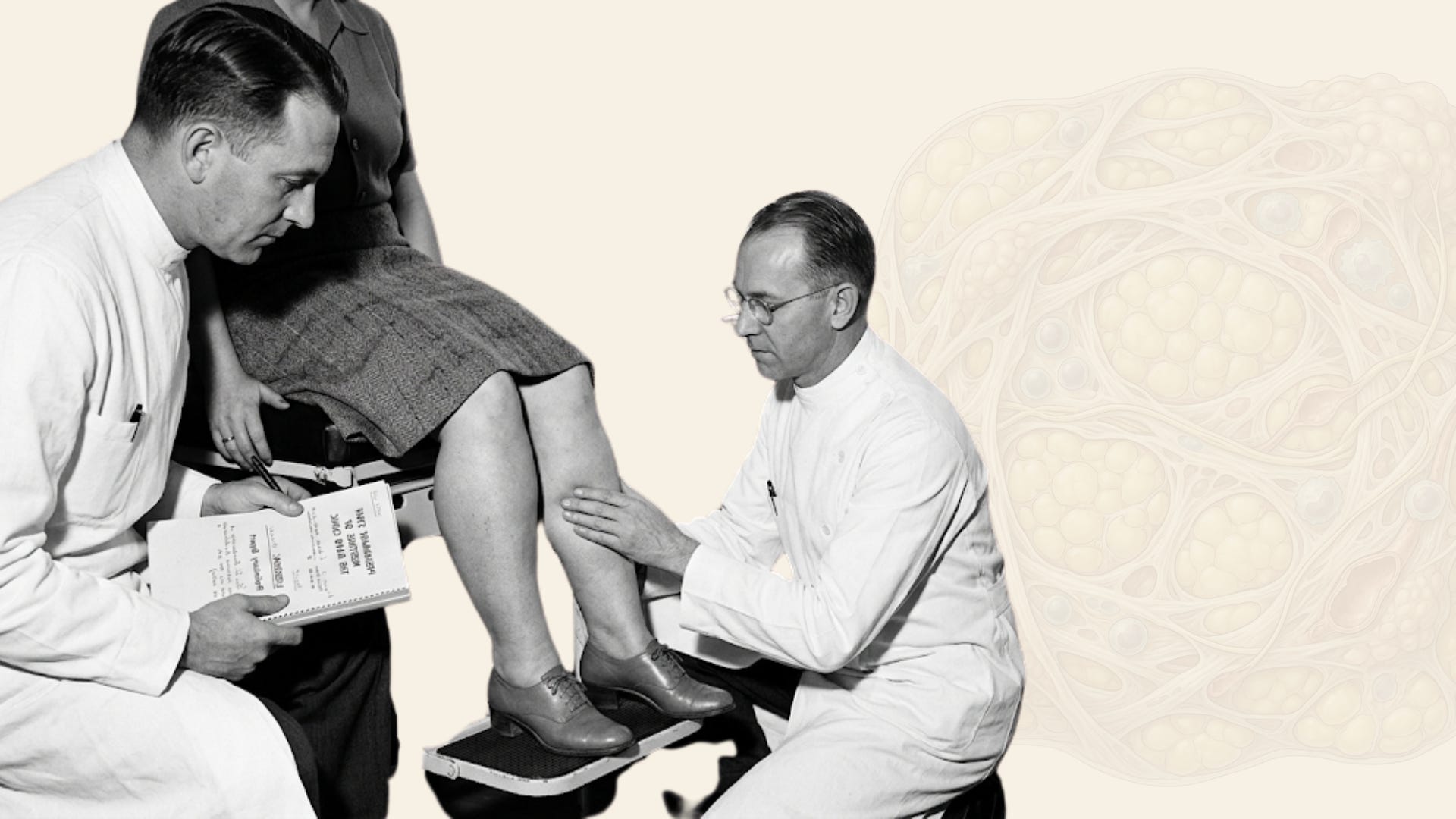
They describe it carefully. They distinguish it from lymphedema. They note the striking hormonal pattern — it appears almost exclusively in women, often emerging or worsening at puberty, pregnancy, or menopause. They use words like “bilateral” and “symmetrical” and “painful” that, eighty-five years later, remain the clinical hallmarks.
And then, for the most part, the world moves on.
There is no explosion of follow-up research. No dedicated funding stream. No clinical guidelines. No awareness campaigns. No medical school curricula. The condition sits in the medical literature like a message in a bottle, occasionally retrieved by a curious clinician in Germany or Austria or the Netherlands, occasionally cited in a lymphology textbook, but never truly examined with scientific rigor. For the next six decades, lipedema exists as an orphan entity — named, observed, and almost entirely unstudied.
Why the silence?
This is worth asking, because the silence was not accidental. It reflects something systematic about which bodies medicine has historically chosen to investigate — and which bodies it has chosen to explain away.
Lipedema affects women almost exclusively. It involves fat tissue, a category that medical culture has long viewed through a moral rather than a biological lens. Its primary symptoms — disproportionate fat distribution, pain, swelling, easy bruising, heaviness — are things women have been told to expect, to endure, to lose weight to fix. When you combine female biology, adipose tissue, and chronic pain in one condition, you get something medicine has historically been very comfortable ignoring.
The word “obesity” did enormous damage here. Because lipedema can coexist with obesity, and because it causes visible fat accumulation in the lower body, clinicians who encountered it often stopped at “she needs to lose weight” and never looked further. The specific, structural, biological distinctiveness of lipedema tissue — its abnormal cellularity, its vascular dysfunction, its inflammatory signature, its resistance to caloric restriction — remained hidden beneath a layer of assumption that was, in retrospect, both medically incorrect and deeply unkind.
It took the molecular revolution in biology to finally crack this open.

The Literature Begins to Wake Up (1990s–2009)
In the 1990s, a small but meaningful body of European literature begins to accumulate, primarily from German-speaking countries — Germany, Austria, Switzerland — where a tradition of phlebology and lymphology had kept lipedema at least minimally alive as a clinical concept.
