
The Emotional Stages After a Lipedema Diagnosis
When you discover you have lipedema, the journey ahead isn’t just about your body — it’s about learning to face shock, grief, and eventually finding a new sense of balance and self-care.

The Diagnosis That Changes Everything
There are moments that divide life into before and after. For many women with lipedema, diagnosis is one of them. After years of unexplained symptoms, pain, and being told to “just exercise more,” you finally have an answer — but it’s not an easy one.
At first, there may be relief. Finally, you know what’s happening. But soon comes another emotion: the loss of control. Lipedema cannot be cured, and it cannot be trained away. You must live with it — and it takes time to understand what that truly means.
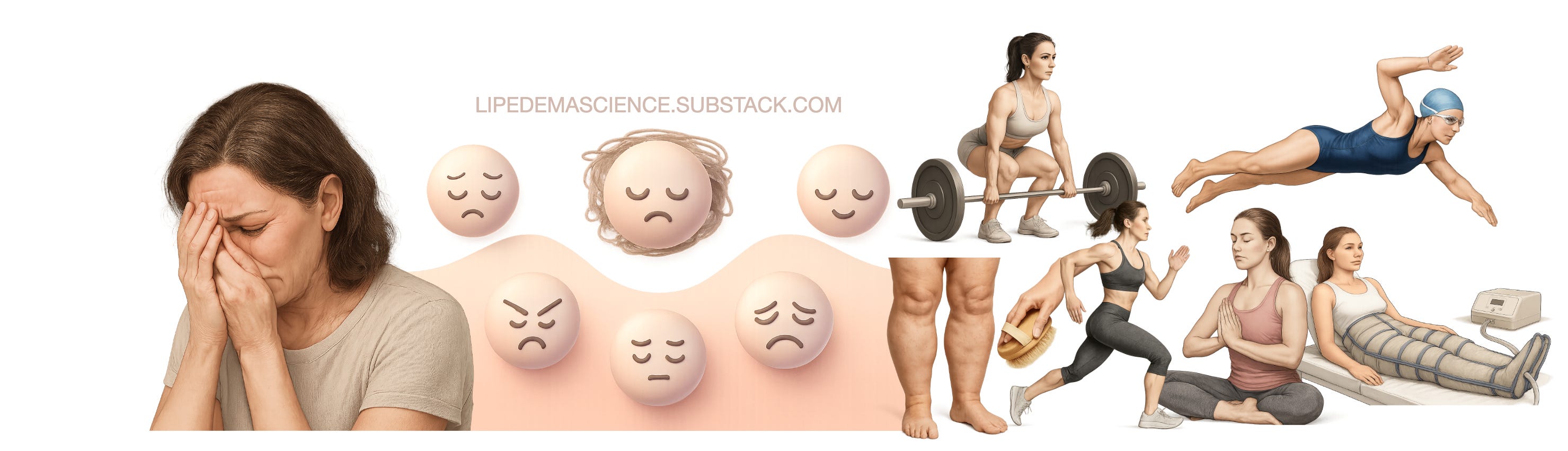
Living with lipedema often involves moving through an emotional process much like the five stages of grief, first described by psychiatrist Elisabeth Kübler-Ross: denial, anger, bargaining, depression, and acceptance. They are not steps on a ladder, but waves you learn to ride — a journey from shock to strength.
Denial – “This can’t be true”
At first, the diagnosis may feel unreal. After years of believing it was only about lifestyle or weight, hearing that it’s a chronic disease of the fat tissue can be hard to take in. Many continue as before, hoping the doctor is wrong, or seek out new experts looking for a different answer.
Denial is the brain’s way of giving you breathing room. It shields you from becoming overwhelmed. But as the information begins to sink in, the need for understanding becomes stronger than the desire to reject it.
This is the time to learn, not to panic — about the lymphatic system, about what lipedema actually is, and about how you can support your body rather than punish it.
Anger – “Why me?”
Once reality settles in, anger often follows — anger at the system that overlooked you, at doctors who dismissed you, at a body that feels like it’s turned against you.
Anger is painful, but it’s also energy. It’s protest, and protest means you still believe things can be better.
In this phase, it helps to channel anger outward, not inward. Talk about how you’ve been treated. Share your story with others. Many women find strength in using their experiences to advocate for awareness and change — for themselves and for those who come after them.
Bargaining – “If I just do everything right…”
This is the phase of trying to make deals with yourself. “If I follow this diet perfectly, it will go away.” “If I exercise every day, I’ll look normal again.”
It’s a natural reflex — the mind’s attempt to regain control. But lipedema cannot be negotiated with. No quick fix will erase it.
Still, this stage often leads to something valuable: experimentation. You start testing new routines. You learn what actually helps — dry brushing, using a lymphatic pulsator, water exercise, daily walks. When you begin to feel what brings lightness to your body, desperation slowly gives way to learning.
Depression – “I can’t do this anymore”
After cycles of effort and disappointment, a deep sadness can set in. You realize this isn’t something that will pass. The fatigue, the pain, and the sense of injustice can feel unbearable.
This is often the low point — not because all hope is gone, but because hope has finally become realistic.
Depression here is not weakness; it’s mourning. You’re grieving the body you thought you had, the control you thought you possessed.
This is when you need gentleness — rest, stillness, and people who can sit beside you without fixing. Maybe therapy, maybe community. When you begin to speak honestly about how it feels, the heaviness slowly starts to lift.
Acceptance – “I live with it, not against it”
Eventually, slowly, something shifts: you stop seeing lipedema as an enemy and start seeing it as part of your body — a body still worthy of care.
You find rhythm in new routines: dry brushing in the morning, using your pulsator in the evening, gentle workouts, and food choices that soothe rather than inflame.
Acceptance doesn’t mean giving up; it means taking ownership again. You become the expert on your own body, and you begin to recognize the strength in what you’ve learned.
Acceptance isn’t a destination; it’s a way of living — one that makes space for good days, hard days, and everything in between.
How to Support Yourself Along the Way
Make space for every emotion. There is no “right” way to react. Whatever you feel is valid.
Seek connection. You are not alone. Meeting others with lipedema can turn isolation into understanding.
Build knowledge. The more you learn, the less power fear has.
Take small steps. Change happens gradually. One action at a time is enough.
Celebrate effort, not outcome. Every time you care for yourself, you win a small victory.
When Someone You Love Has Lipedema
If someone close to you has just been diagnosed, they may move through all these emotions — sometimes all in one week. Here’s how to help:
Be present. You don’t need solutions; you need to listen.
Avoid oversimplified advice. “Just exercise more” or “try this diet” can hurt more than help.
Acknowledge their effort. Living with a chronic condition takes courage. Say it out loud.
Offer practical help. Drive them to appointments, assist with errands, or simply spend time together.
Finding Meaning in Change
Ultimately, this journey isn’t only about illness — it’s about building a new relationship with yourself.
The five stages of grief are not signs of weakness; they are the natural process of adapting when life changes direction. Through them, you learn patience, self-care, and resilience.
Lipedema can take a lot from you — but it can also teach you something profound: that strength isn’t about control, but about finding calm within what you cannot control.
The Stubborn Persistence of Grief Stage Theory (DOI: 10.1177/00302228231184290)