

Research matters, but so does what we learn from each other, especially with a condition that is still understudied and often misunderstood. A structured survey helps turn individual experiences into patterns we can compare, learn from, and later translate into better questions for researchers and clinicians.
A total of 159 of you contributed to this article by answering the 23-question survey. Sharing your experience is incredibly important for the lipedema community. I also have scientists and healthcare professionals who follow this account, so your engagement can help move the science forward. Thank you for contributing.
I am a nutritionist and food scientist with a passion for making lipedema research and knowledge understandable and accessible. I was diagnosed with lipedema in 2012, and I am dedicated to bridging science, lived experience, and hope for women living with this condition.
Question 1
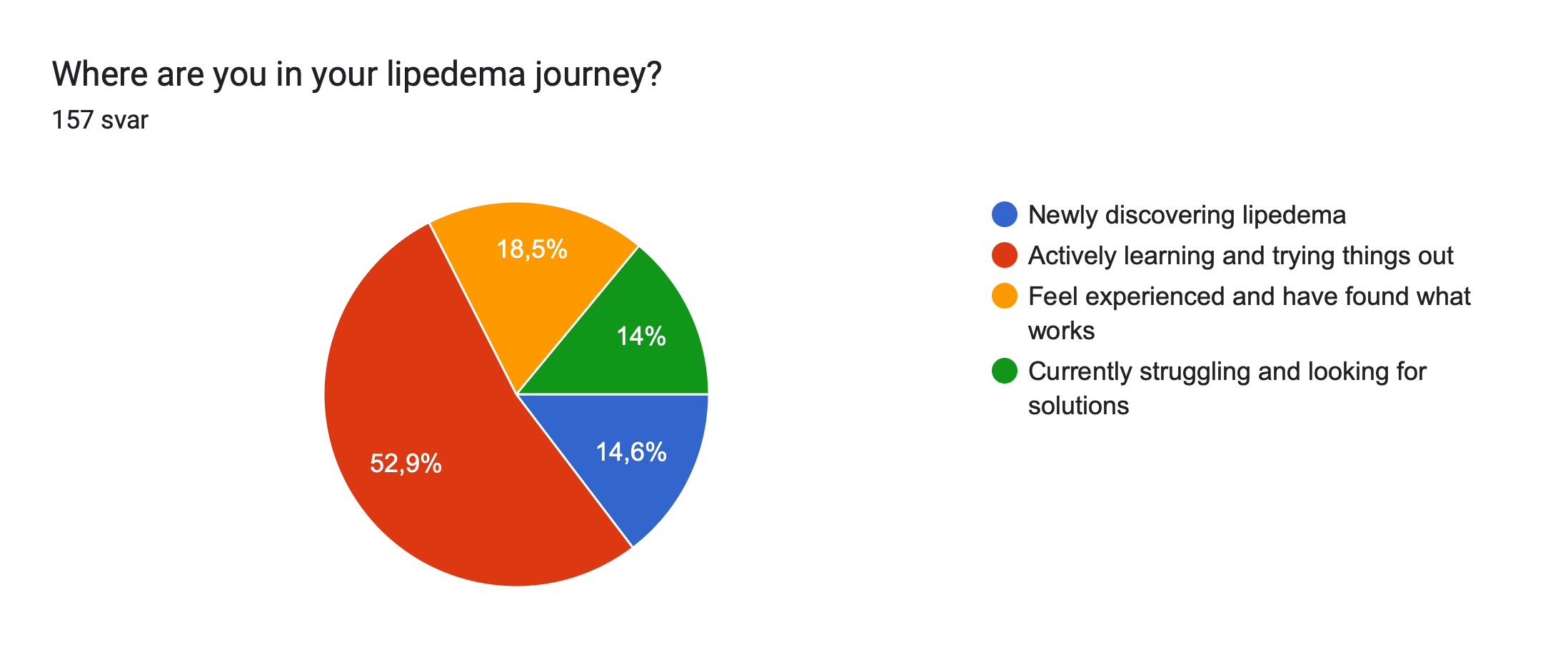
This chart reflects 157 responses to the question, “Where are you in your lipedema journey?” Most people, 52.9% (83 respondents), say they are actively learning and trying things out. It makes sense. Many are still testing what helps, what doesn’t, and what is even worth the effort.
The rest of the responses are spread across different phases. 18.5% (29) feel they’ve found what works, while 14.6% (23) are newly discovering lipedema. Another 14% (22) say they’re struggling and looking for solutions. Taken together, it shows a community with very different needs at the same time. Some are just starting to make sense of things, some are tired and stuck, and some have experience that could be valuable to others if we find ways to share it clearly.
Question 2
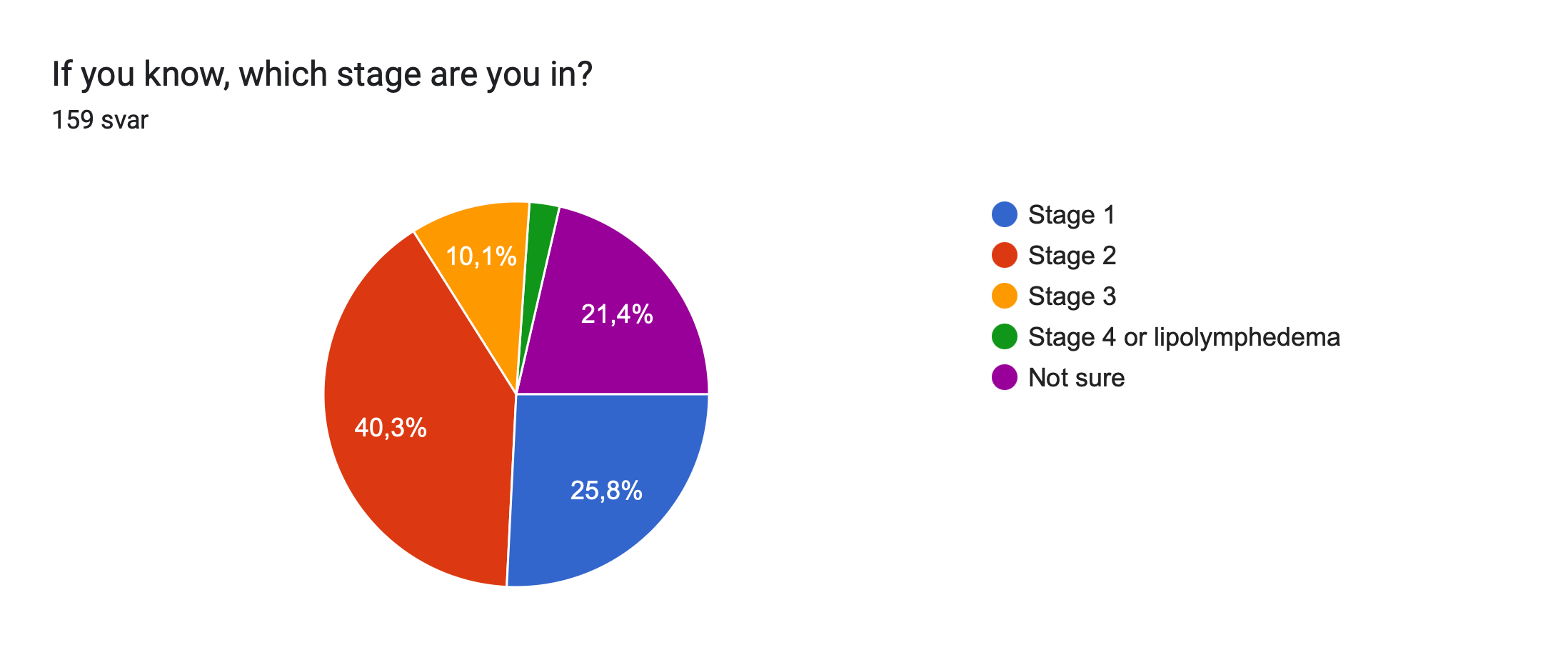
This chart summarizes 159 responses to the question, “If you know, which stage are you in?” Stage 2 is the most common answer at 40.3 percent, followed by Stage 1 at 25.8 percent. Stage 3 makes up 10.1 percent, and only a small minority report Stage 4 or lipolymphedema at about 2.4 percent.
What stands out, though, is that 21.4 percent are not sure. That is a reminder that staging is not always clear in real life. Many people do not get a thorough assessment, and the criteria can be hard to apply without experienced clinical support.
Question 3
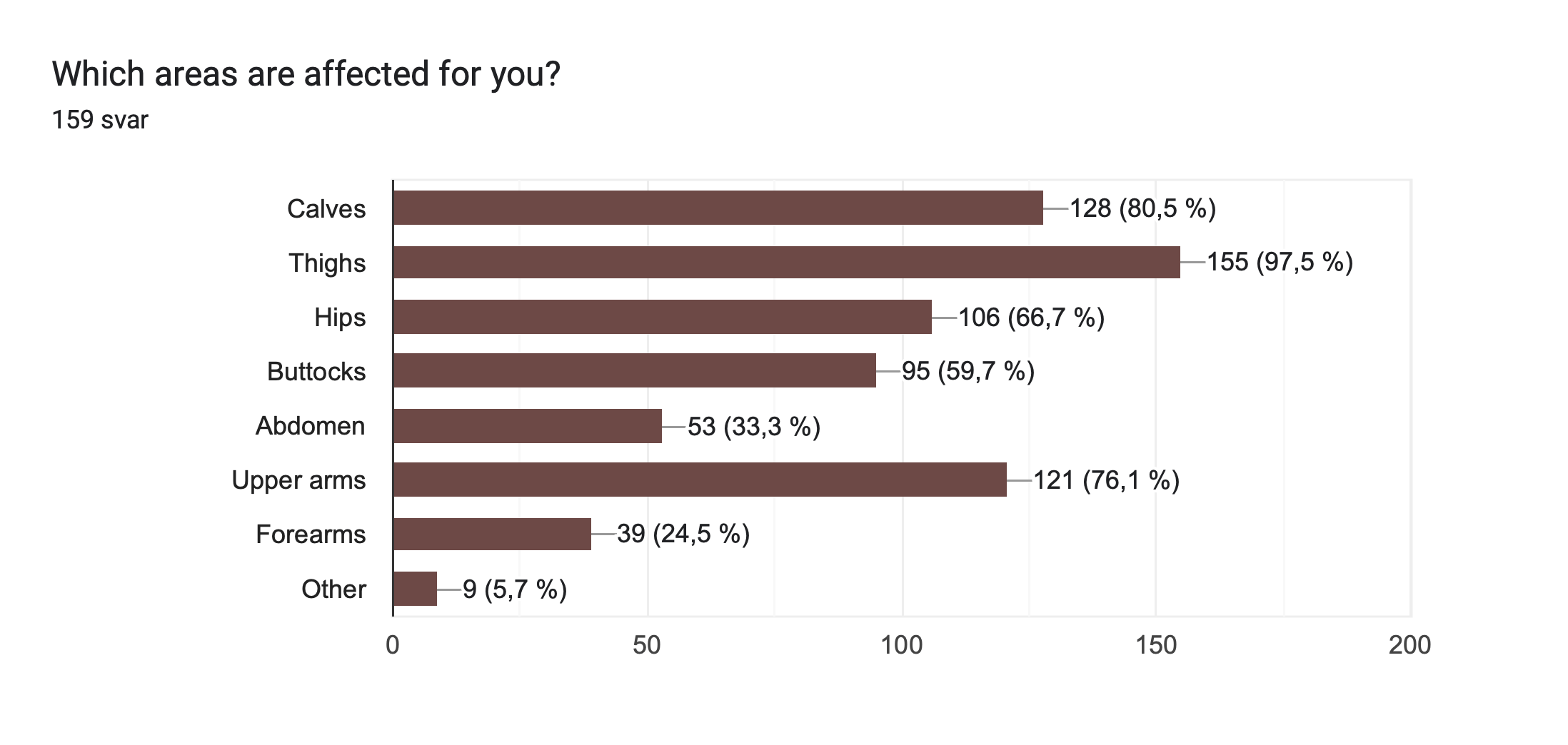
This chart shows which body areas respondents associate with lipedema, based on 159 answers. Nearly everyone reports involvement in the thighs, 97.5 percent. From there, the distribution spreads across the lower body and arms. Calves are affected for 80.5 percent, and upper arms for 76.1 percent. Hips are reported by 66.7 percent and buttocks by 59.7 percent.
Fewer people report areas that are sometimes debated or harder to interpret. One in three include the abdomen, 33.3 percent, and about a quarter report forearms, 24.5 percent. A small group selected other areas, 5.7 percent. Overall, the pattern fits the picture many recognize, lipedema most commonly centers on thighs and lower body, with a substantial share also experiencing symptoms in the upper arms.
Question 4
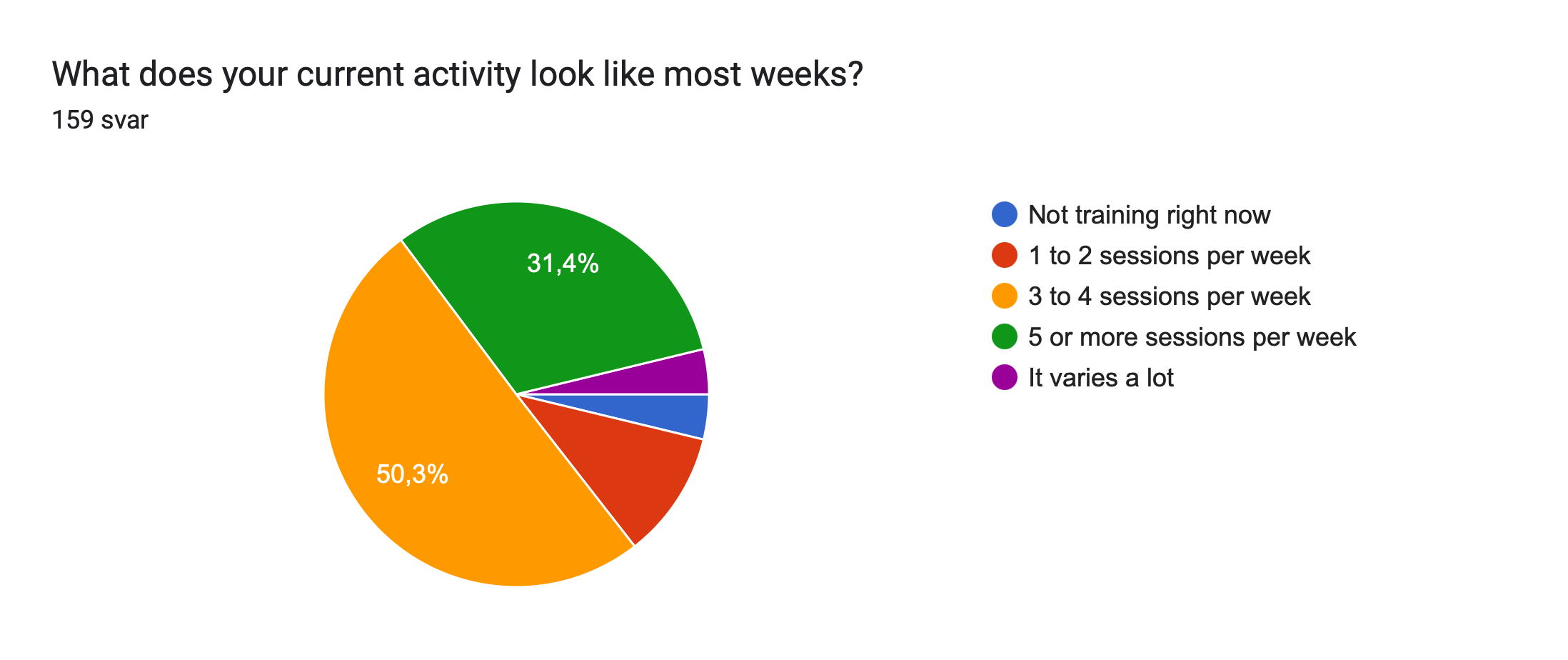
This chart describes what weekly activity looks like for 159 respondents. The largest group, 50.3 percent, reports training three to four times per week. Another 31.4 percent train five or more times per week. Together, that suggests many are staying consistently active.
The remaining responses are split between lower frequency activity, not training right now, and weeks that vary a lot. That mix makes sense in a condition where pain, fatigue, flare ups, time, and access to the right type of movement can shift from week to week.

Question 5
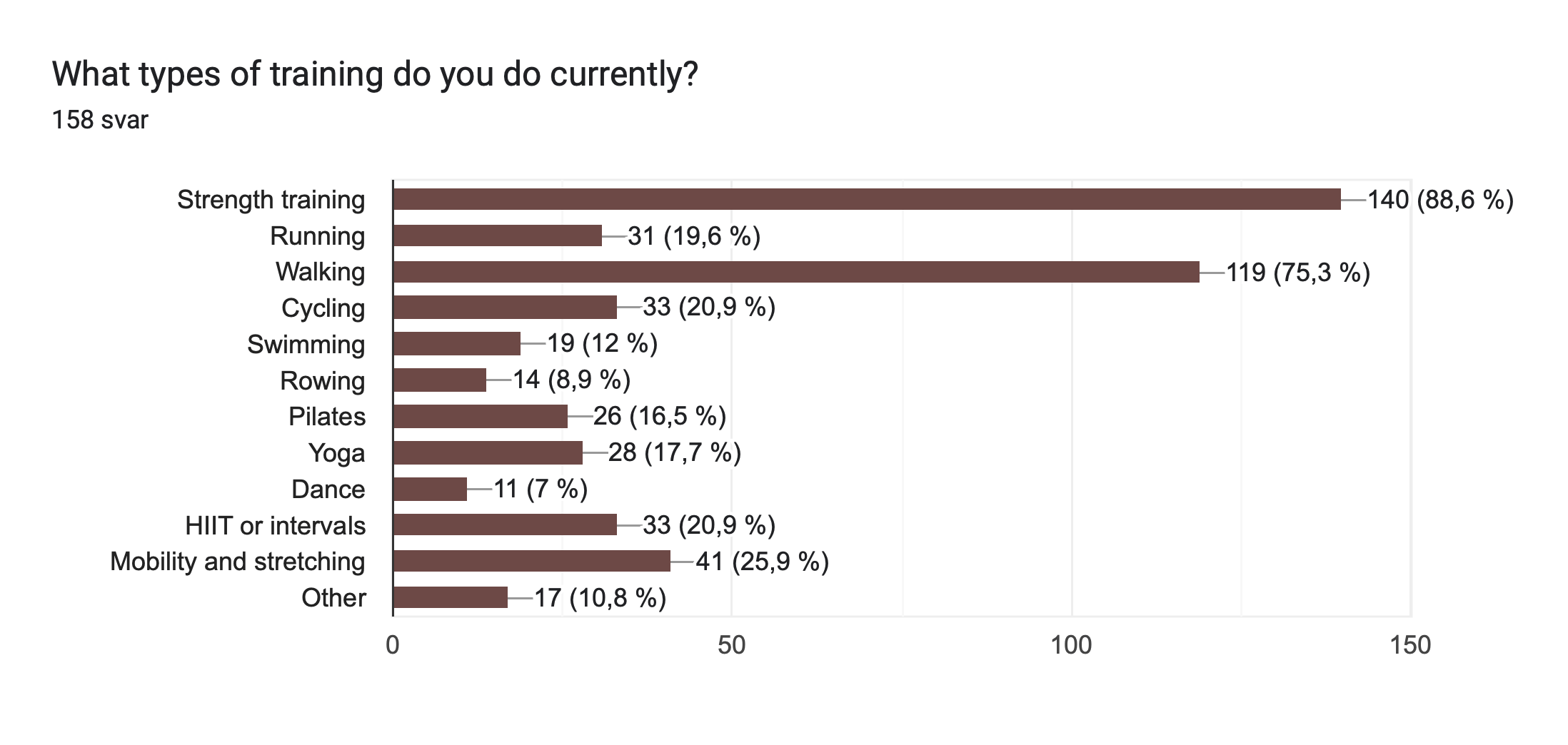
This chart shows the types of training 158 respondents currently do. Strength training is the clear front runner. 88.6 percent report doing it, followed by walking at 75.3 percent. In other words, most people are leaning on two practical pillars that many can adapt to pain levels, time, and energy.
After that, the picture becomes more mixed. Around a quarter include mobility and stretching, 25.9 percent. Smaller groups report cycling and HIIT or intervals, both at 20.9 percent, and running at 19.6 percent. Yoga, Pilates, swimming, and rowing each sit in the 9 to 18 percent range, while dance is reported by 7 percent. A small share chose other types of training, 10.8 percent.
Overall, it looks like many are building routines around movement they can scale up or down, rather than relying on one single format.
Question 6
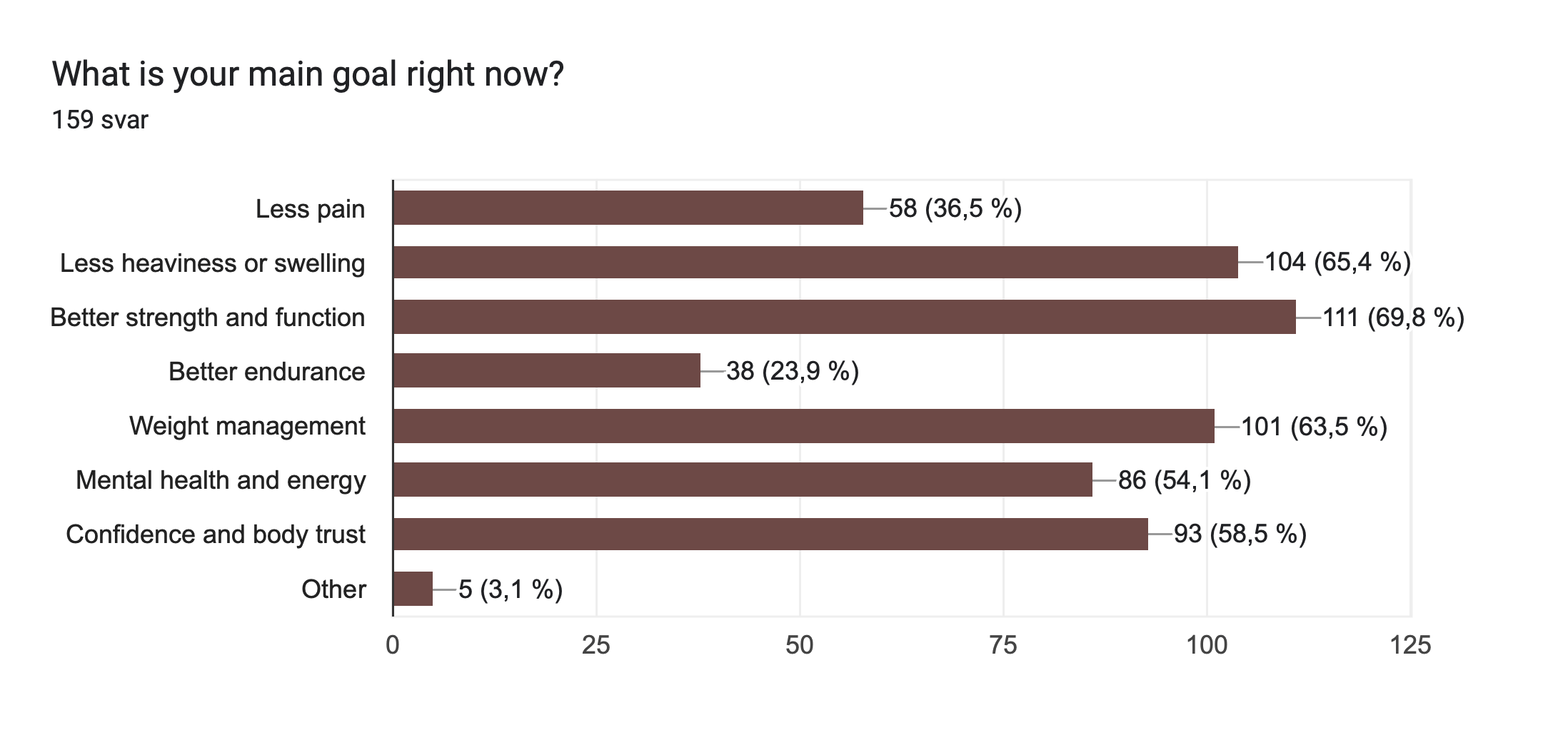
This chart shows what respondents say their main goal is right now, based on 159 answers. The strongest theme is function. Nearly 70 percent chose better strength and function. Close behind are goals that reflect day to day symptom burden. 65.4 percent want less heaviness or swelling, and 36.5 percent want less pain.
Weight management is also a major goal, reported by 63.5 percent. But it does not stand alone. Many are aiming for outcomes that are just as practical and lived, like confidence and body trust, 58.5 percent, and mental health and energy, 54.1 percent. Better endurance is mentioned by 23.9 percent, and only a small share selected other goals.
Overall, the pattern reads less like a single goal and more like a set of priorities that often sit together. People want to move better, feel lighter, and have more capacity for normal life.
Question 7
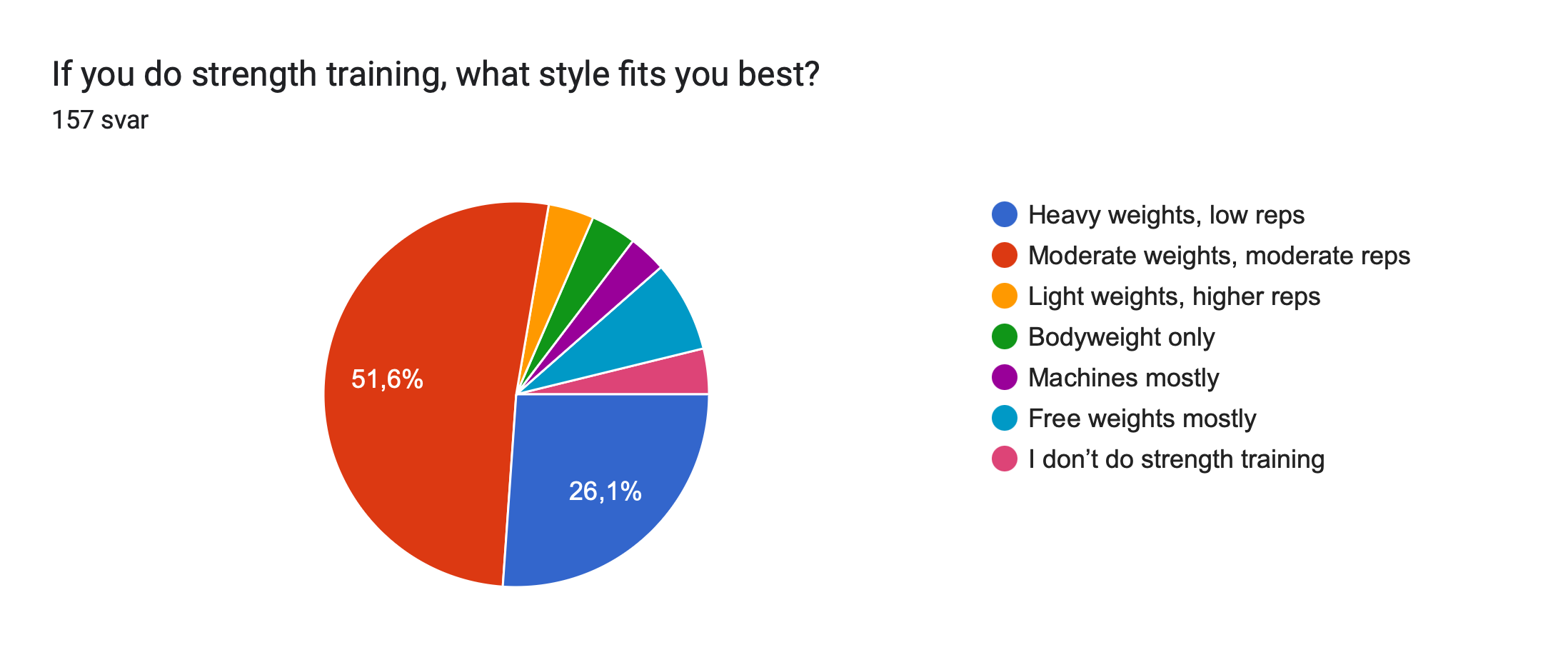
This chart shows how 157 respondents describe their preferred style of strength training. Most people, 51.6 percent, choose moderate weights and moderate repetitions. Another 26.1 percent prefer heavy weights with lower reps. Together, that covers more than three quarters of everyone who strength trains and suggests many are working in a balanced, progressive range rather than at either extreme.
Smaller groups lean toward other styles. Light weights with higher reps account for a few percent, while bodyweight, machines, and free weights each gather single-digit shares. A small group, shown in pink, say they don’t do strength training at all.
Overall, the picture fits with what many describe in practice—training with enough load to build capacity, but still keeping it manageable for a body that needs to move carefully and recover well.
Question 8
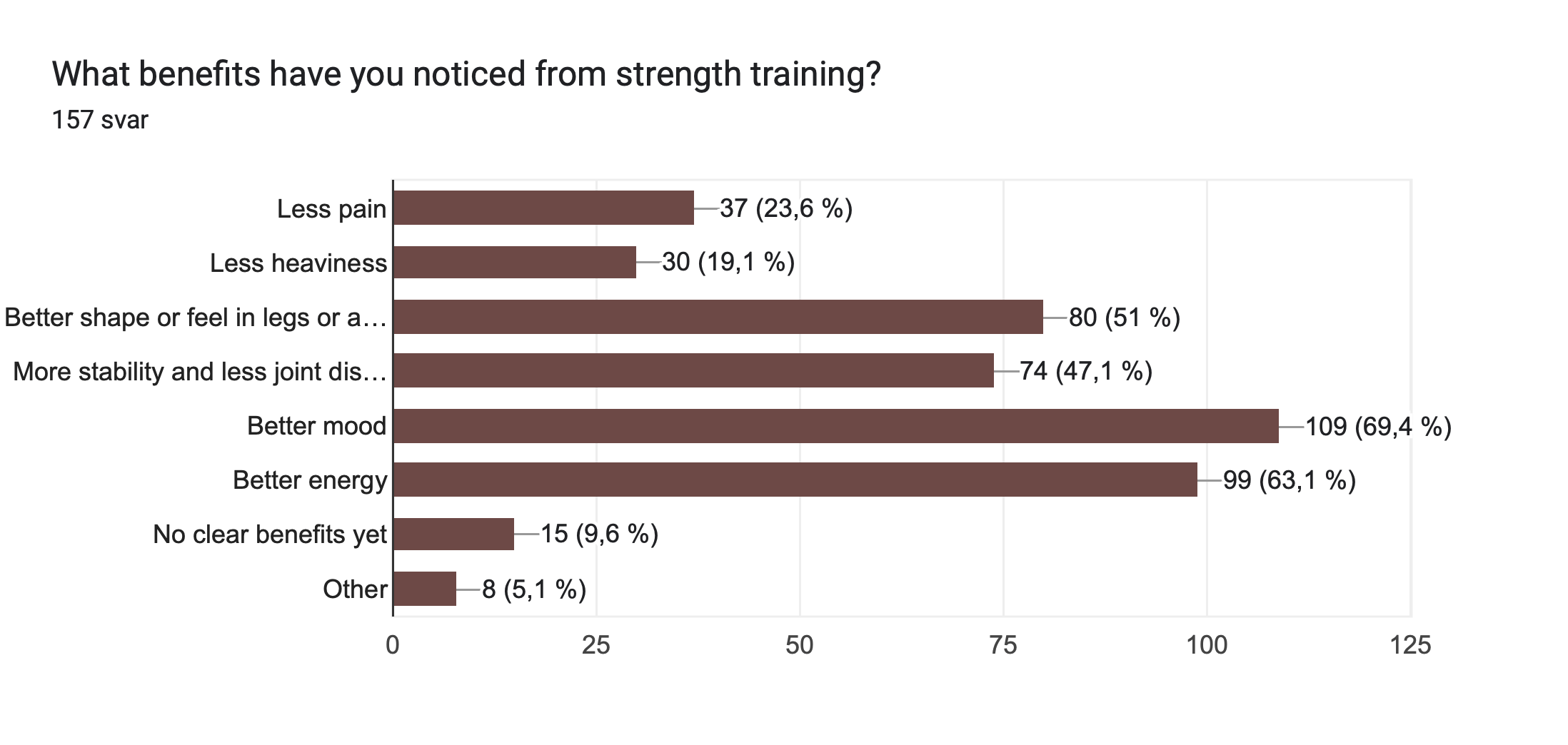
This chart captures what 157 respondents say they have noticed from strength training. The most common benefits are not primarily about symptoms in the legs. They are about how people function and feel day to day. Better mood is the top response at 69.4 percent, followed closely by better energy at 63.1 percent.
About half report physical changes they can sense in their body and movement. 51 percent notice better shape or feel in the legs or arms, and 47.1 percent report more stability and less joint discomfort. Fewer respondents report direct symptom relief. 23.6 percent notice less pain and 19.1 percent notice less heaviness.
A small group, 9.6 percent, say they have not noticed clear benefits yet. Taken together, the pattern suggests that for many, strength training shows up first as improved capacity and resilience, with symptom changes being more variable.
Question 9
“What is the hardest part about strength training with lipedema?”
Across 141 answers, two themes come up again and again. The first is heaviness, pain, swelling, and recovery. Many describe legs and arms that feel heavy before they even start, joints that limit exercise choices, and soreness or inflammation that can last for days if they push too hard. A lot of people are trying to find a narrow middle ground where they can train hard enough to get stronger, but not so hard that they trigger a flare.
The second theme is that effort does not reliably translate into visible change. People talk about getting stronger and still not looking “toned,” especially in the legs and arms. Some describe the frustration of watching the rest of their body respond while the affected areas stay the same, or even look bigger. That gap between what the body can do and what the mirror shows seems to be one of the most draining parts mentally. Mixed into this are practical barriers that matter in real life. Energy after work, gym clothes that fit, discomfort in machines, bruising from pressure points, and simply not feeling comfortable training in a gym setting.
Question 10
“Are there any exercises you avoid or modify because of lipedema?”
Across 137 answers, the most common pattern is not a long list of forbidden movements. It is a steady drift away from high impact and high intensity when symptoms push back. Running is the clearest example. Many say they avoid it completely because of joint pain, heaviness, swelling, or simply how it feels in the body. Others still run, but describe it as slower, more demanding, and something that requires more recovery than it “should.”
The second cluster is lower body strength work that loads the knees and hips hard. Squats, split squats, lunges, and high rep leg work come up repeatedly, often linked to knee pain, limited range of motion, or delayed swelling and inflammation. Several people describe swapping movements rather than quitting strength training. Leg press instead of squats, less depth, less weight, fewer reps, longer rest, or fewer heavy sessions per week.
A third, smaller theme is about fit and pressure. Machines that do not accommodate body shape, pads that dig into sensitive tissue, exercises that require kneeling or side lying on painful nodules, and bands that create pressure pain all lead to modifications. A few mention upper body limits because of arm size or disproportionate lower body weight making planks or pull ups unrealistic.
What is interesting is the split in confidence. Some answer “no” and keep doing what they love, adjusting day by day. Others say “most,” because the boundary between training and flare is thin. The overall picture is practical. People are not avoiding movement. They are trying to keep moving in ways that do not come with a multi day cost.
Question 11
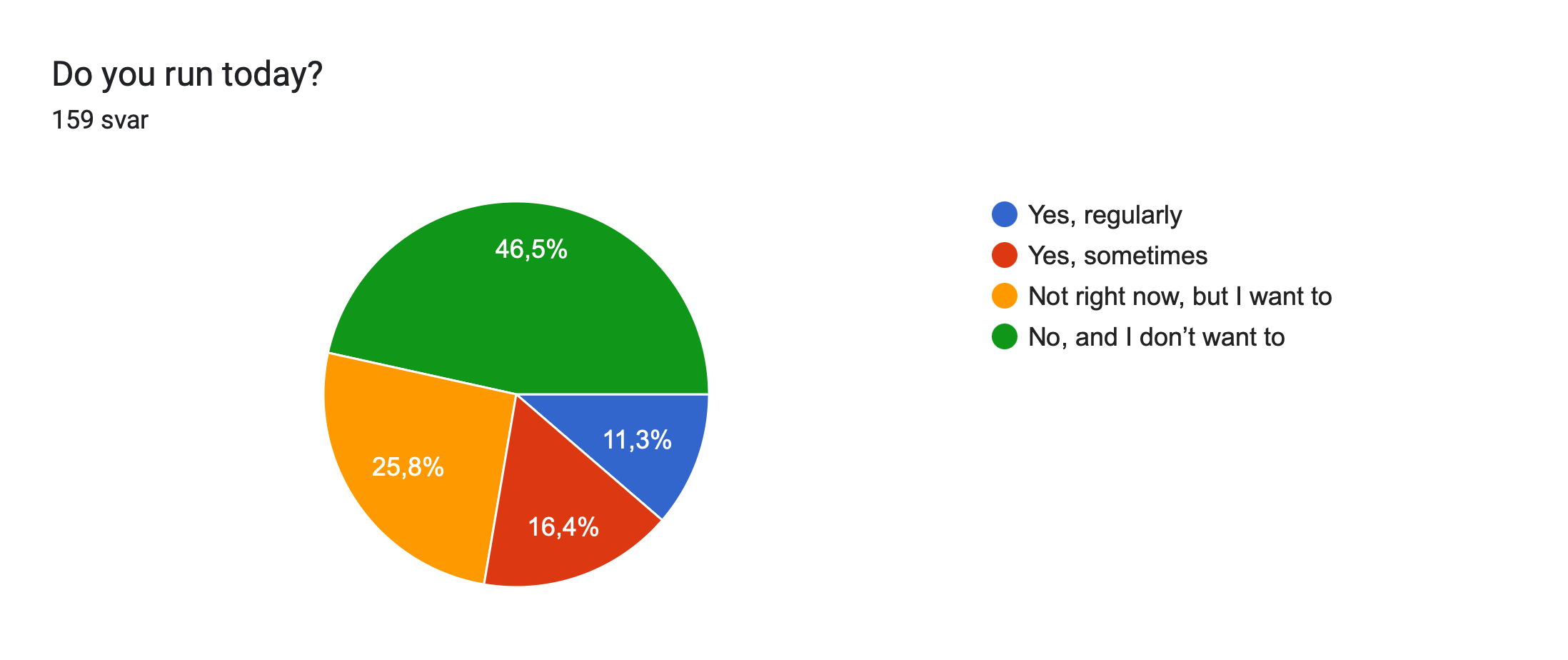
This chart gives a clear snapshot of where running sits in this group, based on 159 responses. A relatively small share run regularly, 11.3 percent, and another 16.4 percent run sometimes. So around one in four still include running in some form.
What stands out is that most do not run right now. The largest segment, 46.5 percent, say they do not run and do not want to. Another 25.8 percent say they are not running at the moment, but they would like to. That split matters. For many, running is not just a fitness choice. It is tied to symptoms, recovery, joint load, and what feels realistic in a body that can react strongly to impact. For some it becomes something they leave behind. For others it stays as a goal, but with a lot of negotiation around timing and capacity.
Question 12
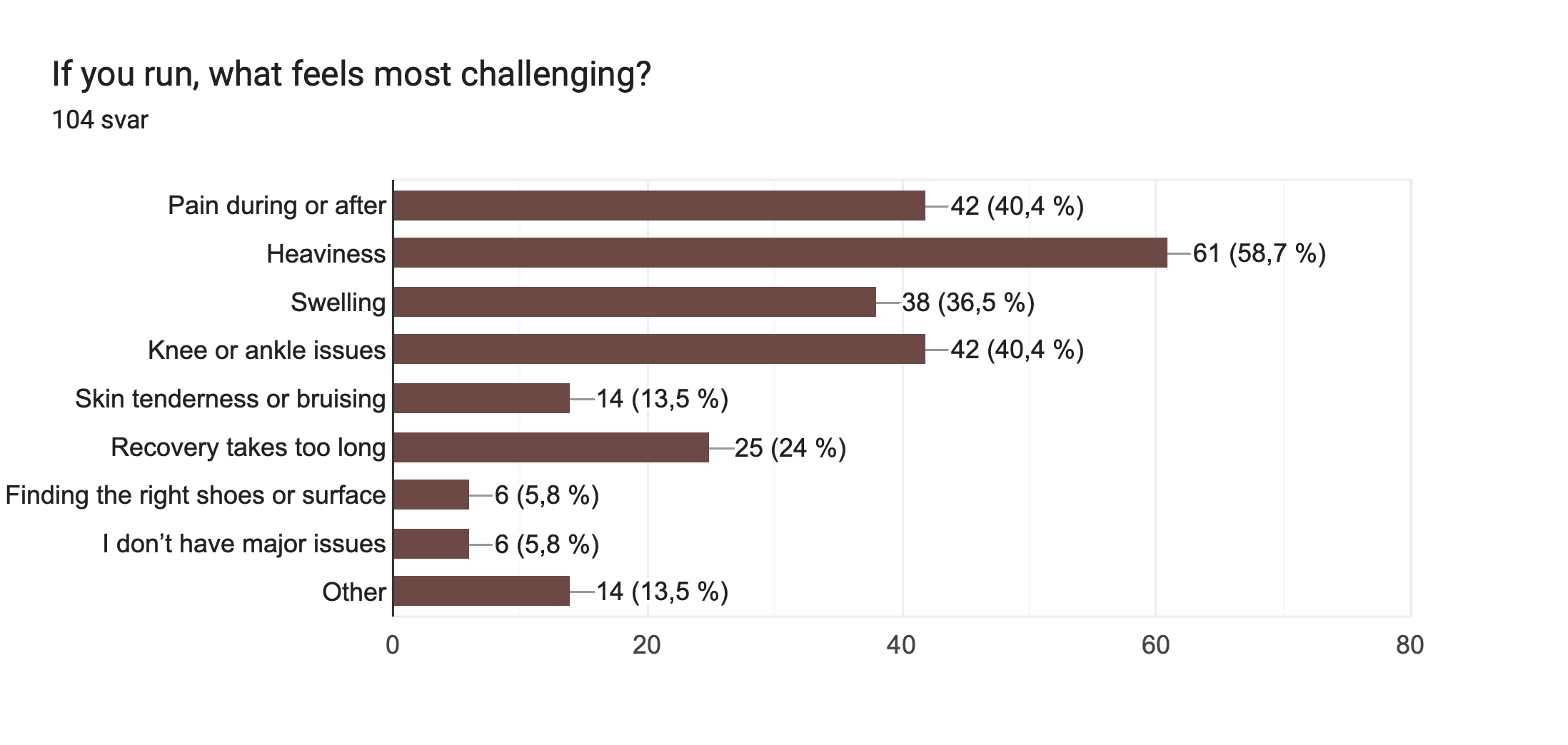
This chart shows what feels most challenging about running for the 104 respondents who answered this follow up question. The most common issue is heaviness. Nearly six in ten, 58.7 percent, chose that option. It captures something many describe in plain terms. Running is not only about fitness. It is about moving a body that can feel weighted down from the start.
After heaviness, the next challenges cluster around pain, joints, and swelling. Pain during or after running is reported by 40.4 percent, and the same share report knee or ankle issues. Swelling is close behind at 36.5 percent. Recovery taking too long is reported by 24 percent, which helps explain why even people who can run may do it less often than they want.
Skin tenderness or bruising is less common at 13.5 percent, as is the “other” category at 13.5 percent. Only 5.8 percent say they do not have major issues. Overall, the pattern is consistent. For most, the barrier is not motivation. It is the physical cost during and after the run.
Question 13
“What helps you run more comfortably, if anything?”
Across 76 answers, the most consistent message is simple. If running works at all, it usually works because people reduce impact, add support, and keep the dose small. Compression shows up more than anything else. Many mention compression tights or socks, sometimes wrapping, and some add knee braces or other support. The point is not performance. It is feeling held together enough that the run does not turn into days of heaviness and swelling.
Footwear and surface come next. People mention cushioned shoes, orthotics, and choosing treadmills, trails, or softer tracks instead of hard pavement. A few describe specific tweaks that make a difference, like a slight incline, slower pace, or interval style running instead of steady jogging. In other words, they are building friction into the plan on purpose, so the body has a chance to tolerate it.
Recovery strategies also matter. Some mention compression boots, elevating the legs, foam rolling, hydration, and spacing runs out, often limiting running to once a week or keeping it very short. Several say that even with all of this, longer runs still carry a cost.
And then there is the other honest thread in the answers. Many say nothing helps, or they have not found a way yet, or they do not run anymore. A few describe that changes in body weight, strength, fitness, or inflammation management made running more possible, but it is not presented as a quick fix. Overall, the tone is practical. Running is not framed as a moral goal. It is one option among many, and for a lot of people, the best support is knowing how to modify it or when to leave it out.
Question 14
“If you stopped running, what was the main reason?”
Across 96 answers, the reasons cluster into a few clear categories, and they often overlap. The most common story is heavy legs paired with pain, especially in knees, ankles, calves, and feet. People describe running as pounding, jarring, or simply too hard to sustain when the legs already feel loaded. For some, it is not just discomfort. It is swelling and inflammation that can take days, or even a week, to settle.
Injuries are the other major driver. Several mention plantar fasciitis, Achilles problems, ankle fractures, stress fractures, shin splints, back issues, hip pain or replacement, and pelvic floor or abdominal surgery that changed what felt safe. A few explicitly say their reason was not lipedema, but the pattern is still the same. Impact plus a vulnerable joint or tissue eventually becomes too costly.
There is also a quieter, but important, mental side to the answers. Some stopped because it became mentally draining to work hard and see little progress, whether that was speed, endurance, or visible change. Others simply prefer other forms of movement and do not feel that running gives them enough back for what it takes.
A small group have not stopped, or do not consider themselves runners in the first place. But overall, the responses frame running as a trade off. Many are not avoiding challenge. They are choosing the option that leaves them with more capacity for the rest of life the next day.
Question 15
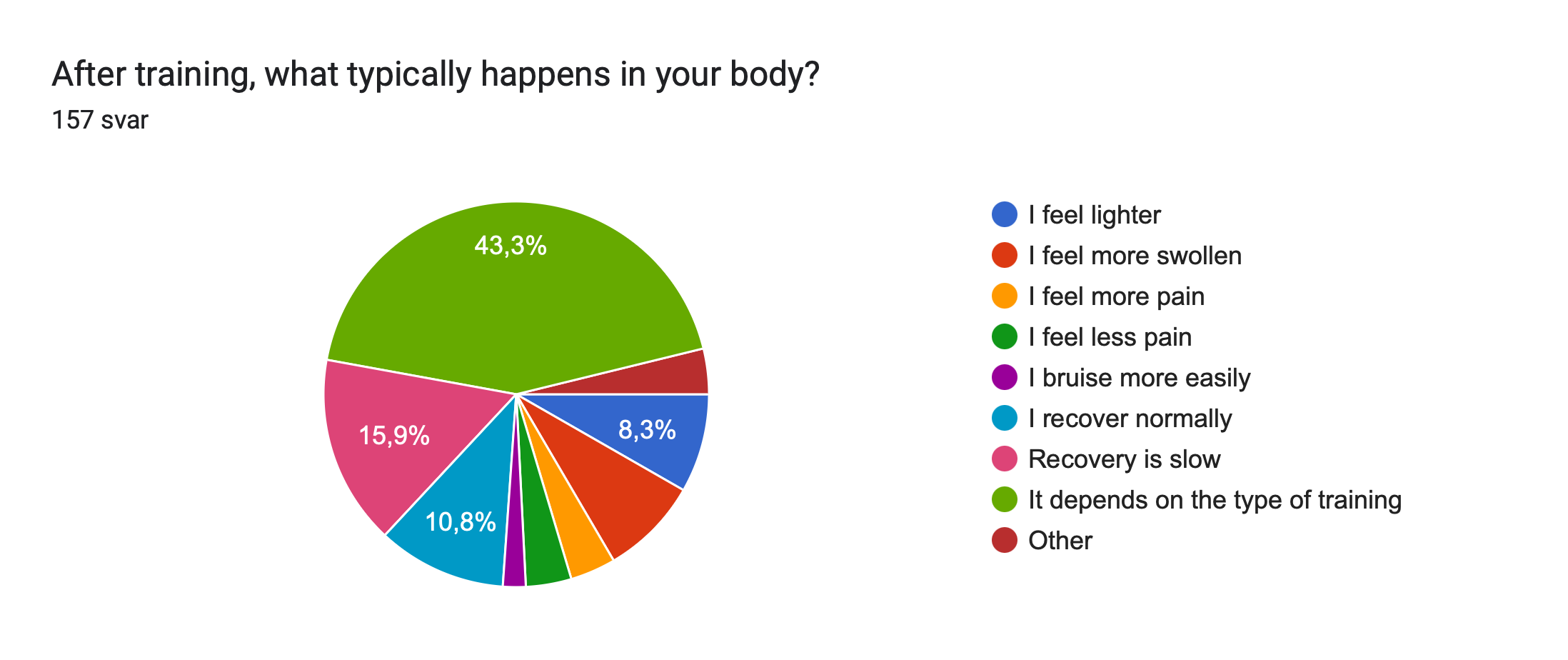
This chart shows how 157 respondents typically feel after training, and the main message is variability. The largest share, 43.3 percent, say the outcome depends on the type of training. That reflects a reality many live with. The same person can feel better after one session and worse after another, even when the effort looks similar on paper.
Recovery also stands out. 15.9 percent say recovery is slow, while 10.8 percent say they recover normally. A smaller group, 8.3 percent, report feeling lighter after training. The remaining responses are spread across feeling more swollen, more pain, less pain, bruising more easily, and other experiences. Overall, it reads like people are not just chasing a workout, they are managing the after effects.
Question 16
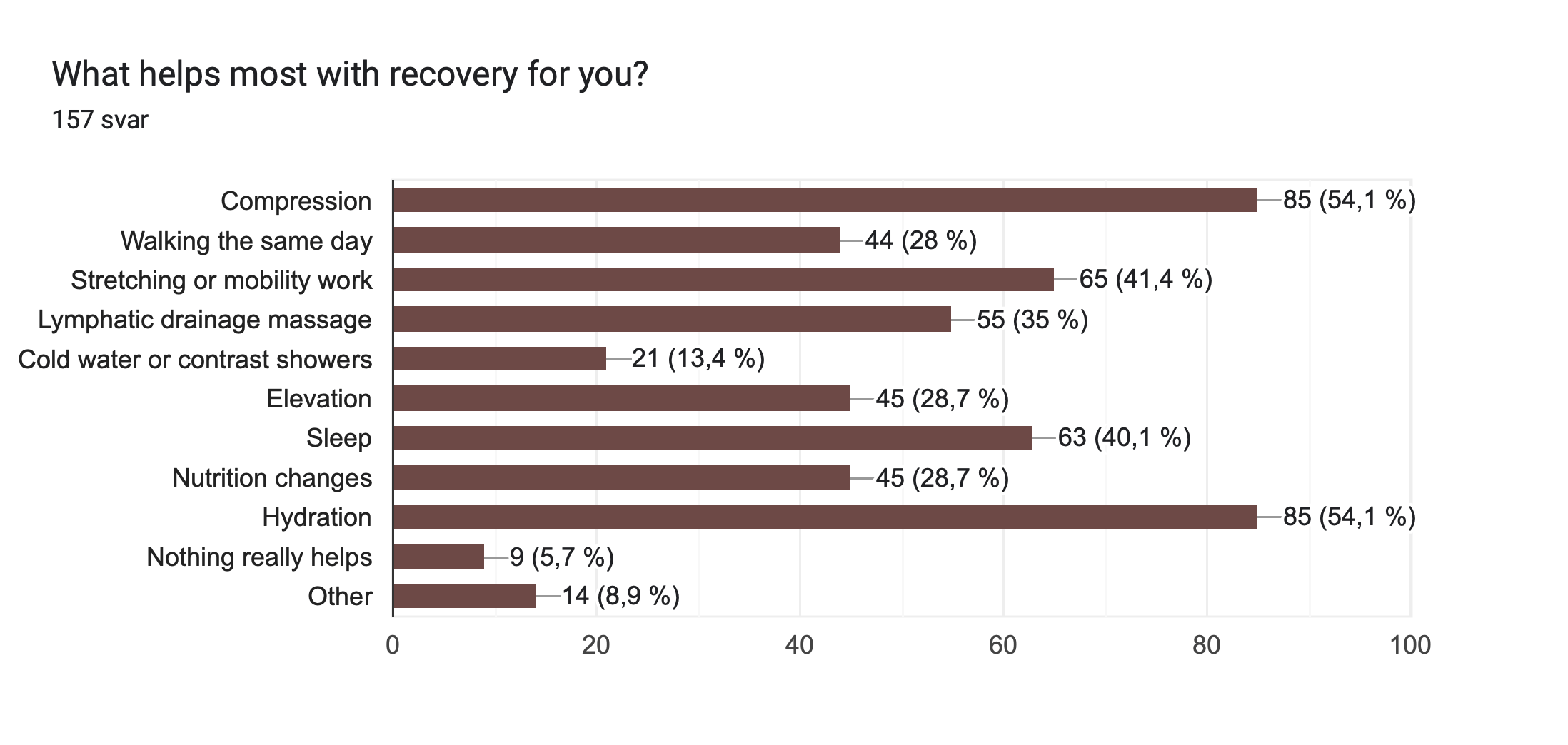
This chart is useful because it shifts the focus from training to what happens after. Based on 157 answers, the two most common recovery tools are also the simplest. Hydration and compression are tied at the top, both chosen by 54.1 percent. That says something about what recovery often means with lipedema. It is not only rest. It is support and fluid management.
After that, several strategies cluster in the middle. Stretching or mobility work is reported by 41.4 percent, and sleep by 40.1 percent. Lymphatic drainage massage is chosen by 35 percent. Elevation and nutrition changes are both at 28.7 percent, and walking the same day is close at 28 percent. Cold water or contrast showers are less common at 13.4 percent.
A small group, 5.7 percent, say nothing really helps, and 8.9 percent chose other approaches. Overall, the pattern feels practical. Most people are not looking for one magic recovery hack. They are building a recovery routine from small, repeatable actions that make the next day more manageable.
Question 17
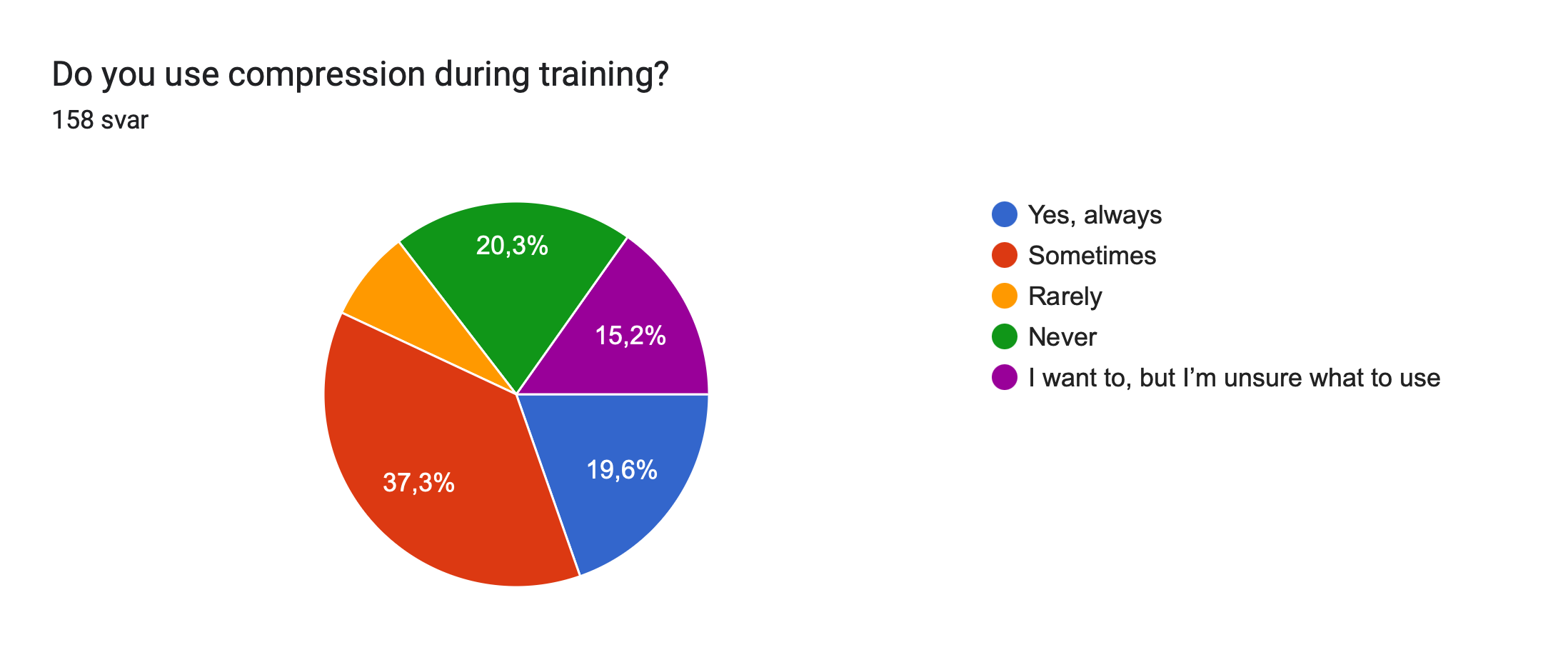
This chart shows how often people use compression during training, based on 158 responses. The most common answer is “sometimes,” at 37.3 percent. Another 19.6 percent say they always use compression. So for many, compression is part of training, but not necessarily every session.
What stands out is the size of the group that is still not fully supported by their setup. 15.2 percent say they want to use compression but are unsure what to use. And 20.3 percent never use compression during training. A smaller share use it rarely.
Taken together, this looks less like a debate about whether compression matters, and more like a practical question of fit, comfort, cost, and knowing what is appropriate for different kinds of movement.
Question 18
“If you use compression, what type works best?”
Across 96 answers, there is no single winning brand or setup. What stands out instead is how people solve the same problem in different ways. Many choose sports compression they can actually train in. 2XU is mentioned repeatedly, along with other “firm” athletic tights that reduce movement and give a sense of support. Several describe reaching for the tightest training leggings they own, even if they are not medical grade, simply because it feels more stable.
A second group relies on medical grade compression, often flat knit and custom made. People mention class 2, 20 to 30 mmHg, and in some cases higher, with full leg options and combinations like thigh highs plus leggings. A few also mention arm compression, bolero style sleeves, or full arm and leg coverage, which fits with how many report upper arm involvement as well.
The third theme is that fit and comfort decide everything. Some cannot tolerate compression because of sensory issues or discomfort. Others want to use it but feel unsure what to choose, or they are still experimenting. There are also practical trade offs. Some use compression mainly after training rather than during, some use knee sleeves only, and a few mention devices like leg pumps or pneumatic compression as part of their recovery routine.
Overall, these answers read like a real world map of trial and error. People are trying to balance support with breathability, cost, appearance, and the simple fact that what works for a run may not work for a strength session.
Question 19
“What is one training tip you wish you had known earlier?”
Across 113 answers, the same lesson shows up in different words. Progress with lipedema tends to come from doing less extreme, more often. People talk about consistency, low impact, and learning to train in a way that does not trigger a flare. Several describe the pattern of building up, feeling better, pushing harder, and then getting set back by pain, swelling, or inflammation. The advice they wish they had internalised earlier is to go slower, leave something in the tank, and plan recovery as part of the program.
Compression is another repeating theme. Many wish they had started using it earlier or used it more consistently, especially for swelling and support. Alongside that are simple basics that make a noticeable difference, like hydration, proper shoes, enough rest days, and paying attention to form.
Strength training is the area where answers split, but the underlying point is the same. Some wish they had not been afraid of heavy lifting and had focused less on punishing cardio. Others learned that lifting too heavy or training too hard can backfire and that moderate loads are more sustainable. What they have in common is that strength work is seen as central, but it needs the right dose for the individual body.
A final thread is emotional, but still practical. People want permission to modify, to stop chasing the “hardest” workout, and to measure success by function, mood, and capacity, not only by visible change. Several say the tip they wish they had known was simply what lipedema is, because understanding the condition changes how you interpret your body’s feedback and how you build a routine you can actually live with.
Question 20
“What kind of training advice feels unhelpful or unrealistic for lipedema?”
Across 113 answers, the clearest frustration is advice that treats lipedema like a standard fitness problem with standard promises. “Eat less, move more,” “just do more cardio,” and anything that implies training will make legs and arms visibly smaller comes up again and again. People are not rejecting effort. They are rejecting the idea that effort automatically produces the same visual outcome for everyone. A lot of the most disliked advice is built on aesthetics and speed. Tone your legs. Get definition. See big changes in twelve weeks. Many respondents describe that as a setup for disappointment.
The second category is intensity culture. “No pain, no gain,” “push harder every session,” marathon goals, hill running, HIIT as the default, or heavy lifting framed as a cure. Several answers point to the same lived reality. More intensity can mean more swelling, more inflammation, and longer recovery. For some, it can make training feel like a cycle of progress and setback rather than forward movement.
At the same time, people are also tired of rigid rules in the opposite direction. “Only light weights,” “only low impact,” or any one size fits all protocol gets called out. Some respondents lift heavy and feel it helps. Others cannot tolerate it. The unhelpful part is not the suggestion itself. It is the certainty, especially when it is delivered without acknowledging staging, comorbidities, hypermobility, pelvic floor issues, injuries, or how symptoms fluctuate day to day.
A final theme is practicality. Some “recovery stacks” sound good on paper but feel impossible to fit into real life. And advice that relies on comparison, “if I can do it, so can you,” lands badly because the starting points are not the same.
Overall, the answers point to a simple need. Advice that respects variability, focuses on function, and makes room for pacing and recovery feels realistic. Advice that promises a fast visual payoff, or demands constant escalation, tends to feel like it was written for someone else.
Question 21
“If you could describe your ‘best training week’ what does it look like?”
Across 135 answers, “best” rarely means extreme. It usually means a week that is steady, varied, and followed by a body that still feels like itself. Many describe some form of movement almost every day, but not the same intensity every day. Walking shows up everywhere, often as a baseline. It is the anchor session, the circulation session, the recovery session, and sometimes the only thing that feels possible.
Strength training is the other central pillar. A common pattern is two to four strength sessions per week, often split into upper and lower body or full body days, with at least one or two leg focused sessions. A smaller but notable group enjoy heavier lifting and progressive overload, but even there, the “best week” is framed as one where recovery keeps up. Several mention scaling back from five or six lifting days to three because they were not recovering.
Cardio tends to be low impact in many of the answers. Incline walking, cycling, swimming, rowing, elliptical, and pool sessions come up repeatedly. Some do run, sometimes two sessions a week, but it is usually described with boundaries. Shorter distances, slower pace, softer surfaces, or intervals rather than long steady runs.
Mobility and recovery are part of the week for many, not an optional extra. Yoga, Pilates, stretching, vibration plate, rebounding, sauna or cold water, and lymph drainage are woven in as support. Nutrition, hydration, and sleep also show up as part of what makes the week “work.” Quite a few describe their best week as one where they can hit their protein, stay hydrated, and feel recovered enough to keep showing up.
The overall impression is practical. The best weeks are not defined by perfection or by the hardest workouts. They are defined by rhythm. Strength to build capacity, low impact cardio for circulation and conditioning, walking as the daily thread, and enough recovery that the next session is possible.
Question 22
Out of 156 respondents, 29 (18.6%) say they have had lipedema reducing surgery, while 127 (81.4%) have not. That matters for how we read the rest of the training answers. Most of this dataset reflects life before surgery, where people are trying to manage symptoms, recovery, and progression with conservative tools and day to day adjustments. At the same time, a meaningful minority have been through surgery, which likely changes what feels possible, what recovery looks like, and how training feedback is interpreted.
Question 23
“Is there anything you want researchers, clinicians, or coaches to understand about training with lipedema?”
Across 111 answers, people are not asking for motivation. They are asking to be believed, and to have training guidance that matches what their bodies actually do. The recurring physical themes are heaviness, pain, swelling, bruising, rapid fatigue, lactic acid, and recovery that can take days. Several describe how “normal” training rules break down. A session that would be manageable for someone else can trigger inflammation and set them back, especially when hormones, life stage, or comorbidities are in the mix. Hypermobility and EDS are mentioned directly, and joint vulnerability comes up repeatedly.
The second theme is the mismatch between effort and visible results. Many describe working hard, sometimes training for years, building strength, and still looking “soft,” especially in legs and arms. That is not vanity. It becomes a clinical issue when appearance is used as a proxy for progress, and a psychological issue when people feel judged, blamed, or written off as lazy. Several explicitly ask clinicians and coaches to stop measuring success by BMI, the scale, or “toning,” and to track function instead. Strength, mobility, confidence in movement, pain, swelling, and how clothes fit are described as more meaningful outcomes.
There is also a clear call for nuance. People push back against fear based messaging that implies they must avoid anything outside low impact forever, and they also push back against intensity culture that tells them to push harder and harder. The common request is individualisation. The ability to modify day by day, to pace, to build capacity without triggering flares, and to have recovery treated as part of training, not a failure of willpower.
Finally, many answers point to gaps that feel researchable. Better evidence on conservative management, on recovery and lymphatic support, on fascia and inflammation, on which movements tend to aggravate symptoms, and on how performance goals can be pursued safely. Some mention surgery as a turning point for tolerance and recovery, and others mention medication effects on inflammation, with a desire for clinical clarity rather than anecdotes. Underneath all of it is a straightforward message. Lipedema does not remove ambition. It changes the cost of training, and people want professionals to understand that cost and plan around it with them.
If any part of this resonates with you, I would really like to hear from you in the comments. What has training been like in your own lipedema journey, what has helped, and what has not been worth the cost? Your reflections help put these numbers into context, and they also help other readers feel less alone while they are figuring out what works.
Thank you thank you thank you!!!! This is one of the most relatable pieces I have ever read on living/training with this condition. Infact, I have tears in my eyes because it is the first piece that resonates so strongly. I could have written this myself! I have spent near to 40 years trying to find what works for me and I’ve been doing it alone, because clinicians were not interested or willing to believe I was doing all they instructed, but it was not working. So I stopped asking. I stopped asking because their responses were destroying my mental health. To this day I am reluctant to seek support because of past experience This is such important work and I implore medical people to take us seriously, to believe us, to truly listen. Not for me, but for the young ladies who come after me, so that they don’t need to go through the isolation, misunderstanding, misdiagnosis, dismissiveness. Living with this condition and trying to find guidance and support feels truly like trying to find the exit in a maze with a blindfold on. I truly feel the psychological impact this condition has is as devastating as the physical impact it has. It would be amazing to see similar work on the mental anguish many of us live with due to dealing with a medical condition society does not recognize and medical professionals dismiss. Again, thank you for this work.
This is so thorough. Thank you. I am walking 4-6 times a week and want to move to 2 lots of strength work as well add was unsure on light weights more reps or heavy weights less reps, and have realised it doesn't matter. I haven't been to the gym for 2.5 decades because I lost hope. Train hard enough for a less mills body, implied I wasn't training hard enough, I was lazy. I gained muscle but still felt I had fat on top of it - despite diet and doing more cardio - all weight training I felt did was add bulk, especially in arms. I also find the heart rate thing a fob off. Train in zone 2 - well I'm in zone 3 walking up hills and still talking so ??? Now I just walk - whatever. Movement is movement.