

I love salt. It is the one thing on my plate I reach for without thinking. Flaky salt on tomatoes, salt on good bread with butter, salt in the water when I cook. If I have a guilty pleasure with food, this is it..
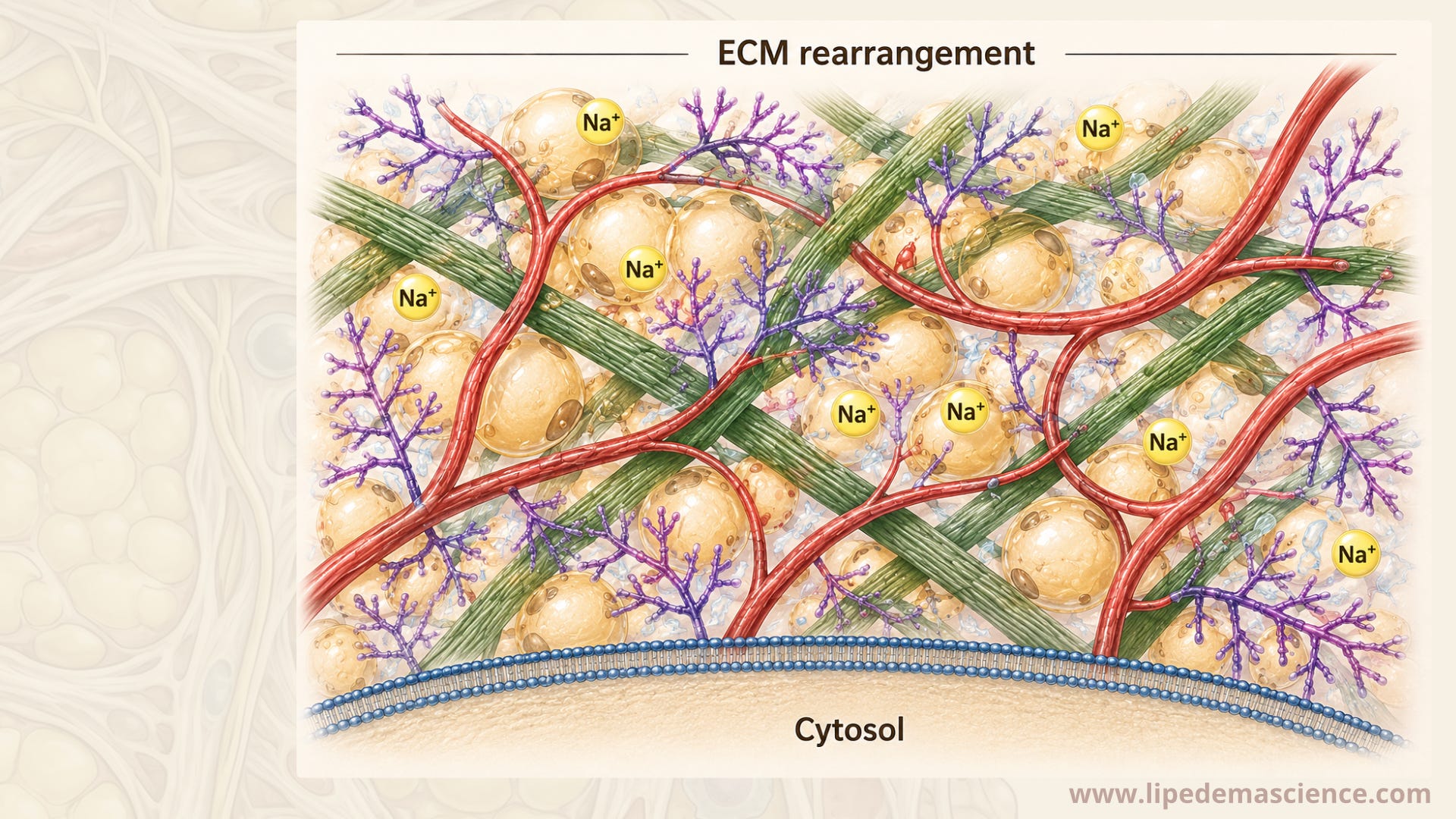
So I want to be honest before I write anything else. Salt is not one of my triggers. When I eat too much of it my legs do not light up with the deep, tender, pressing pain I know from sugar, or from certain hormonal weeks when my body seems to work against itself. I can still swell and feel heavy. That happens to me for many reasons. But the sharp inflammatory reaction, the kind that leaves the tissue sore to the touch, does not come from salt for me.
I could have left it there. My body was not asking me to think about salt. But lipedema has taught me that the quiet things are often the ones worth understanding, and salt turned out to be one of the most interesting quiet things in this disease. What it is built upon reaches straight into the part of lipedema that I have come to believe matters most, which is the tissue around the fat rather than the fat itself.
Where this started for me
The first time salt and lipedema came together in my mind was in a webinar with Dr. Karen Herbst. I watched it years ago now. It must have been not long after my own surgery period ended in late 2022, because I remember watching it in that strange recovery stretch when I was reading and listening to everything about this disease that I could get my hands on.
Herbst said something that reorganised how I thought about my own legs. Lipedema, she explained, is not only a disorder of fat. It is a disorder of the loose connective tissue, the living scaffolding that sits between and around our cells. And that scaffolding, she said, has a particular relationship with salt.
One idea about GAGs
To follow why, you need one idea, and it is not a hard one.
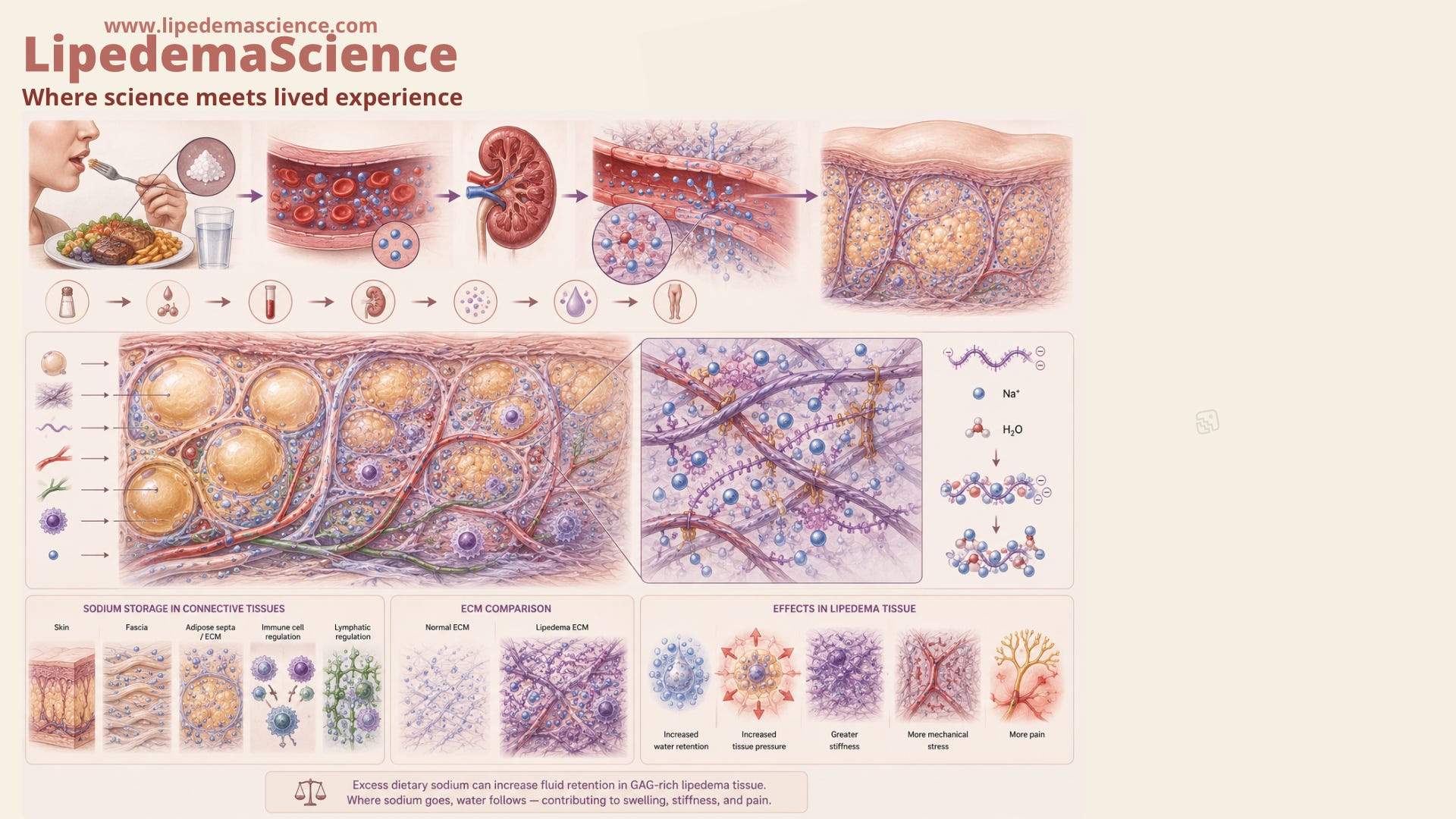
The connective tissue in our bodies is filled with long molecules called glycosaminoglycans. The name is a mouthful, so most people shorten it to GAGs. You can picture them as long sugar chains woven all through the tissue. Two of them matter for this story, hyaluronan and chondroitin sulfate, and the important thing about them is that they carry a strong negative electrical charge along their whole length.
Salt, once it is inside the body, splits into charged pieces. Sodium is the positively charged one. Opposite charges pull toward each other, so sodium is drawn to the negatively charged GAGs and collects around them. And where sodium collects, water tends to be pulled in as well. Connective tissue that is rich in these molecules therefore holds on to more sodium and more water than tissue that is not.
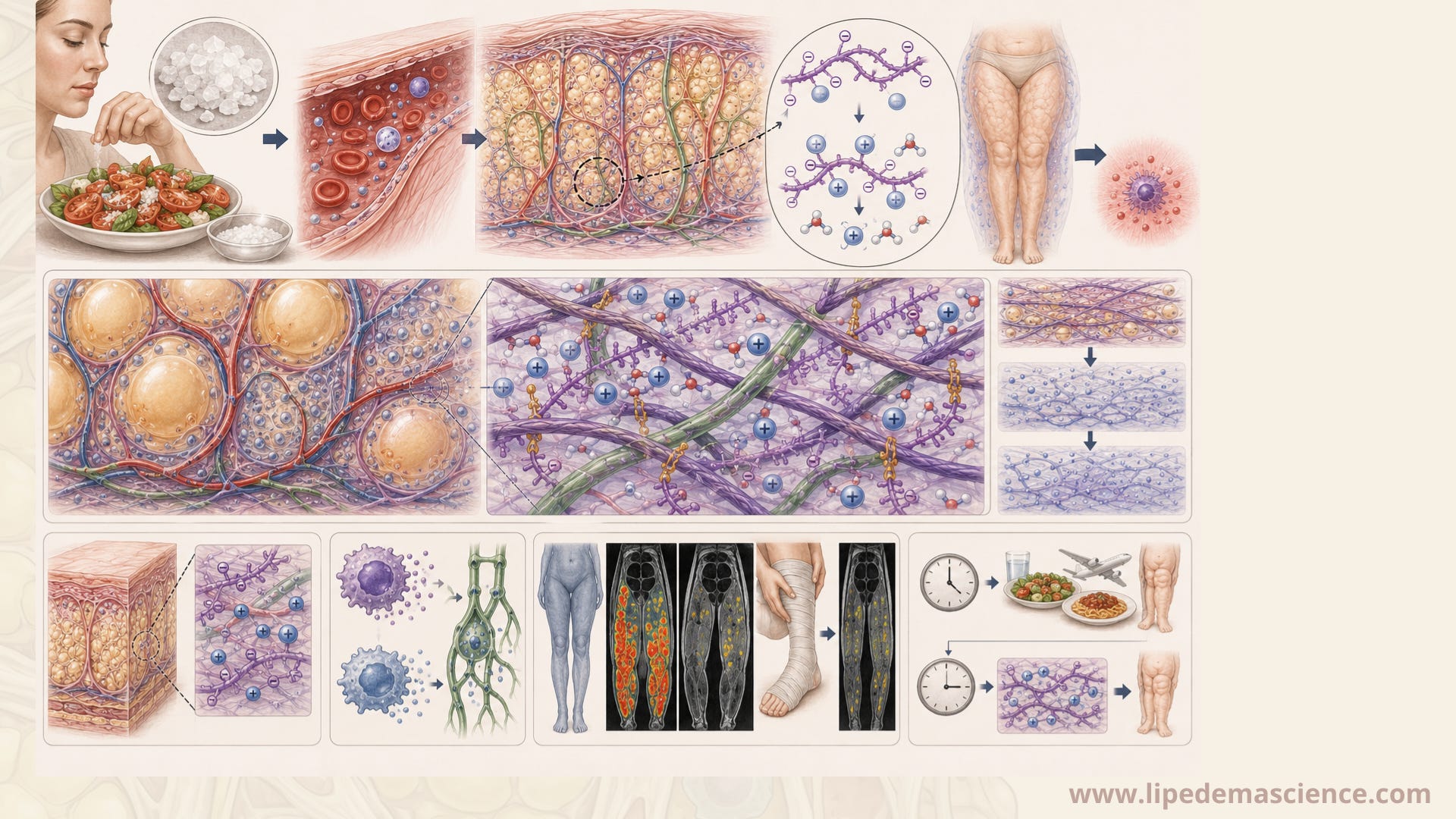
Now bring lipedema into it. The tissue in lipedema is not built like ordinary tissue. Studies describe a remodelled matrix with more of these GAG molecules, more fibrosis, which is a kind of internal scarring, and more fluid held in the spaces between the cells. Put plainly, the lipedema matrix is by its very construction better at holding sodium and water. That was the sentence Herbst planted in my head, and it has stayed there ever since.
The part that surprised me
There is a second piece that makes this stranger and more interesting than I first expected. For a long time medicine taught that salt lives in the blood, and the kidneys deal with whatever is left over. In the last fifteen years or so that picture has changed. We now know that sodium can also be stored inside the connective tissue itself, in the skin and the fascia, held against those same charged GAGs. Some of this stored sodium simply sits there quietly, without dragging along the amount of water we used to assume. Immune cells and the lymphatic system, the drainage network of the body, help manage these stores.
This is why lipedema is such a natural place to ask the question. The three parts of the body most involved in storing and clearing tissue sodium, the connective tissue, the immune cells, and the lymphatic system, are all altered in lipedema. It would be strange if sodium handling turned out to be completely normal in a disease that touches all three at once.
If you’d like full access to the entire LipedemaScience library, consider becoming a member. LipedemaScience is where you’ll find the articles you didn’t even know you were looking for, written by food scientist CarinaW, who was diagnosed with lipedema at a Norwegian hospital in 2012. With a background in human nutrition, food science, and research on human cells, bacterial DNA, and peptides, she translates complex science into practical knowledge for women living with lipedema.
This is not only theory
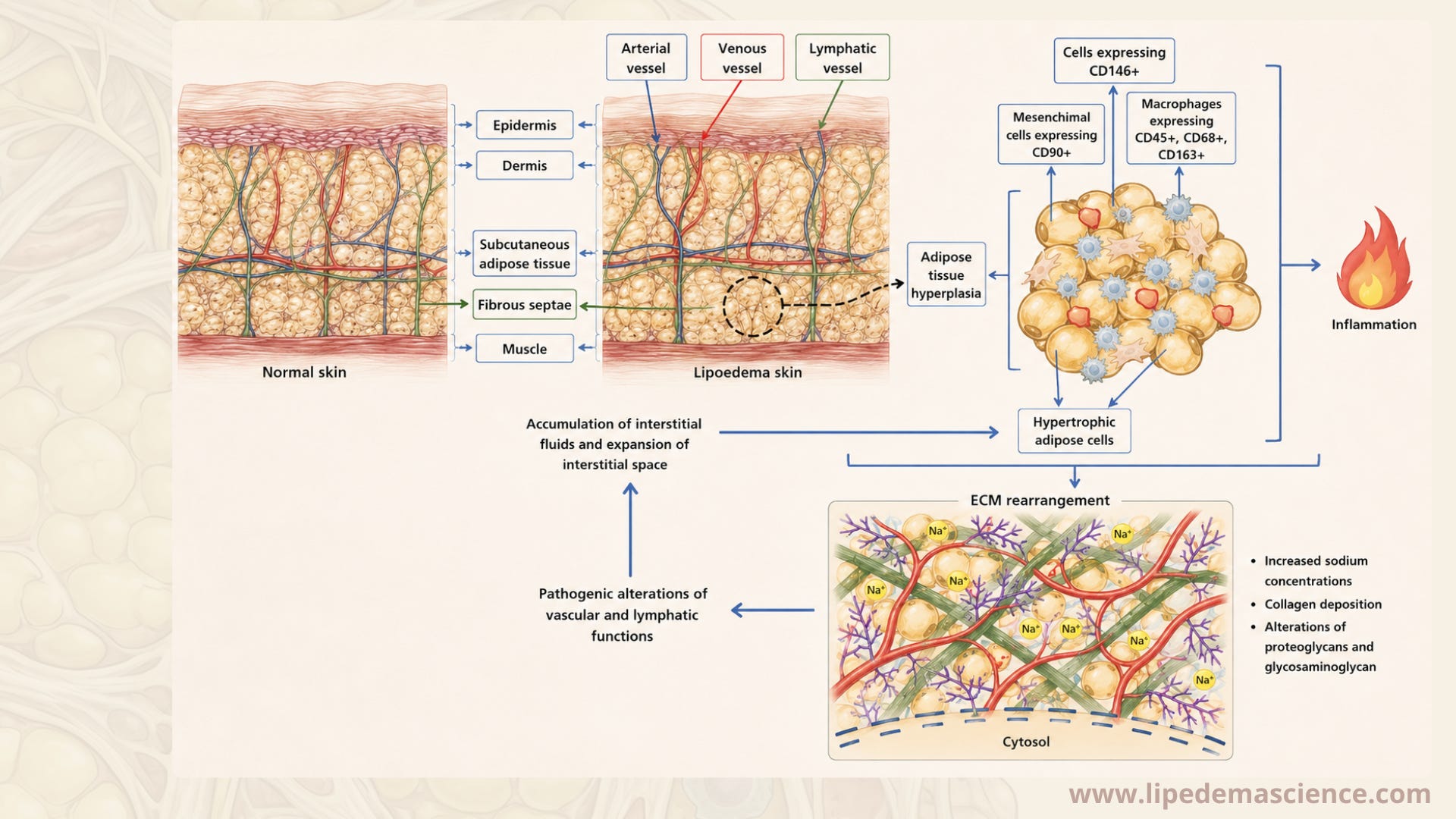
The part I find most convincing is that we can now look, not just reason. Dr. Rachelle Crescenzi and her colleagues built a way to see sodium in living tissue using a special form of MRI. When they scanned women with lipedema, they found more sodium in the tissue of the legs than in women of a similar body size who did not have lipedema. The arms did not show the same difference, which fits the way lipedema settles in the lower body. The extra sodium was present even when there was no loose, visible fluid to point to.
Then they went one step further. In a small study, women with early lipedema were given hands on physical therapy, the manual work and compression that helps move fluid out of a limb. Afterward, the sodium in the tissue had dropped, and the size of that drop tracked with less pain and better quality of life. It was a small, early study, and the authors were careful to say so. But it showed something that matters. The sodium in lipedema tissue is not locked in place forever. It can be moved, and when it moves, people can feel better.
Two different clocks
Here is where I want to slow down, because this is where a lot of confusion lives.
When people talk about salt and swelling, two separate things get folded into one, and they run on very different clocks.
The fast one is the heavy, tight feeling many of us know after a salty restaurant meal or a long flight. It can arrive within hours. That quick swelling is mostly ordinary fluid shifting into the tissue, the same kind of thing that comes with heat, with sitting still too long, and with the premenstrual phase. It is real. It is also not the deep matrix storage.
The slow one is the sodium held against the GAGs over days and weeks. That is the storage system, the one Herbst and Crescenzi are describing, and it does not swing up and down because of a single dinner.
This distinction matters because so many of us quietly blame ourselves for a body that seemed to change overnight. If your legs feel enormous the morning after salty food, that is almost certainly the fast fluid response, not proof that you have permanently packed your tissue full of salt. The two are related, but they are not the same thing, and it helps to stop treating them as one.
What we actually know, and what we do not
I will not tell you something is proven when it is not, so let me be exact.
The biology is real. GAGs bind sodium. The lipedema matrix is remodelled. Imaging shows more sodium in lipedema legs, and shows that it can be reduced. That much stands on solid ground.
What has never been done is the obvious next study. Nobody has taken a group of women with lipedema, carefully changed how much salt they eat, and measured what happens to their tissue and their symptoms. In heart disease and in kidney disease, that kind of controlled salt study has been done many times over. In lipedema it has not been done even once. So there is no evidence that eating less salt changes lipedema. There is a believable mechanism and an open question, and those are not the same as proof.
That is why I do not tell anyone to cut salt. I do not know that it helps, and I am not willing to build a rule for your body on a mechanism that has never been tested in ours.
The one small thing I did
What I did was smaller and more personal than a rule. When I was still living in Norway and this idea was new to me, I made one quiet change. I started reaching for a salt where part of the sodium is replaced, a salt made to carry less sodium for the same taste on the tongue. I did not stop salting my food. I love it far too much for that, and salt was never my trigger in the first place. I only changed the kind of salt in my hand, because understanding how the GAGs work made it an easy and low cost thing to try.
I cannot tell you it did anything measurable for me. It was not an experiment and I ran no numbers on it. It was a small choice I felt comfortable making with what I understood at the time, and I am sharing it as my choice, not as a plan for yours.
Why I wanted to write this anyway
The reason I wanted to write about salt, even though salt does not hurt me, is that the salt question is really a doorway. Walk through it and you end up standing in front of the tissue around the fat, the connective tissue, the matrix, the fluid, the drainage. That is the part of lipedema I think we have underestimated for far too long. For years the entire conversation was about fat cells. The more I read, the more convinced I am that the scaffolding around them is doing at least as much of the work in how our legs feel, how they swell, and how much they hurt.
Salt is one small window into that larger idea. I still love it. I still use it. But I understand my own tissue a little better because I stopped to ask what salt was actually doing inside it, and understanding, for me, has always been its own quiet kind of relief.
Tissue Sodium Content is Elevated in the Skin and Subcutaneous Adipose Tissue in Women with Lipedema (DOI: 10.1002/oby.22090)
Upper and Lower Extremity Measurement of Tissue Sodium and Fat Content in Patients with Lipedema (DOI: 10.1002/oby.22778)
Physical Therapy in Women with Early Stage Lipedema (DOI: 10.1089/lrb.2021.0039)
Sodium magnetic resonance imaging of tissue sodium (DOI: 10.1161/HYPERTENSIONAHA.111.183517)
Interesting topic. I find that salt helps w the POTS I experience which I assume is related to slowed blood flow in my legs due to lipidema.