
Rest, Stress, and the Lipedema Body
Understanding how stress and poor sleep affect your body—and why knowing this brings acceptance.

If you live with lipedema, you probably know the feeling of being tired no matter how much you sleep. It’s not just “in your head.” Research shows that women with lipedema have poorer sleep quality than women without the condition. Pain, swelling, and the constant effort to manage your body can keep your nervous system on high alert, making true rest difficult. When the body cannot fully relax, both physical and emotional fatigue build up over time.
How stress and sleep are connected
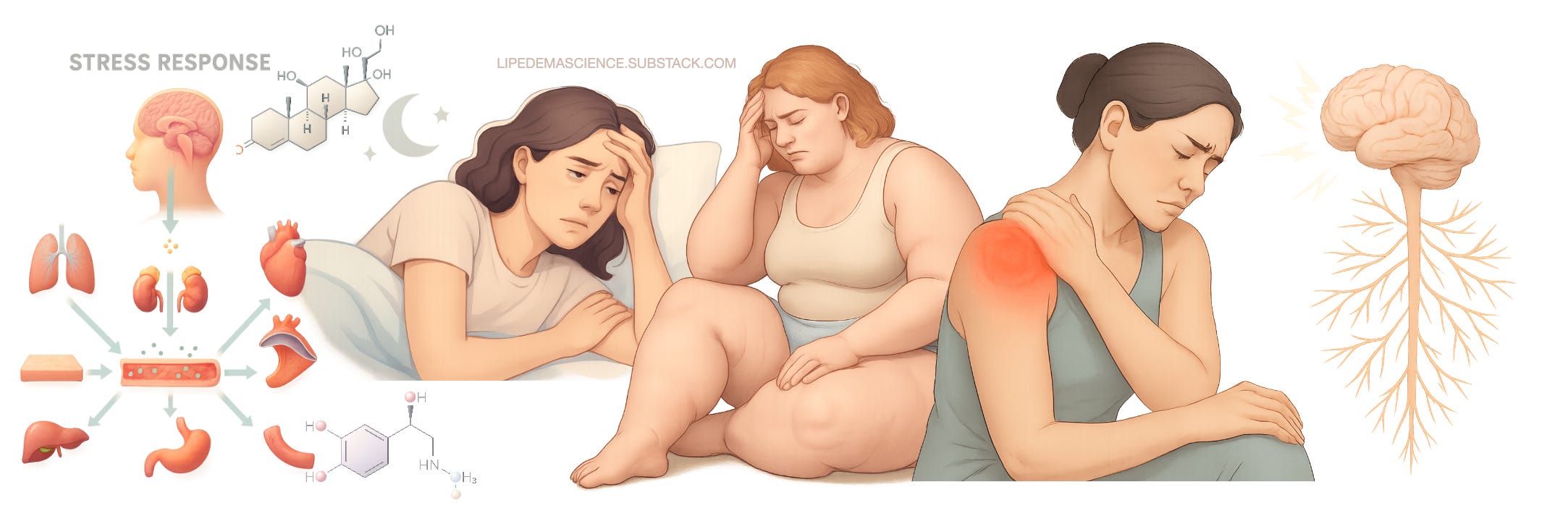
Stress and sleep affect each other like two sides of the same coin. When you are stressed, your body releases hormones such as cortisol and adrenaline. These hormones prepare you to act—they raise your heart rate and keep your mind alert. But when they stay high for too long, they disturb your body’s natural rhythm for rest. You may fall asleep later, wake up more often, or wake up without feeling refreshed. Poor sleep then increases cortisol levels even more, and the cycle continues.
Why stress feels heavier with lipedema
For women with lipedema, stress doesn’t just affect mood—it shows up in the body. Cortisol, the main stress hormone, can increase inflammation and water retention. It can also change how the lymphatic system drains, adding to that heavy or swollen feeling many women describe. When the body is tired and tense, pain signals are stronger, and daily tasks can feel harder than before.
The tired brain and emotional eating
When sleep is poor and stress is high, the brain looks for comfort. It releases signals that make us crave sugar and quick energy. This is why many people reach for sweet or salty foods when feeling exhausted or overwhelmed. It’s not about weak willpower—it’s biology trying to bring relief. For women with lipedema, who already face stigma about body weight, this knowledge is important. It turns guilt into understanding.
What science says about sleep and lipedema
A recent study found that women with lipedema not only sleep worse but also experience more daytime fatigue and lower physical function. In other words, poor sleep is not just an effect—it’s part of the condition’s burden. Fatigue, pain, and stress are linked, forming a circle that drains energy and joy. That is why doctors now recommend asking about sleep quality at every check-up for lipedema patients.
Simple ways to calm the system
You don’t need perfection—you need recovery. Try to build small moments of rest into your day. Breathing slowly for a few minutes, stretching gently, or listening to calming sounds can lower cortisol and help your nervous system reset. Keep a steady bedtime routine, dim the lights, and avoid screens before sleep. Even small improvements in rest can ease pain and help your body feel safer.
Acceptance starts with understanding
Your tiredness, your cravings, and your stress reactions are not personal failures. They are natural responses from a body doing its best under pressure. When you understand the link between stress, sleep, and lipedema, you stop blaming yourself. Knowledge turns judgment into care—and that’s where real healing begins.
Rest/stress intradermal lymphoscintigraphy in diagnosis of lipedema (DOI: 10.4103/wjnm.WJNM_5_20)
Does stress influence sleep patterns, food intake, weight gain, abdominal obesity and weight loss interventions and vice versa? (DOI: 10.1111/obr.12603)
The Nutrition Source > Stress and Health (https://nutritionsource.hsph.harvard.edu/stress-and-health/)
Lipedema, body-related emotional and disordered eating to cope (DOI: 10.1016/j.soard.2023.03.013)
Lipedema: The intersection of physical and mental health (DOI: 10.12740/APP/201427)
The Relationship Between Sleep Quality, Fatigue, and Quality of Life in Women with Lipedema (DOI: 10.1177/15578585251387100)