

Caroline is 34 years old and lives in Østfold, Norway, with her husband, teenage daughter, and dog. From the outside, her life might look fairly ordinary. But inside her body – and throughout her entire life – it has never been “just a bit of extra weight.” It has been pain, shame, bullying, crossed boundaries, misdiagnoses, heavy treatments, and a constant fight to be taken seriously.
This is the story of how an entire life was shaped by other people’s gaze on her body – and how she has slowly found language, explanation, and resilience through the diagnosis of lipedema.
A child turned into a “project”
Already as a child, Caroline was turned into a “weight-loss project.” Her grandmother and grandmother’s partner were focused on her weight. Hiking clothes, skis, and hiking boots were bought – not primarily for play and mastery, but to make her lose weight. On trips, she was not allowed to eat like the others. A thin strip of Kvikk Lunsj chocolate had to be enough, because “Caroline can’t eat more.”
In documents from first grade, it is written that she was bullied because of her weight. Early on, she felt how her body became a problem – something others commented on, controlled, and shamed.
When she moved to her father at the age of nine, the focus on weight became even stronger. Her father commented on her body regularly. She was compared to siblings and stepsiblings – who was allowed to drink chocolate milk, and who only got half a glass of milk because she was “fat.” While her stepsister got a bus pass, Caroline got a bike – so she could “get some exercise” on the way to school. Pride from adults almost only appeared when she had lost some weight.
Pain, smell, and shame: “ugly, fat, and smelly”
On top of the weight focus, Caroline had chronic ear infections caused by a specific bacteria. The infection smelled like rotten eggs. Other children assumed she didn’t shower. She became “that ugly, fat, smelly girl.”
At the same time, her father had an alcohol problem, and home was an unsafe place. Caroline regulated her emotions with food. Just hoping there was chocolate spread in the cupboard could be a way of getting through the day.
That combination – shame about her body, insecurity at home, painful symptoms, and bullying at school – laid a foundation that would shape her for many years.
Teen years: leg pain, PE classes, and self-harm
In lower secondary school, the pain in Caroline’s legs became more obvious. She couldn’t run in PE; it hurt too much. The answer she received was familiar: you are overweight, you just need to exercise more. Eventually she was also diagnosed with asthma, and the solution was presented as simple – use asthma medication and stay active. The pain in her legs was still not taken seriously.
At the same time, her self-esteem was falling apart. Comments about her being “fat,” being above the normal range at the hospital, and a daily life where she was taught that her value was tied to her body size, left deep marks.
In upper secondary school, the self-harm started. Caroline was 15, felt ugly and worthless, and found meaning in taking care of others. She stopped eating regularly, limiting herself to one or two meals a day, and when she did eat more, she forced herself to throw up. She only received positive attention when her waist got smaller. Yet she still had large thighs and arms – an early body feature many women with lipedema will recognize, but no one had words for it.
A support worker at school became an important ally, but the secrets were huge: neglect, alcohol, abuse, responsibility for younger siblings, and the role of a “backup mom.” She carried all of this in her body – in weight, pain, and self-hatred.
Relationships, violence, and miscarriages
At 17, Caroline got a summer job in Fredrikstad and stayed with her mother. There she met the man who would later become the father of her daughter. He was eleven years older and seemed like someone who truly saw her. When she went back to her father’s home, she missed the freedom and the absence of constant weight comments. When she told her father about her boyfriend, he exploded. The next day she moved to her mother.
In practice, she mostly ended up staying with her boyfriend. Food became both comfort and control. She ate everything she could get hold of, every single day, and gained almost 40 kilos in one year. Her mental health deteriorated, she struggled to complete school, and her body was in constant imbalance.
She became pregnant in 2009, but when she was believed to be 16 weeks along, an ultrasound showed that the pregnancy had stopped at 8 weeks. She had surgery under general anesthesia. The months that followed are mostly a blur. She left her boyfriend, but the relationship remained close enough that he could still manipulate her. He called her a “monster” when she was on the pill and criticized both her body and her mood.
Later she became pregnant again – this time with her daughter. The pregnancy triggered severe pain in her legs, pelvic girdle pain, and eventually great difficulty walking. Once again the explanation was: it’s because you are overweight. Still, she gave birth vaginally, with hypermobile joints, and was praised as “fantastic” – without anyone asking what this body had already been through.
Being a mother – and forgetting herself
After becoming a mother, Caroline lived in constant alert mode. Her child had its own challenges and needed close follow-up. She completed a two-year general study competency track, alone with full custody.
She entered a new relationship, this time with an even more manipulative and violent man. The bruises became more numerous than ever. She was told she “couldn’t tolerate anything,” while her body was covered in bruises on arms and legs – a pattern her father had already commented on earlier: “you get bruises from nothing.”
Lipedema is known to cause easy bruising and pain on touch. For Caroline, this was yet another sign that nobody interpreted correctly. Instead, it was used as criticism or as a weapon in conflict.
After a year in what she describes as hell, she managed to leave. She moved with her daughter to a new apartment on the second floor. Many days she could hardly get up the stairs. The pain in her legs was so intense that each flight felt like a mountain. But her child needed her, so she pushed through.
Searching for solutions: training, therapy, and new rejection
Caroline was accepted into university, studying social education, and completed her first year. But her daughter did not cope well with full days in kindergarten, so Caroline chose to take leave. She started working out at a gym. She never fully understood why some exercises caused extreme pain or why jogging and running were impossible. But she had learned that the answer was always “eat less, move more.”
She managed to lose 20 kilos on her own. At the same time, nothing was emotionally processed. Pain came and went. She tried physiotherapy, talk therapy, and osteopathy. After treatments, her body looked like a color chart of bruises, and being touched was excruciating.
She asked her GP for a referral to a specialized obesity clinic and to a district psychiatric center. Both applications were rejected. Her BMI was two points below the threshold for the obesity clinic, and her symptoms were not “severe enough” for the psychiatric center. Instead, she was prescribed antidepressants, and her weight increased.
Still, she did not give up. She hired a personal trainer, trained hard, became an ambassador at the gym, used the stair machine, ski-erg, bike, and step box – until her body collapsed. She could no longer attend regularly, but even then the voice inside her was brutal: quitting is for losers.
Gastric bypass – and pain that doesn’t go away
As her weight continued to increase, she finally qualified for treatment at the obesity clinic. Her highest recorded weight there was 139 kilos. At the introductory course in January 2020, she met Ron. They connected immediately, and eventually they became a couple.
In October 2020, Caroline underwent gastric bypass (GBP). On the day of surgery, she weighed 130.3 kilos. Over the following two years she lost a significant amount of weight:
after 6 months: 107.5 kilos
after 12 months: 102.5 kilos
after 18 months: 97.7 kilos
after 24 months: 95.2 kilos
But when her weight started to creep up again after 12 months, she panicked. Her GP prescribed Mysimba first, then Saxenda. She fought hard to keep the number on the scale down, while the pain in her legs, arms, neck, and shoulders continued.
At the two-year follow-up at the obesity clinic, she was told to stop Saxenda. She was informed that this was not a medication she “needed,” and that “the body can manage this weight loss on its own.” When she tried to talk about the pain, the response was still mainly focused on weight – as if weight loss alone should fix everything.
The first time someone says “lipedema”
In 2022, she was referred to Jeløya Unicare because of fibromyalgia. In the summer of 2023, she had a week-long assessment stay there. That became a turning point.
A senior physician examined her thoroughly – both with regard to fibromyalgia and other possible explanations. He spent almost two hours with her. Finally he said a word she had never heard before: lipedema. He explained that he had worked with it at a hospital in Northern Norway and that he was absolutely certain she had lipedema. He told her to read up on it, contact a physiotherapist with expertise in the field, get compression garments, and consider lymphatic treatment.
In the medical report, he wrote clearly that Caroline has lipedema, and that this probably explains much of both her pain and her difficulties with weight.
Caroline went home in shock. At last, an explanation – but also a new grief. What now? What help actually exists?
Ibsen Hospital – and another blow
To get a more detailed assessment, Caroline went to Ibsen Hospital in Porsgrunn and met the physician Ashwin. There, the diagnosis was confirmed, and later they concluded that her lipedema had progressed – likely up to stage 4.
On the way home, she cried. In practice, the treatment options she was offered were the same things she had already tried: focus on weight, compression, and self-management. Surgery was a theoretical possibility, but financially out of reach.
She was left with questions that many women with lipedema recognize painfully well:
Am I just fat after all? Why does it hurt so much? Why does no one see the whole picture?
Mental health, diagnoses – and an ectopic pregnancy
At the same time, she continued fighting for adequate mental health care. This time she was accepted at the district psychiatric center and attended a trauma-focused group program. She was diagnosed with generalized anxiety disorder, and later, after further assessment, also ADHD.
In April 2024, she married Ron – the man from the obesity clinic, whom she describes as kind, supportive, and loving towards both her and her daughter exactly as they are. They talked about whether they should try for a baby together, even though he already felt content being a father figure to her daughter.
On their honeymoon, Caroline became pregnant. During another stay at Jeløya in the summer of 2024, she felt nauseous and exhausted. At first she thought it was simply because she had just finished a bachelor’s degree in social welfare studies. But the pregnancy test was positive, and the whole family was overjoyed.
At an early ultrasound, the midwife could not see clear fetal development. Her hCG levels continued to rise, but Caroline experienced spotting and pain. Suspicion of an ectopic pregnancy led to emergency appointments at the out-of-hours clinic and the hospital. Eventually it was confirmed: the pregnancy was located in the fallopian tube. The embryo had had a heartbeat up to eight weeks. Caroline underwent emergency surgery.
Afterwards came the silence. Grief, hormonal turmoil, trauma memories, and an already painful body made the rest of 2024 extremely heavy. Her weight and pain increased further – especially in her legs, arms, and hips/buttocks.
When the body can’t do it anymore
Over the course of 2024, her functional level gradually declined. Her legs gave out during walks with the dog. Stairs, short walks, and everyday tasks became increasingly difficult.
In February 2025, she was reassessed for her lipedema. The conclusion: progression, likely up to stage 4. It was also made clear that it is unlikely she will be able to lose enough weight to reach the BMI threshold required for publicly funded surgery. Another blow – medically and socially.
Caroline tried warm-water exercise in a heated pool. In the water, she felt light, free, and strong. She managed things she usually cannot do, and her pain was significantly reduced in the moment. But afterwards came the cost: three to four days on the sofa, completely exhausted, too weak even to lift the compression pump. Now, for every activity, she has to weigh the joy of doing it against the inevitable “crash” afterwards.
Aids, compression, and pain in everyday life
Today, Caroline uses compression every single day. She has two-piece compression garments from Jobst: class 2 knee-high stockings (Elvarex Soft) and made-to-measure tights – the only thing that has worked for her body shape. She has tried compression for her arms without finding anything that stays in place and gives the right effect.
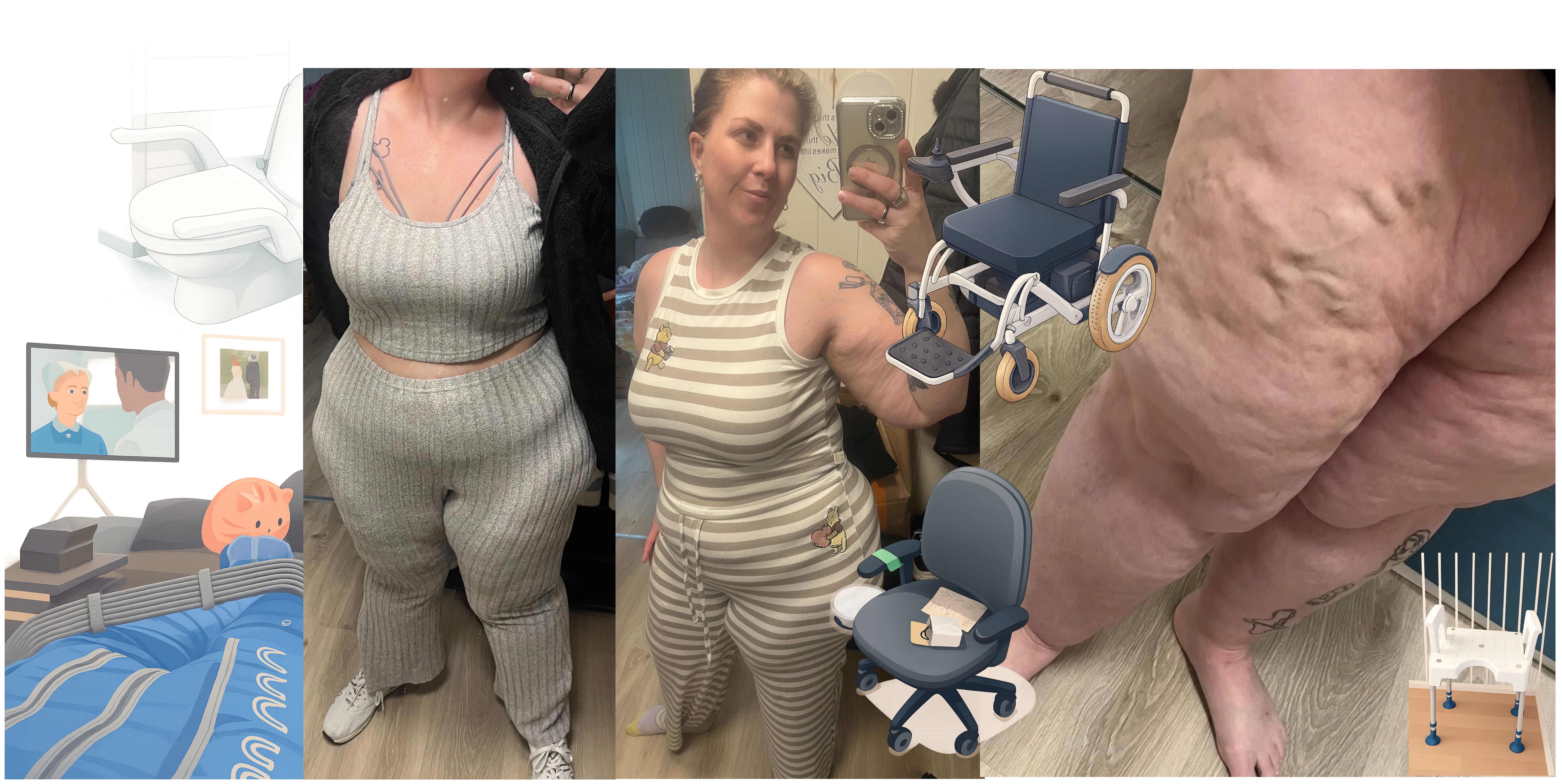
Through an occupational therapist and the Norwegian Labour and Welfare Administration, she has also received several aids for living with lipedema:
a shower stool, because it is painful and exhausting to stand for long
a raised toilet seat, to make toilet visits easier
a work chair in the kitchen and for folding laundry, to relieve her legs
a bed grab rail, to help her get up from bed
an adjustable bed that allows her to elevate her legs at night
She has night compression garments as well, but even though they are softer, they still put enough pressure on her legs that she often has to take them off. The adjustable bed has therefore become a “lifesaver.”
In addition, she has a compression pump, an electric wheelchair (Eloflex) for local use and shopping centres, and a Permobil X850 for outdoor terrain. These aids allow her to go on proper walks with the dog again – but they are also daily reminders of how much function she has lost at such a young age.
On top of everything, she uses strong pain medication several times a day. She lives on the minimum sickness benefit level, has applied for disability benefits, and has been clearly told by several professionals that she now has to prioritize taking care of herself.
From shame to voice: Caroline as a carrier of knowledge
In the middle of all this, Caroline has made a choice: she wants to be open. She wants others to avoid the same long and lonely road she has walked.
She has already helped several friends receive a lipedema diagnosis early. They have thanked her for the information – and for finally understanding why their legs have hurt and been damaged for years.
She has shared her story on the Snapchat account “lipødemdamene” (“the lipedema ladies”) to show more sides of the disease: not just “before and after” pictures, but also bruises, aids, exhaustion, psychological burden, and loss of function. She knows how brutal it is to be constantly met with “you’re just overweight,” when you, in reality, have a chronic, painful fat tissue disease.
Caroline is very clear about what she wants:
more people should be identified early, before the damage becomes too severe
women with advanced stages, multiple diagnoses, and low functional level must also be included in research
no one should have to be physically and mentally broken before they are taken seriously
needing aids and living with constant pain in your 30s must not be treated as “normal”
She carries both her own pain and a strong desire for systemic change.
What can we learn from Caroline’s story?
Weight is not the whole explanation.
Caroline’s story shows how dangerous it is when healthcare and society reduce everything to “obesity.” When pain, bruising, loss of function, and typical lipedema fat distribution are not properly examined, we lose the chance for early diagnosis and targeted treatment.Early recognition could have changed everything.
If someone had connected easy bruising, pain on touch, heavy and painful legs, declining function, and psychological strain to lipedema earlier, Caroline could have received different follow-up, different language for her own body, and less guilt. Her story illustrates how crucial it is that healthcare professionals know about lipedema – and dare to use the diagnosis.Openness gives others a shorter and kinder path.
By being open – with family, friends, and in public channels – Caroline has already helped others receive a diagnosis earlier. Her story is a reminder that when one woman dares to speak up, it can be the key that prevents many others from having to fight as long and as hard just to be believed.
Tøft å lese dette! Takk for at du deler så åpent! ❤️