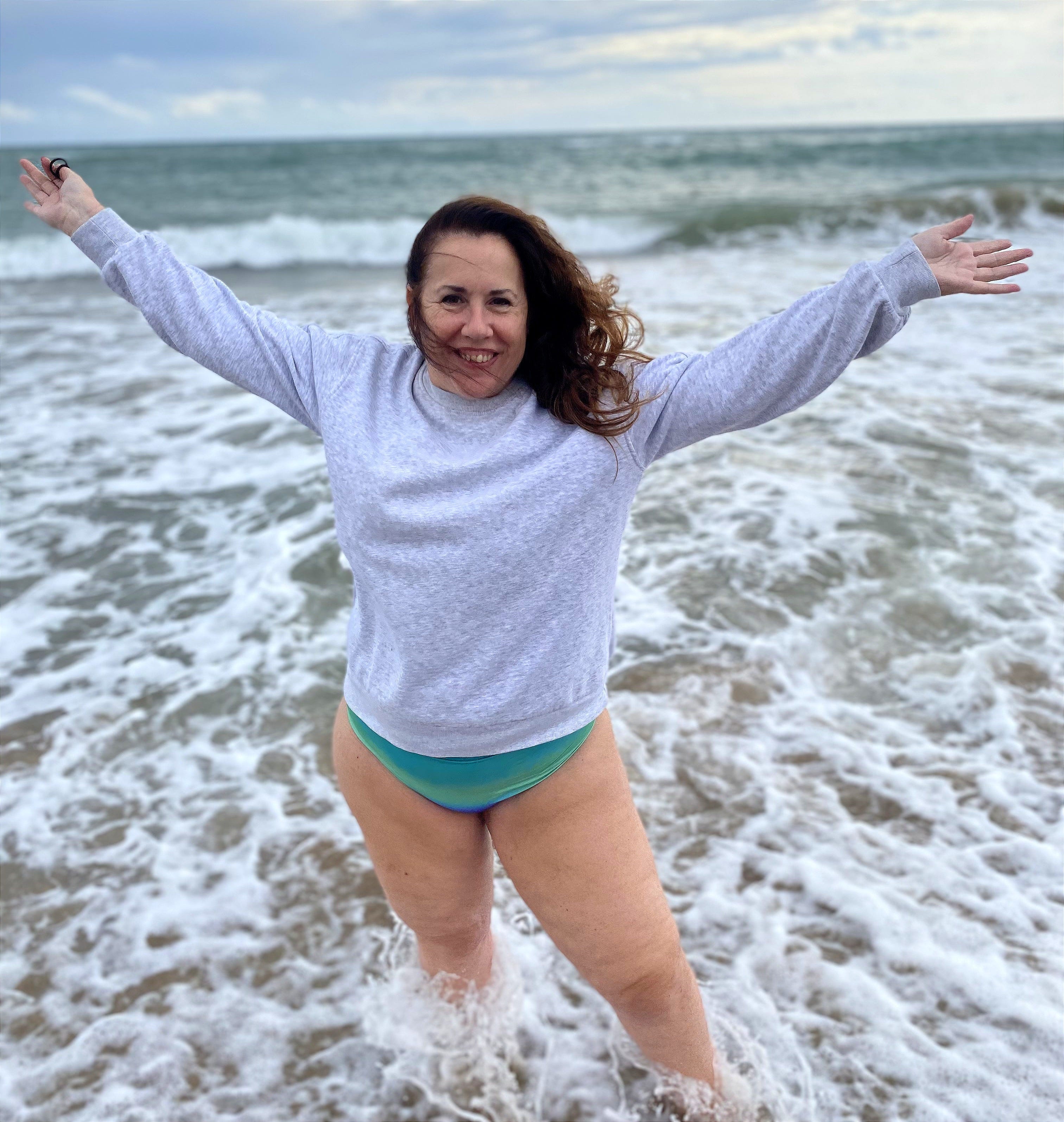
Elise is 51, lives by the Mediterranean coast in Spain, and built @lipedemawithelise after years of researching her own symptoms and realizing other women needed clearer, safer information. If you live with lipedema, her story will feel familiar in the places that hurt—and hopeful in the places that open.
This is her story, told in her voice, shaped for you as a reader who knows what it means to carry pain, heaviness, shame, and the constant mental load of “How do I manage this?”
Who Elise is beyond lipedema
Elise describes herself as curious, engaged, and constantly reinventing. She studied journalism, worked in media, then moved into real estate and later luxury retail for more than 15 years. Today she’s a wife and mother of two daughters—one a teenager, one at university—and she credits the sea, sunlight, and the calm rhythm of coastal life for helping her regulate what the medical system never really touched: stress, nervous system overload, and the emotional exhaustion of being misunderstood.
When she was diagnosed in 2018, she didn’t just “get information.” She cracked open. And by the end of 2024 she felt a clear internal shift: I can’t keep this to myself. That’s when her Instagram platform became her way of giving back to women who are still stuck in the same confusion she lived in for decades.
Why journalism became her lipedema superpower
Elise doesn’t share content the way trends do. Her journalist brain doesn’t allow it.
She reads studies. She compares sources. She cross-checks claims. She listens to clinicians who work with lipedema and filters out the noise that makes women feel ashamed or desperate. Her goal is not to overwhelm you with science, but to make you feel safe in the information—safe enough to act, advocate, and experiment gently until you find what works for your body.
That’s the thread running through everything she does: information that doesn’t gaslight you, doesn’t blame you, and doesn’t sell you miracles.
The beginning: signs that were there long before the word “lipedema”
Elise says her legs never looked “typical,” even as a child. Her mother avoided buying shorts and summer dresses, and there are almost no childhood photos where her legs are visible. Not because anyone said it out loud—but because both of them were silently trying to protect her from attention and judgement.
She remembers one ballet photo at age six where her knees already look wide and swollen compared to the rest of her small body. By age ten she was wearing clothes meant for older girls because nothing fit her lower body. Puberty made the contrast even sharper: one size on top, a much larger size on the bottom, despite eating what she describes as a normal Mediterranean diet.
And then there were the “hidden” signs many of us recognize now: the heaviness, the fatigue that didn’t match effort, the stairs that felt unfair, the clumsiness, the feeling of being the slow one even when you were trying.
The moment she finally got a name for it
Elise first saw the word lipedema in a major Spanish newspaper. Three women showed their legs publicly and said, openly: There is a name for this. There are treatments. There is even surgery.
That visibility hit her like lightning.
But even then, she needed three medical opinions before she could emotionally believe it. When all three said “textbook lipedema,” her first reaction was fear—because the word chronic changes how you see your future.
Under the fear, though, was relief. Relief that decades of “just lose weight” weren’t a moral failure on her part. Relief that her body wasn’t broken. Relief that she could finally stop fighting herself.
She says it simply: a name is power. Not because it fixes you—but because it gives you a direction.
When healthcare becomes another source of bruises
Elise is clear: Spain has many strengths as a healthcare system. But lipedema, and weight-related care in general, often falls into stereotypes.
She remembers moments that stayed with her for years: being humiliated for symptoms, being dismissed because she “ate healthy,” being spoken to like her struggle was somehow absurd. She also describes the strange, constant side-industry of “aesthetic solutions” that promise relief without addressing the underlying condition—treatments that can feel like they’re designed to keep you paying, not to help you understand.
What hurts most, she says, isn’t only the disease. It’s the years of not being believed—and the shame that grows in that silence.
The turning points: hormones, inflammation, surgery, menopause
Elise describes her journey as a loop of grief stages—denial, anger, bargaining, sadness—repeating until she started building a plan.
A major turning point for her was hormones. After pregnancy, she got a hormonal IUD, and she describes it as one of the worst decisions of her life. Her weight increased rapidly without lifestyle changes. Her arms became more affected. Her pain escalated. Her knees developed a sharp, stabbing pain she didn’t recognize as “normal.” And what stayed with her was the fact that she warned her gynecologist about lipedema—and was told it wouldn’t matter.
For Elise, that became a hard lesson: hormones are not a side note. They’re often the plot.
Surgery was not framed as a miracle, but as a boundary: I choose myself. Menopause then forced another rebuild—one that taught her resilience and patience in a body that doesn’t respond the way “standard advice” expects.
Why she decided to show her body online
At first, she couldn’t. In her early posts she focused on tips, routines, compression, movement—anything except her actual body. Then she realized something that many creators with lipedema eventually face:
If you don’t show the body you’re talking about, the women who look like you stay unseen.
So she started showing the parts she had hidden for decades—ankles, thighs, hips, even the parts most women never show publicly. She talks about the fear that comes with that, especially in videos like cold therapy challenges where she’s in a bikini on camera in winter. But she also knows the other side: somewhere, a woman watches and thinks, If Elise can show her legs, maybe I can go to the pool. Maybe I can stop hiding.
She receives mostly love and gratitude. The negativity exists, but she doesn’t let it lead the story.
What surprised her most about building a global community
The messages that move her most aren’t only from women with lipedema. They’re from sisters, friends, partners—people saying: I shared your video with someone I love because I think she might have this.
For Elise, that is the point. If one share leads one woman to a diagnosis earlier than she got hers, the work is worth it.
Elise’s “typical lipedema day”:
practical pillars that keep her stable
Elise’s routine is built around one principle: do the basics consistently, and listen to your body loudly.
She starts most mornings by activating lymph flow early—often rebounding on a mini trampoline. She notices immediately when she skips it.
Food-wise she follows an anti-inflammatory approach aligned with the RAD framework: no gluten, no lactose, as natural as possible, higher protein, and “gentle” on her inflammation. She doesn’t present it as a trend or a moral identity—she frames it as symptom control.
Compression is daily for her. Not optional.
She also protects her stress levels intentionally. She avoids draining workplaces, unnecessary conflict, and relationships that keep her nervous system activated. For her, peace isn’t self-help—it’s treatment.
Cold therapy is the modality she says has surprised her most lately. Weekly sessions leave her legs feeling lighter for days.
The gluten turning point: when her body proved the link
Elise lived with chronic constipation for 44 years. She says no doctor ever suggested gluten could be a trigger. When she removed gluten, the constipation resolved. Headaches improved. Energy shifted.
Then came the moment that made it undeniable: after eating gluten-heavy desserts for a few days at Christmas, she bruised heavily and her legs changed. It was a direct cause–effect experience that made her decide she wouldn’t go back.
Now, if she gets gluten accidentally, she feels dizzy and unwell within 30 minutes. Her body gives immediate feedback—and she trusts it.
The mental work: releasing guilt, rebuilding self-worth
Elise says the diagnosis didn’t remove pain overnight, but it removed guilt. And that mattered more than she expected.
She speaks openly about body shame and the long process of changing how she looks at herself. She didn’t start with confidence. She built it through repetition: showing up, learning, making choices that reduced symptoms, and slowly letting her body be seen without apologizing for it.
Her hardest battle has been other people’s ignorance: the casual blame, the “have you tried…” comments, the judgement. But she’s reached a point many women describe as a milestone: she no longer negotiates with other people’s opinions.
The gap between research and what women are told
Elise believes the biggest problem in lipedema care isn’t only the lack of research—it’s the lack of translation.
Research has moved forward: inflammation, hormones, connective tissue, lymphatic overload, pain mechanisms, microcirculation. But many women still hear the same sentences: lose weight, it’s cosmetic, it’s normal, you’re exaggerating.
Her frustration is directed at the system, not individuals. And her message is consistent: we need clinicians to update their script.
Elise’s hope for the next 5–10 years
She wants early diagnosis to become normal, not rare luck.
She wants mandatory training for clinicians, universal access to compression and conservative care, clear guidelines around hormones and contraception, and mental health support integrated into lipedema care.
If she could deliver one sentence to health authorities, it would be: Believe women the first time.
If you’ve just discovered lipedema and you feel overwhelmed
Elise’s first advice is simple: don’t panic. Start small. Build step-by-step.
A little movement. Compression. One food change at a time. Tracking what your body does. Finding your community. Talking to someone who gets it.
She sees connection as part of treatment—not because it cures the tissue, but because it reduces the isolation that makes everything heavier.
What we can learn from Elise’s story
1. Diagnosis is not the end of hope—it’s the start of strategy
A name doesn’t fix everything, but it changes your direction. It helps you stop fighting yourself and start advocating for real care.
2. Your basics matter more than your extremes
Consistency—movement, compression, inflammation-aware food choices, and stress protection—can change daily life even when the condition is chronic.
3. Visibility is a form of care
Elise found her own path because other women dared to be seen. When one woman shares honestly, another woman gets answers sooner. That’s how the map spreads.