

Ida was almost 40 before the word lipedema entered her life. By then, she had already lived a lifetime in a body that felt “wrong”, lived with pain no one could explain, gone through seven lipedema surgeries – and received an ADHD diagnosis that threw new light on both her body and her exhaustion.
This is the story of believing everything is your fault, and then discovering it never was.
A body that stood out – long before anyone saw it
When Ida looks back at childhood photos, she sees it clearly: her body stood out already in primary school. Back then she didn’t have the words for it – she just knew she was “different”.
Her legs were bigger than the others’, and PE days were a nightmare. In the 60-metre sprint, no matter how hard she tried, she never managed to run as fast as the others.
In lower secondary school, the gap from her peers became even more visible. She cut the size label out of her Levi’s because the number was several sizes above her friends’. She felt that her body did not match the person she was inside. She never really became “friends” with her own body.
And so it continued, year after year. The feeling that her body was wrong, that she was doing something wrong, followed her into adulthood.
Almost 40 before she got a word for it
Ida was close to 40 when a friend gently asked whether she had ever considered that it might be lipedema.
At that time she had been on sick leave for several months because of pain, without anyone finding a cause.
The question triggered something. Ida started googling, reading, recognising herself. She brought it to her GP and asked directly whether it could be lipedema. The answer was careful but important: “It’s not impossible.”
Her GP had a few other patients with lipedema, but they were further along in the course of the disease. Ida was “too early” for the doctor to recognise the pattern. On top of that, Ida had become very good at hiding her body over the years.
Even so, she was taken seriously. The GP referred her on to examinations at the hospital and a pain clinic, and later to a lymphedema therapist. Eventually, a referral was sent to UNN (university hospital in Northern Norway) – it was rejected, but for Ida it still mattered: it left a footprint in the system, a sign that someone had tried to get her into a healthcare structure that still isn’t built for lipedema.
A system that can both lift and crush
In many ways, Ida describes herself as lucky. She has had a GP who listened, took her seriously, and “turned many stones” to help her. She had strong support from her lymphedema therapist, who both confirmed lipedema and later became the one who suggested ADHD assessment.
But she has also felt the other side of the healthcare system.
After lipedema had been confirmed by the lymphedema therapist, Ida went to a surgeon in Oslo for another assessment. She wanted to confirm the diagnosis and hear whether surgery might be an option.
She did get lipedema confirmed – but also something else: she was told she had to lose weight before they could help her. Ida experienced being seen as overweight and personally responsible for her situation.
The advice was simple and brutal: count calories, eat under 1200 a day, come back when you’ve lost at least 12 kilos. No one asked what she actually ate, how active she was, or what her daily life looked like.
When Ida did the math, she realised she was already at 600–800 calories a day – far too little, but without the weight moving. Still, the conclusion was: “you just need to eat less.” The surgeon also dismissed lipedema in her abdomen, calling it a “typical obesity belly”.
Later, during lipedema surgery with another surgeon, 4.6 litres of fat were removed from her abdomen. Lipedema tissue.
Ida never went back to the first surgeon.
Living in a body you hate
For Ida, lipedema has never just been about pain and volume. It has been about identity, self-image and place in the world.
She describes a life where she has almost always felt ashamed. She started swimming in clothes at 15. As an adult she avoided public swimming entirely. When she learned that swimming was compulsory in her early childhood education degree, she almost dropped out. She was 28 years old at the time.
She said no to activities, trips and people – not because she didn’t want them, but because she didn’t have the strength to be in her own body in front of other people’s eyes.
Over time, she developed social anxiety and experienced panic attacks. She describes living in a body she couldn’t accept as something that affected everything: friendships, relationships, how much space she took in a room, and who she dared to be.
To survive the feelings, she became “the funny one, the cheeky one with the quick comeback”. The role became protection. At the same time, she was constantly self-critical, self-conscious and convinced she was “less than”.
Diagnosis: relief, grief – and a new way of seeing herself
When Ida finally got lipedema confirmed, her reaction was double. On one side, immense relief:
It wasn’t just “being overweight”. It wasn’t just lack of willpower. She had a real, chronic disease.
On the other side, grief. Grief over all the years she had blamed herself. All the times she had pulled away, said no, stayed inside, swum in clothes, cancelled, hidden herself.
She realised how much of her life had been steered by shame and misplaced responsibility. Her body and the person she felt she was inside had never matched.
With the diagnosis came another kind of vulnerability: the knowledge that this is chronic and progressive. She knows she’ll have to adapt for the rest of her life. She’s not bitter, but she does feel a kind of unfairness.
She has to put in a massive amount of effort – in food, activity, treatment and self-care – just to keep the disease as calm as possible. Whatever she does, lipedema will still be there, affecting her every day.
Seven surgeries in under two years
Between January 2022 and September 2023, Ida went through seven lipedema-reducing surgeries:
calves
front of thighs
back of thighs
arms
abdomen
back and chin
buttocks
For her, not having surgery never felt like a real option. The pain was so extensive that she could not see another path forward. She had already tried conservative measures – compression, pumps, movement, diet – without enough effect.
The first surgery on her calves was a shock, both physically and mentally. She had prepared as best she could, but little can truly prepare you for waking up with a new pair of legs.
She describes the moment she lifted the blanket and realised the legs were actually attached to her body as surreal. They were her legs – but completely new.
That experience repeated itself after every operation. Each time she came home with a body that looked different from when she left. New proportions. New lines. A new way to wear clothes. A new way to move.
She had to get to know her body all over again, again and again – with only a couple of months between each major change.
It was painful, demanding and emotionally heavy. But for Ida, it also became a decisive before/after.
Already after the first operation, she felt a dramatic difference: the constant, gnawing pain in her calves was gone, even though the surgical pain was there. It was only then she fully understood how much the disease had done to her.
A lighter life – but not a life without disease
Today, Ida describes a body that is lighter, stronger and more functional than ever. She has less inflammation, less pain and far better capacity.
She can exercise without drowning in lactic acid. She can climb stairs without her legs “burning up”. She can squat down and sit cross-legged – something she hadn’t been able to do in years. For the first time, she experiences that exercise actually gives results.
The surgeries have changed her life. But they have not cured her.
She still lives with lipedema. She also lives with the long-term consequences of having carried the disease for many years without knowing, and without receiving help.
And she lives with something else: ADHD.
ADHD, stress and a body that finally shut down
In 2024, at age 41, Ida was diagnosed with ADHD. It was her lymphedema therapist who first asked the question.
Despite “perfect efforts” – keto diet, high exercise load, conservative treatment – her lipedema continued to progress during the surgery run. The therapist suspected that unregulated ADHD, and with it chronic stress and high cortisol, could be playing a much bigger role than anyone had realised.
For Ida, many things clicked into place.
She recognises herself in overriding her body’s signals again and again. Hyperfocus allows her to work for hours without eating, drinking or resting. She finishes, pushes, delivers – and crashes afterwards.
For many years she thought she was “just like that”, that she simply needed little sleep and functioned best in high gear. In hindsight she sees that she lived with untreated ADHD and a nervous system in constant fight-or-flight.
The end result was a body that eventually shut down. She fainted. She needed to sleep after work every day. Weekends were spent recovering just enough to survive another week.
At the same time, her ADHD has aspects she values: enormous willpower, passion, creativity, the ability to go “all in” when something matters. But in combination with a chronic, physical disease, the mix becomes extremely demanding.
She describes it as having an overactive inner life in a body that is often completely empty of energy. Claustrophobic, frustrating – and hard to explain.
Life after surgery – and expectations that don’t see the whole picture
After seven surgeries, Ida now has a body that functions much better physically. But she experiences that both professionals and systems have too narrow a view of what “after surgery” means.
She describes an expectation that she should now be “fit for fight”: back to normal, perhaps even stronger and more capable than before.
For her, the reality is far more complex.
Yes, she is lighter and stronger. But she is also deeply exhausted after years of chronic inflammation, untreated ADHD, shame, masking, overcompensating and fighting to be taken seriously.
She talks about a fatigue that does not disappear with a good night’s sleep, but feels like emptiness. As if there is nothing left to draw on.
This is the whole picture she wishes health services, welfare systems and people around her would see. Lipedema cannot be understood in isolation from the rest of the body – or the rest of life.
She doesn’t ask for pity, but for insight. Genuine curiosity. A chance to tell the full story without being reduced to a diagnosis code, a number on a scale or a before-and-after picture.
Community, her sister and social media as a lifeline
Ida has had several important supporters along the way: her husband, children, extended family, friends, her GP, her lymphedema therapist and the surgical team she eventually chose.
But one relationship means something entirely special: her sister.
Her sister also turned out to have lipedema. They have shared operation dates several times, been in the clinic together, and shared fear, hope, pain and relief. They recognise each other’s stories down to the smallest detail. Ida describes her sister’s support as invaluable.
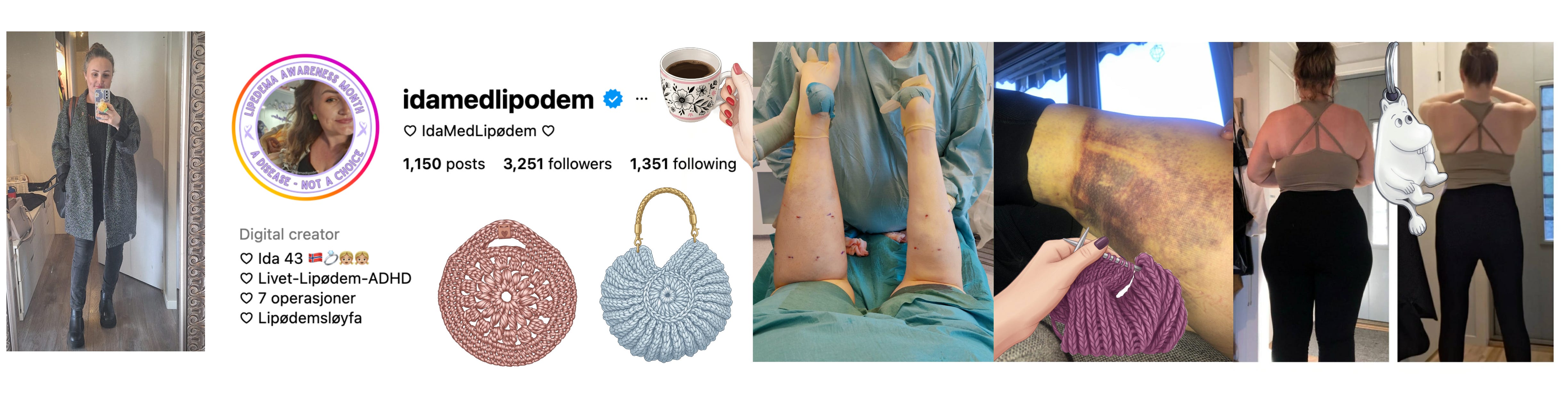
In addition, social media has become an anchor. Through her Instagram and Snapchat accounts @idamedlipodem, she shares everyday life, surgery journeys, thoughts, highs and crashes.
There she has met other women with the same diagnosis – some live just a short walk away and have become close friends. For Ida, this is one of the best things that has come from her lipedema journey: being with people who understand without long explanations.
A clear message to professionals and decision-makers
Ida wants a healthcare system and a public system that:
actually knows what lipedema is
sees how deeply it affects life, work ability and mental health
understands that life after surgery is still life with disease
She dreams of a diagnosis code, standardised care pathways and real access to help – both conservative treatment and surgery – before the disease progresses too far.
She is also clear that lipedema cannot be viewed separately from factors like ADHD, exhaustion and long-term stress. Many of the stories do not fit into a ten-minute GP appointment, but they are no less real.
“It’s not your fault – and you are not alone”
For other women with lipedema, Ida has several messages.
The most important: It is not your fault. It never was. You have lived with a disease you didn’t know you had.
She encourages women to ask for help – and to demand help. Not to settle for the first “no” if something feels wrong. Ask for second opinions. Lean on others who have walked the path before you. Ask critical questions.
She knows it costs energy. She knows being your own advocate is exhausting. But she has experienced, again and again, that it can make all the difference.
And she reminds us of the community: there are others who understand. Many of the kindest, strongest and most caring people she knows live in lipedema bodies.
“You are never alone,” she says. Not even on the days it feels that way.
What can we learn from Ida’s story?
Shame is not a diagnosis – lipedema is.
Ida lived for decades in shame and self-blame before she got the words that explained her body. Her story reminds us that “obesity” often hides undiagnosed disease, and that misplaced guilt can shape an entire life – friendships, education, work, relationships and self-worth.Body and nervous system are inseparable.
Lipedema, untreated ADHD, chronic stress and long-term inflammation were tightly woven together in Ida’s life. She shows how important it is that healthcare sees the whole person – not just kilos, volume or single diagnoses – and understands how an overloaded nervous system can worsen both symptoms and exhaustion.Surgery can change a life – but not on its own.
Seven lipedema surgeries gave Ida less pain, better function and a body she can finally live in. But she still lives with lipedema, ADHD and severe fatigue. Her story shows that surgery can be a powerful tool, but never a “quick fix”. Long-term support, understanding, conservative care and realistic expectations all have to be part of the picture if women like Ida are to have a real chance at a sustainable life going forward.
Ida, gode Ida! ❤️ Takk for alt du deler, du er en del av løysinga mi på gåten min rundt lipødem! 🍀🍀❤️❤️👏👏 Du imponerer meg med alt du klarer, tross heftig motgang med en kropp som begrenser deg! Så glad for at eg har funne deg og gleder meg til vi treffes neste gang! Det er så utruleg fint å vere med deg, vi har en egen forståelse som eg sett uendelig pris på! Takk Ida! ❤️❤️🥰👏👏💪💪