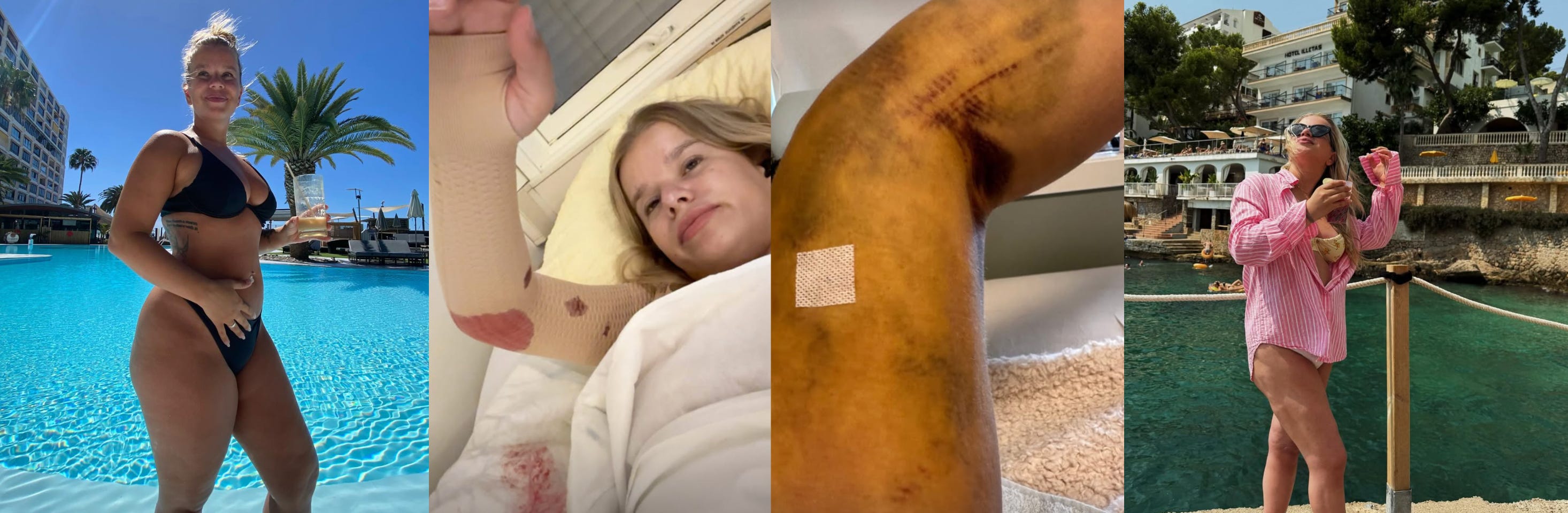
“Surgery or a wheelchair”: Gina’s path through lipedema, pain – and reclaiming her life
When you meet Gina today, you meet a warm, engaged and deeply present woman. She describes herself as positive, an initiator, someone who shows up for the people she cares about. But she also says something else:
It is only now, after receiving her lipedema diagnosis, that she truly sees who she is.
Behind her lies a lifetime of pain, chronic illness – and a body that never behaved like everyone else’s.
A childhood shaped by unexplained pain
Gina has lived with chronic illness since she was a little girl. She has “always hurt.” Over the years she received diagnoses like hEDS (hypermobile Ehlers-Danlos), ME and chronic pain syndrome. Pain became her normal.
But in the three years leading up to her first lipedema surgery, something shifted.
The pain changed. It intensified, became more persistent, and reacted poorly to medications meant to reduce inflammation. Her body responded in the opposite direction: more swelling, more inflammation, more pain.
Eventually she sensed that this no longer fit with her earlier diagnoses. Something else was happening.
A GP who listened – but a system that attributed everything to her other conditions
Gina’s GP tried everything. She was referred from specialist to specialist. Each new symptom was added to the list of conditions she already had.
Like many women with lipedema, the new and worsening symptoms were explained away by the diagnoses she had carried for years.
Everything changed when Gina said: This can’t be the whole explanation.
Once lipedema was mentioned, the shift was immediate. She describes her body leaving a state of constant fight-or-flight. There was relief. And validation.
“Surgery or a wheelchair”: a choice that didn’t feel like a choice
Gina knew about surgery long before she had the official diagnosis. She had followed other women online, read their stories, and understood that surgery could be an option.
When her diagnosis was finally confirmed, her decision was clear:
Her pain was so severe that she felt her options were surgery – or a wheelchair.
For her, it wasn’t a difficult choice.
Choosing the right surgeon in the middle of chaos
When she went looking for a surgeon, she wasn’t focused on cosmetic outcomes. She wasn’t comparing techniques or obsessing over before-and-after pictures. She was in pain, overwhelmed, and focused on one thing: relief.
She looked for something deeper:
safety
understanding
someone who truly saw her
When she finally met a surgeon who explained everything in detail and spoke to her with clarity and grounded reassurance, she knew she had found the right place.
Six surgeries – and soon a seventh
So far, Gina has undergone six lipedema surgeries, with a seventh on the way.
She has paid for all of them herself, without public support.
Financially, it has been draining. She has spent her savings. She still lives at home. The dream of buying her own place is on hold. But one sentence from someone close to her changed the way she viewed everything:
“What’s the point of owning an apartment you can’t enjoy?”
She has never looked back.
A body that can finally live – not merely endure
The changes since surgery have been profound:
She can walk without fearing collapse.
She no longer wakes up panicked from pain.
The constant inner tension she didn’t even know she carried has lifted.
She no longer relies on a shower stool – she can stand in the shower.
Washing her hair no longer causes disabling arm pain.
She can have long hair again because it doesn’t require the same physical effort.
She can enjoy concerts, conversations, and ordinary days without fear.
She says:
There are far more positives than negatives. Sometimes I have to pinch myself.
Between surgeries: learning, resilience – and aggressive lipedema
The periods between surgeries have not only been about rest. For Gina, they have been full of insight and self-discovery.
She has learned how mentally strong she is, and how much her body can endure. She has been fortunate – no complications, smooth healing, and excellent support from her team.
But she has also faced aggressive regrowth in her remaining lipedema tissue.
This is one of the reasons she is going into surgery number seven: to prevent further progression.
She lives with uncertainty, but takes it one day at a time. The future is unknowable – and she chooses not to fear something that hasn’t happened yet.
A mental shift: pain relief mattered more than appearance
While outsiders may focus on aesthetics, Gina never did.
She went into surgery with a single wish: less pain.
She told her surgeon plainly:
“I don’t care how I look as long as I’m pain-free.”
She was prepared for all possible outcomes. Cosmetic changes were irrelevant. Function and relief were everything.
Sharing her story – because others once shared theirs
A defining part of Gina’s journey is her openness.
She chose to share because other women once shared with her. Without their courage and transparency, she believes she may not have realized she had lipedema at all.
Seeing other women document swelling, bruises, compression garments and recovery made her own path less frightening.
And because she lives in a small town, she also wanted to stop rumours before they started. Sharing openly allowed her to control her own narrative.
The media response – and the messages that changed her
After being featured in KK, VG and Lofotposten, Gina was inundated with messages.
Women wrote:
that they finally recognized themselves
that they were grateful for her honesty
that they had gone through with surgery because of her
that they were scared and not being heard
Some messages made her cry. Some led to friendships. Some deeply moved her in ways she struggles to put into words.
The ones that stay with her the most are:
Women who chose surgery because her story helped them understand their own body.
Women who are desperate because no one listens to them.
To the latter group, she repeats: Don’t give up. There is help. Keep looking until you find someone who sees you.
Being visible – and the very little negativity
Surprisingly, she has received almost no negativity. Once, someone with lipedema accused her of being “attention-seeking,” but it didn’t stick.
Everything else has been overwhelmingly positive. She believes this comes from how she shares: honest, grounded, and without dramatics.
What Norway is missing
Gina is clear about what women with lipedema need now:
Access to proper compression garments, regardless of income or geography.
More physiotherapists with lipedema-specific competence.
More clinical nutritionists who understand lipedema physiology.
Psychological support for every woman going through (or living after) surgery.
The mental impact of waking up with a new body – sometimes multiple times a year – is enormous.
For women who cannot afford surgery, a skilled physiotherapist and nutritionist can change everything. She has lived this herself.
Her message to healthcare providers
One reason she wasn’t diagnosed earlier is that she was “too slim” to match the typical lipedema stereotype.
She emphasizes:
Lipedema has countless presentations.
There is no single lipedema body.
Healthcare providers must listen more deeply and look at the whole picture.
What Gina has learned about herself
Through everything, she has discovered:
that she is stronger than she ever knew
that she stands firm in storms
that she can ask for help
that she can trust herself and her decisions
This insight has changed everything.
Life after surgery number seven – what she hopes for
Her next surgery includes an area that is currently causing her a lot of distress: her neck. She hopes it will ease the physical burden on the rest of her system.
What she wants most moving forward is simple:
To be kinder to herself.
To trust her strength.
And to keep choosing what gives her the most life.
To the newly diagnosed woman sitting at home, scared and overwhelmed
Gina wants her to know this:
Read other women’s stories.
Don’t be afraid to reach out to those who’ve walked the path before you.
Ask questions. Learn.
Knowledge is power when you’re not believed.
If one doctor or physiotherapist doesn’t see you – try another. Don’t stop.
Most importantly:
You do not have to do this alone.
What we can learn from Gina’s experience
Pain is a signal – not a character flaw
Gina’s story shows how easy it is for symptoms to be dismissed when other diagnoses already exist. Pain deserves to be taken seriously, even when it doesn’t fit neatly into a box.
Surgery can be life-changing – but support around it matters just as much
For Gina, surgery brought mobility, relief and a new life. But the journey also shows how vital physiotherapy, nutrition support, compression and psychological care can be.
Openness creates pathways for others
By sharing her reality, Gina has helped countless women understand their own symptoms, seek help sooner and feel less alone. Stories build community – and community builds strength.