

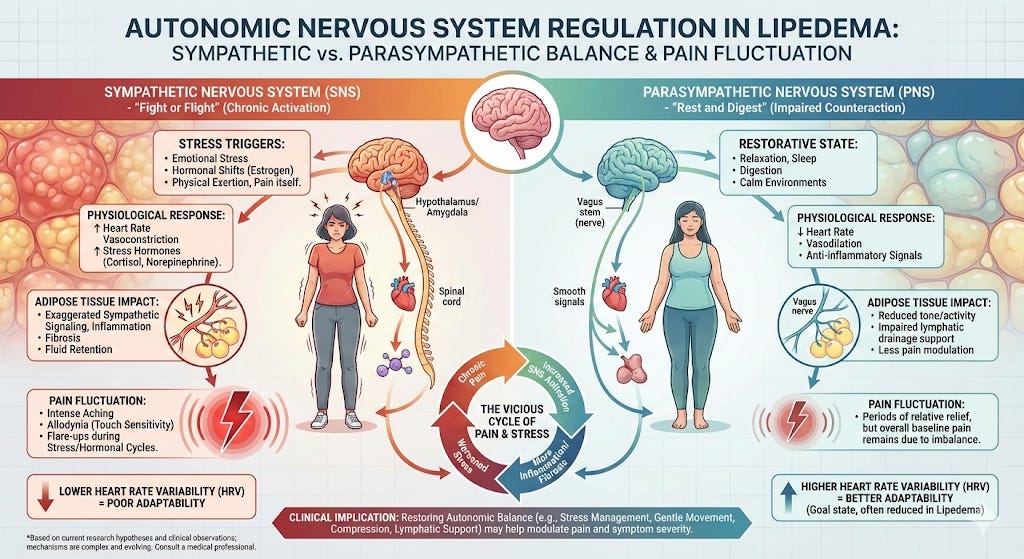
Lipedema is increasingly described as a complex adipose tissue disorder that involves more than altered fat distribution. Many patients report disproportionate pain, dermal hypersensitivity, easy bruising, edema-like sensations, and significant impairment in daily functioning. Alongside these physical features, a substantial emotional burden is common, shaped by years of symptom dismissal, stigma, and the practical limitations of living with chronic pain. This broader clinical picture raises an interesting and still underexplored question. To what extent might autonomic nervous system activity influence the day-to-day expression of lipedema symptoms.
The autonomic nervous system is central to physiological regulation. It modulates vascular tone, heart rate, stress hormone signaling, inflammatory activity, digestion, and multiple dimensions of pain processing. The sympathetic branch supports mobilization and threat responses, while the parasympathetic branch, mediated largely through vagal pathways, supports restoration, digestion, and recovery. In chronic pain states, autonomic imbalance and reduced autonomic flexibility are frequently discussed, often in the form of sustained sympathetic activation or reduced parasympathetic tone. Lipedema research has documented altered sensory and pain profiles, including dermal hypersensitivity and indications consistent with neurogenic inflammation, suggesting that the interface between peripheral tissue and the nervous system may be clinically relevant.
Are you someone who wants lipedema knowledge to become more accessible to those of us living with the condition?
Support the author, CarinaW, by becoming a member of LipedemaScience. The stronger the support behind her work, the deeper and more comprehensive the articles we can create together. Researchers and healthcare professionals are already reading LipedemaScience — and collectively, we can help generate a cascade of new insight and understanding around lipedema.
Become part of the community and learn something new about lipedema every day.
It is important to be careful with causality. There is currently limited evidence that nervous system regulation changes lipedema disease progression or tissue architecture. However, it is biologically plausible that autonomic state may modulate symptom intensity. Stress-related sympathetic activation can amplify pain perception, alter microcirculatory dynamics, and influence fluid regulation. Many people with lipedema describe symptom fluctuation in relation to psychosocial stress, sleep disruption, hormonal transitions, or periods of high allostatic load. This does not establish a direct mechanism, but it does point toward a plausible symptom modulation pathway that deserves attention and stronger research designs.
A second dimension concerns emotional regulation. Several studies report higher rates of anxiety and depressive symptoms in lipedema cohorts, and difficulties in emotional regulation have been highlighted as a relevant factor in patient well-being. These findings should not be interpreted as psychologizing lipedema. Rather, they fit a common pattern seen in chronic conditions where persistent pain and physical limitation increase stress-system load over time. If chronic stress physiology contributes to symptom amplification, then interventions aimed at restoring autonomic flexibility may represent a useful adjunct to standard management, not as a replacement for compression, movement therapy, surgical approaches, or medical evaluation, but as a complementary strategy for symptom coping and recovery capacity.
When people refer to “regulating the nervous system,” they often mean interventions intended to shift autonomic balance toward parasympathetic activation or to improve the capacity to move flexibly between states of activation and recovery. Examples include slow diaphragmatic breathing, restorative movement, mindfulness-based practices, sleep stabilization, graded physical activity, and supportive relational context. In broader clinical research, these approaches have been associated with changes in autonomic markers such as heart rate variability and with improvements in perceived stress and pain in some populations. Direct interventional evidence in lipedema specifically remains limited, which makes this an area where patient observation and symptom tracking can be valuable, not as proof, but as data that can motivate better studies.
I would like to open this as a discussion. Do you experience clear symptom fluctuations tied to stress, sleep, or emotional load? Have you tried breathwork, restorative yoga, meditation, psychotherapy, vagal toning practices, or other approaches intended to reduce physiological arousal? If so, what changed, pain intensity, heaviness, swelling, or fatigue? What did not change? Did anything unexpectedly worsen symptoms? If you track biomarkers such as resting heart rate, sleep quality, or heart rate variability, have you noticed patterns that align with symptom shifts?
I am especially interested in the boundary between tissue pathology and nervous system modulation. Lipedema tissue is not inert. Adipose tissue is vascular, innervated, immunologically active, and responsive to endocrine and stress signals. The clinical experience of lipedema may therefore reflect not only tissue structure, but also the physiological state in which that tissue is interpreted and regulated. This is not a final conclusion. It is a research-informed hypothesis for collective reflection. If you are comfortable, I would appreciate your experiences in the comments, including what has helped, what has not, and what you would want researchers and clinicians to investigate next.
I absolutely 100 percent notice a difference in pain when I’m anxious or stressed. And in fact my lipedema pain and progression excelerated during the stress of covid, the cancer diagnosis and death of my beloved cat, and my own health scare. When I am consistent with daily walks in nature, and yoga/mindfulness practices, the perception of pain decreases. I will add I have a history of childhood trauma, and I am diagnosed with anxiety, depression, PTSD and OCD