

For years, I had no idea that there was a name for what was happening to my body. I only knew that my legs hurt, that they seemed to change differently from the rest of me, and that none of it made much sense.
I was around 15 when the first dramatic change happened. I had started taking hormonal birth control and gained approximately 12 kilograms in two months. It was not only the number on the scale that frightened me. The shape of my lower body changed too, and it did not feel like ordinary weight gain.
My legs became heavy and swollen. There was a deep, aching pain inside the tissue that I still find difficult to describe. The closest comparison I have is a severe toothache, except that the pain was inside my thighs and lower legs. Some nights, I would lie in bed massaging them because it was the only thing that calmed the pain enough for me to sleep.
At 15, I did not have a framework for understanding any of this. I did not know what lipedema was. I did not know that hormones might be relevant, or that other women had experienced similar changes. I simply knew that my body seemed to respond differently from the bodies around me.
Food appeared to make a difference too. Sugar became one of my clearest triggers. If I ate a lot of it, my legs could feel more swollen, painful and irritated afterwards. I could not explain why, and I am still careful not to turn my own experience into a universal rule. But the pattern was noticeable enough that I began paying attention to it long before I understood anything about the condition.
I also noticed something else. When I lost weight, it disappeared from my face and upper body much more readily than from my hips and legs. My proportions remained. This was not a question of refusing to exercise or consistently eating too much, although that is often how disproportionate bodies are judged. I could make my body smaller, but I could not make it respond in the way people expected it to.
Finally, a name
In January 2012, when I was 20, I was assessed at a Norwegian hospital. By then, I had lived with swelling in both legs for several years, and it had become noticeably worse during the previous six months.
My legs felt tight, heavy and tender. Although the discomfort usually increased as the day went on, I sometimes woke up with heavy legs in the morning. During the examination, it was noted that my feet were unaffected, while the tissue from my ankles towards my hips was enlarged and painful to pressure.
Other possible explanations were investigated, including blood clots, venous insufficiency, obstruction and lymphedema. The overall clinical picture was consistent with lipedema.
I was diagnosed at a BMI of 19.
I keep returning to that detail because it challenges one of the most persistent misunderstandings about lipedema. I was lean, and I was also in significant pain. Both things were true. Body size alone could not explain what was happening, nor could it show how much the condition was affecting my life.
Having a name for it should have provided clarity. In some ways it did, but a diagnosis and an explanation are not the same thing.
I was advised to wear class II knee-high compression garments and to avoid gaining weight. That was essentially the full treatment plan. Most of my symptoms extended well above my knees, so I struggled to understand how knee-high garments were supposed to address them. I did not know what progression might look like, what I could do for the pain or what the diagnosis could mean for my future.
I left the hospital knowing that I had lipedema, but knowing very little about how to live with it.
The loneliness after diagnosis
For several years, lipedema felt like something that existed only inside my own life. I did not know anyone else who had been diagnosed. There were no large online communities where I could recognise myself in other people’s stories, and I could not find a patient-friendly platform that explained the research in language I could actually use.
It took around four years before I heard another Norwegian woman speak publicly about lipedema on television. Four years is a long time to have a diagnosis without hearing another person say its name.
My symptoms remained relatively stable for a while, but in 2018 they became significantly worse during an intensely stressful period of my life. That experience strengthened something I had already begun to suspect: my symptoms did not seem to be governed by body weight alone.
Hormones appeared to matter. Stress seemed to matter. Sleep, food and movement appeared to influence how my body felt from one period to another. Inflammation and individual biology could also be part of the picture. Some of these relationships are scientifically plausible, but plausibility is not the same as proof, and the research has not yet given us all the answers. What I knew from living in my own body was that my symptoms were not static and that the scale could not explain every change.
When surgery became a real possibility
Around 2020, I learned that the cousin of someone I knew had undergone surgery for lipedema. Until then, surgery had felt distant and almost theoretical. Suddenly, it was something a real person had done.
I began reading everything I could find. I wanted to understand not only the potential benefits, but also the risks, the recovery and the uncertainty. Surgery is sometimes discussed as though it produces one predictable outcome. It does not. It is an invasive treatment, and every person enters it with a different body, symptom history and risk profile.
Between September 2021 and October 2022, I underwent four lipedema surgeries. The first was in September 2021, followed by procedures in November 2021, February 2022 and October 2022. Different areas of my legs and arms were treated across the four operations.
It was a demanding year. Recovery meant pain, swelling, exhaustion, compression garments and periods when I did not know whether what I was experiencing was normal. Travelling between procedures added another challenge. Flying could cause substantial swelling and fluid retention, and at times I wore two layers of compression to make the journey manageable.
There were complications too. I developed a seroma in my thigh, experienced internal bleeding in my hand and had symptoms consistent with nerve irritation. I mention these things because I do not want to rewrite surgery as a simple success story just because it ultimately helped me. The benefits were real, but so were the risks and the difficult parts of recovery.
Even with those complications, the operations changed my life. The deep pain improved considerably. Movement became easier, and my body felt lighter. I still have areas of fibrosis and sensitivity, and surgery did not remove every symptom. I do not describe myself as cured. Lipedema is still part of my body and part of the way I make decisions about my health.
The difference is that it no longer controls my daily life in the way it once did.
What living with lipedema looks like now
There is no single thing I do to manage lipedema. It is more like a collection of choices that changes depending on what my body needs.
I use compression when I fly because I know how strongly travelling can affect my legs. I receive manual lymphatic drainage when needed and use pneumatic compression at home. Strength training, running and everyday movement are important to me, as are sleep and stress management. I also pay attention to food, not because I believe there is one magical lipedema diet, but because I have learned that certain choices work better for my symptoms than others. Sea bathing and dry brushing are also part of my personal routine.
I am describing what I do, not prescribing what everyone else should do. People with lipedema can respond very differently to the same intervention. Something that brings relief to one person may do very little for another, or may not be practical or appropriate at all.
My approach has developed through years of observing patterns, getting things wrong, trying again and adjusting when my body changes. It is not a perfect system. It is simply how I have learned to live more comfortably in a body that does not always behave predictably.
The scientist and the patient
My relationship with lipedema has also been shaped by my academic background. I began studying human nutrition in 2014 and later completed a master’s degree in food science. Through my education and professional work, I gained experience in areas including cell biology, inflammation, intestinal cell research, bioactive peptides, microbiology, whole-genome sequencing and scientific writing.
I have worked in laboratories, managed laboratory operations and contributed to published research. This background taught me how to read scientific papers, but perhaps more importantly, it taught me to notice what a study cannot tell us.
For a long time, these felt like two separate parts of my life. On one side, I was a woman living with lipedema, trying to understand pain, swelling and a changing body. On the other, I was trained to assess evidence, methods and uncertainty. After my surgeries, my surgeon encouraged me to bring those two perspectives together and use my background to help people who were searching for reliable information about nutrition, lifestyle and lipedema.
I initially created a knowledge platform for Norwegian women. Then, in November 2025, I took the next step and launched LipedemaScience for an international audience.
Why I created LipedemaScience
LipedemaScience grew out of the experience I had at 20: receiving a diagnosis, leaving the hospital and realising that I still had almost no idea what it meant.
I wanted to create the resource I had needed then.
Today, there is far more lipedema content available online, but more information does not automatically mean better information. People with lipedema are exposed to confident claims about diets, supplements, hormones, medications, inflammation, lymphatic treatments and surgery. Some claims are supported by research. Some are based on early biological theories. Others come mainly from personal experience or commercial interests. Those distinctions matter.
A biological mechanism is not proof that a treatment improves lipedema in patients. An association found in a survey cannot establish cause and effect. A presentation at a conference is not the same as a published clinical trial. A registered study may be promising, but it has not produced evidence until the results are available. Personal experiences can help us ask better questions and feel less alone, but one person’s result cannot predict what will happen in everyone else.
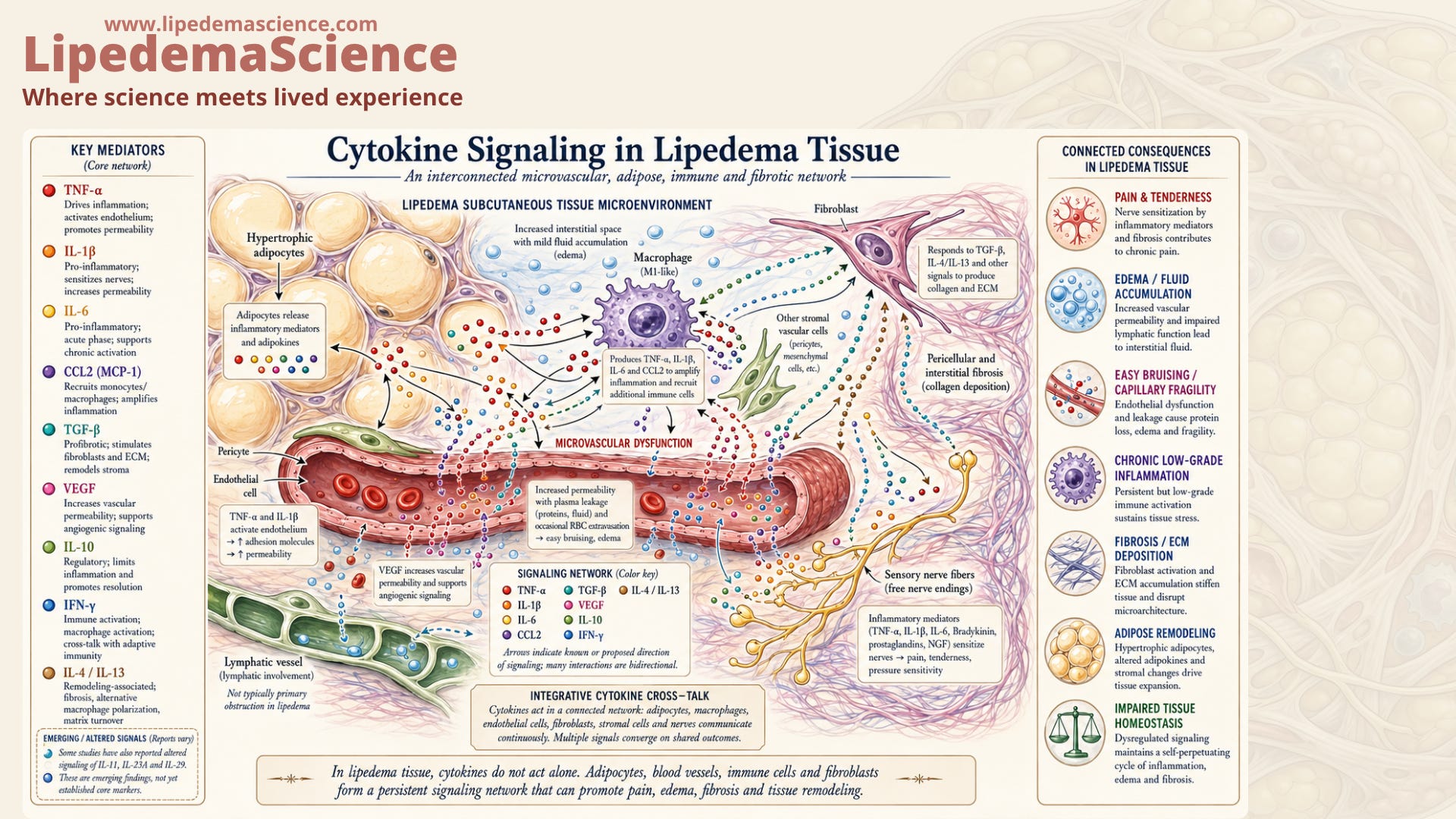
This does not mean that we should dismiss everything that has not yet been proven. It means we should be honest about what we know, what we suspect and what remains uncertain.
That is what I want LipedemaScience to do. I want to make research understandable without stripping away the details that determine what the research actually means. People living with lipedema should be able to understand how a study was conducted, what the researchers found, where the limitations are and whether the conclusions being shared online are stronger than the evidence allows.
Scientific information should not be reserved for academics and clinicians. The people living with the condition belong in the conversation too.
More than 14 years have now passed since I received my diagnosis. During that time, I have moved through pain, confusion, isolation, worsening symptoms, four surgeries and a long recovery. I have also developed a much deeper scientific understanding of the condition and a more workable relationship with my own body.
There are still things I do not understand about my lipedema. There are questions that researchers cannot answer yet either. I no longer see that uncertainty as a reason to fill the gaps with easy promises. I see it as a reason to keep reading, questioning and explaining.
For many years, I felt as though I was carrying all those questions alone. I do not anymore. Through LipedemaScience, I hope fewer people with lipedema will have to feel that way.
What is so disturbing about this horrible affliction is this. I cannot get coverage for surgeries because the United States government does not recognize it as essential. Medicare only covers Lymphedema surgery. So I am losing my mobility, fall down because of the sheer size of my legs. My balance is off when I walk so I get tripped up and fall. I had one hip replacement and will need the other replaced. My knees are deteriorating as well. How is this better than removing the cause of the immobility? Why isn’t someone drawing attention to this matter? I’m told I am beautiful at 68 years of age but I cannot go on a date because of my body. Then I have to see early stage women having surgeries and somehow getting them covered. And I see no signs of Lipedema whatsoever in their photos. And my eye is pretty well trained by now. It makes you not want to go on living. And you can’t say anything on social media about this happening or you are criticized.