


There are some women whose work cannot be separated from their lived experience. Aslıhan Elmas is one of them. She is a specialist dietitian, lecturer, lipedema researcher, and co founder of Eat Clean Turkey, but she is also a woman who has lived inside the very complexity she now helps others navigate. In her story, science and personal experience do not stand apart. They deepen one another.
Based in Istanbul, Aslıhan works at the intersection of women’s health, metabolism, inflammation, hormonal balance, and lipedema. Over the last decade, she has worked closely with thousands of women, while also building an academic and clinical voice in a field that is still too often overlooked. What makes her perspective so compelling is not only her professional depth, but the way she speaks about the female body with clarity, tenderness, and respect. In this conversation, she reflects on lipedema, endometriosis, delayed diagnosis, grief, the failures of healthcare systems, and why women’s health must finally be understood as interconnected rather than fragmented.
A life built around women’s health in Istanbul
Aslıhan Elmas lives and works in Istanbul, where her daily life moves between clinic rooms, academic teaching, research, and public education. She graduated in Nutrition and Dietetics and later completed a master’s degree in Training and Movement Sciences at the Faculty of Sports Sciences at Istanbul University. She also expanded her expertise in sports nutrition through training with the International Society of Sports Nutrition in London. Alongside her academic work, she co founded Eat Clean Turkey Nutrition and Diet Consultancy, where she works closely with clients while continuing to teach as a lecturer, having held roles at four universities throughout her career.
Her work today is grounded in a broad and deeply human understanding of health. For Aslıhan, health is never simply about a meal plan or a number on a scale. It is about the dynamic relationship between metabolism, hormones, connective tissue, inflammation, psychology, lifestyle, and the social environment that surrounds a woman’s life. That wider perspective did not come from textbooks alone. It was also shaped by what her own body would eventually teach her.
Living as both clinician and patient
Aslıhan does not see her identity as a dietitian and her identity as a woman living with lipedema as separate. Instead, she describes them as two realities that have deepened each other and made her work more real, more compassionate, and more honest. The clinician in her understands lipedema through physiology, lymphatic burden, connective tissue changes, hormonal shifts, and inflammatory processes. The woman in her understands something equally important, which is what it feels like to live inside a body that is repeatedly misunderstood.
That distinction matters. Lipedema is not only a condition of tissue change. It is also a condition that can quietly erode a woman’s trust in herself. Women may spend years dieting, exercising, and trying to follow every rule they are given, only to watch resistant changes in their lower body remain. Over time, many begin to internalize blame. They assume the problem is a lack of discipline, rather than biology. Aslıhan knows that emotional burden from the inside, and it is one of the reasons her work goes beyond nutrition plans. She supports women as they begin the much slower and more difficult process of rebuilding trust in their bodies.
The body was speaking long before there was a name
Looking back, Aslıhan can trace the beginning of her story to adolescence. Even as a young and active girl, she sensed that the fat distribution in her lower body seemed different. Volleyball and swimming were important parts of her life, and she was far from sedentary, yet her legs and hips remained resistant in a way that did not match the rest of her body. At the time, she did not interpret that as a medical issue. She simply assumed that this was the body she had.
As the years passed, other symptoms emerged. There was easy bruising, tenderness to touch, swelling, edema, and periods of increasing pain. Yet, like so many women, she moved through those signs without anyone helping her connect them into a coherent picture. Only later would she realize that her body had been sending clear signals from a very early age. The problem was not that the signs were absent. The problem was that they had no name.
The moment lipedema entered the picture
The realization that this might be lipedema did not come quickly. It took years. One of the defining moments came about a decade ago, when one of Aslıhan’s clients introduced her to the word “lipedema.” She still remembers the significance of that moment, because it felt as though scattered pieces of a much older puzzle suddenly began to align. After that, she immersed herself in the German and English literature, where much of the earlier scientific work on lipedema had taken shape.
For her, the diagnosis was about far more than acquiring a label. It meant understanding that what she had lived with was not a failure of willpower, but a biological reality. That recognition brought relief, but it also brought grief. To finally understand a chronic condition is often to face two truths at once. There is comfort in being validated, and sorrow in realizing how long one has carried something unnamed. For Aslıhan, however, that moment also created purpose. She made a decision that lipedema would not remain only a personal matter. It would become a scientific, clinical, and human responsibility.
Beyond one diagnosis
Aslıhan’s health journey has not been limited to lipedema. She has also spoken openly about living with endometriosis, ovarian cysts, surgery, recurrences, hormonal fluctuations, and periods that felt similar to early menopause. Her story reflects something many women know all too well, which is that women’s health rarely fits neatly into one diagnosis. One problem does not simply end before another begins. Symptoms overlap. One process intensifies another. Fatigue, pain, swelling, hormonal instability, and uncertainty can all accumulate until the body no longer makes sense when divided into separate categories.
That is precisely why Aslıhan’s approach to women’s health is so integrative. She does not isolate symptoms and treat them as unrelated events. She sees them as different expressions of a larger physiological picture. It is also why many women are likely to recognize themselves in the way she speaks. She understands the theory, but she also understands the fragility of living in a body where several chronic processes may be unfolding at the same time.
Are lipedema and endometriosis connected
Aslıhan is careful not to overstate what science can currently prove. She does not claim that lipedema and endometriosis are the same disease, nor does she present a definitive causal link between them. What she does say is that clinical observation and emerging literature suggest that they may share important biological pathways. Chronic low grade inflammation, estrogen related dynamics, immune regulation, gut health, and hormonal fluctuation appear again and again in both conditions.
What matters in practice is that women often do not experience these disorders in isolation. They experience them as overlapping burdens inside the same body. This is where the traditional tendency to separate the body into neat compartments becomes inadequate. In real life, symptoms do not respect specialty boundaries. Pain, edema, hormonal imbalance, exhaustion, and emotional vulnerability can become the shared language of several conditions at once. Aslıhan believes that women’s health must therefore be understood through interconnected physiological networks rather than through one organ system at a time.
The cost of not being recognized
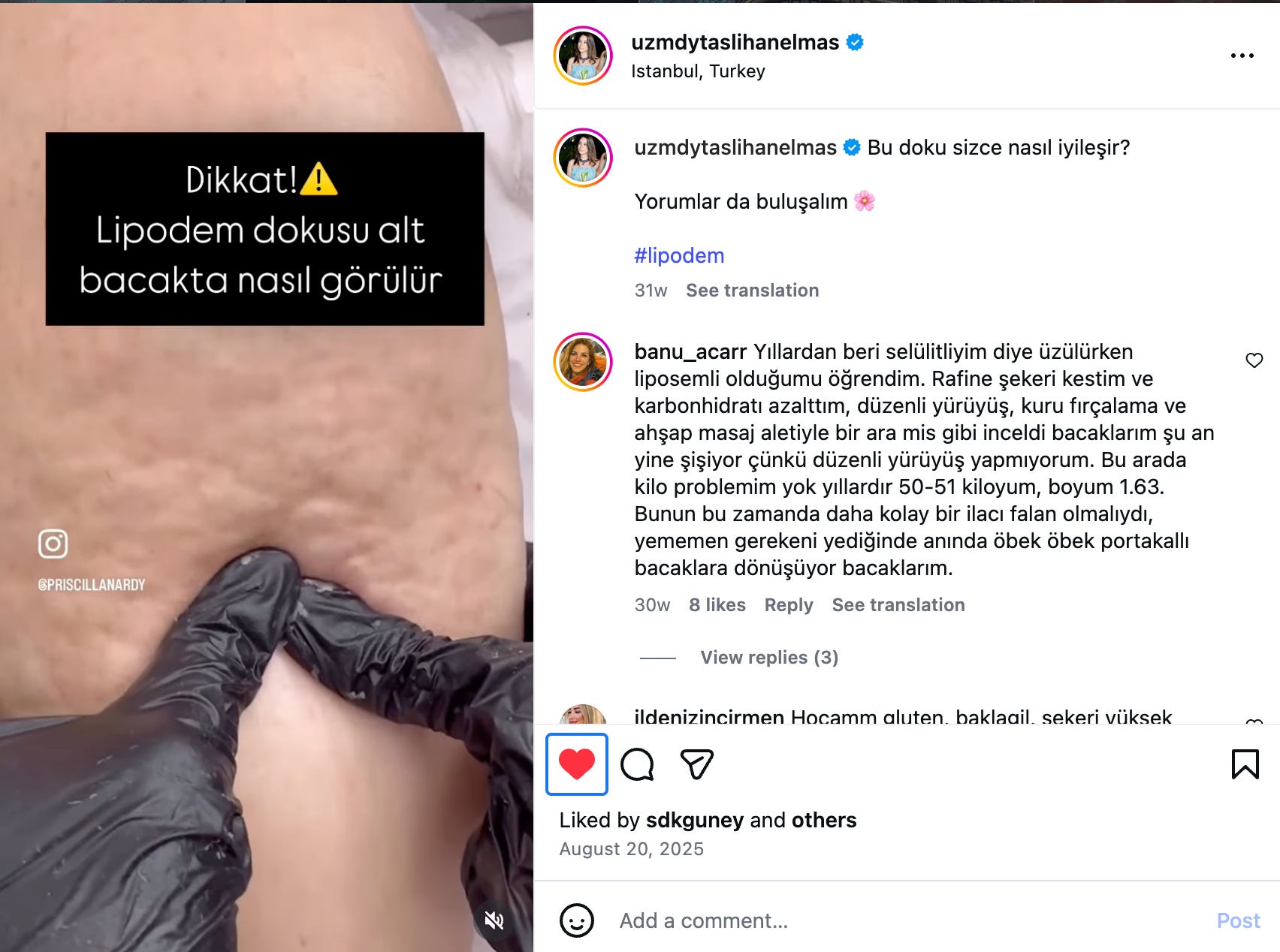
When asked about the healthcare system in Türkiye, Aslıhan speaks with both realism and hope. For many years, she does not believe lipedema was sufficiently recognized. Women were often passed from one specialist to another without ever receiving a meaningful explanation for what they were living with. Their symptoms were reduced to weight gain, regional fat accumulation, or aesthetic concern, while the pain, tenderness, bruising, edema, mobility limitations, and psychological burden remained invisible.
She believes awareness is improving, and that is significant. Social media, patient communities, scientific communication, and growing clinical visibility have all contributed to a much more open discussion of lipedema in recent years. Women are beginning to ask more confidently whether the changes in their bodies are truly normal. Yet Aslıhan is equally aware that visibility can bring misinformation as well as progress. For that reason, she has dedicated years to content creation, teaching, speaking, and research. Her goal is not merely to increase information, but to increase the right kind of information. She wants women to have access to knowledge that is reliable, evidence based, and clinically useful.
The most harmful misconception
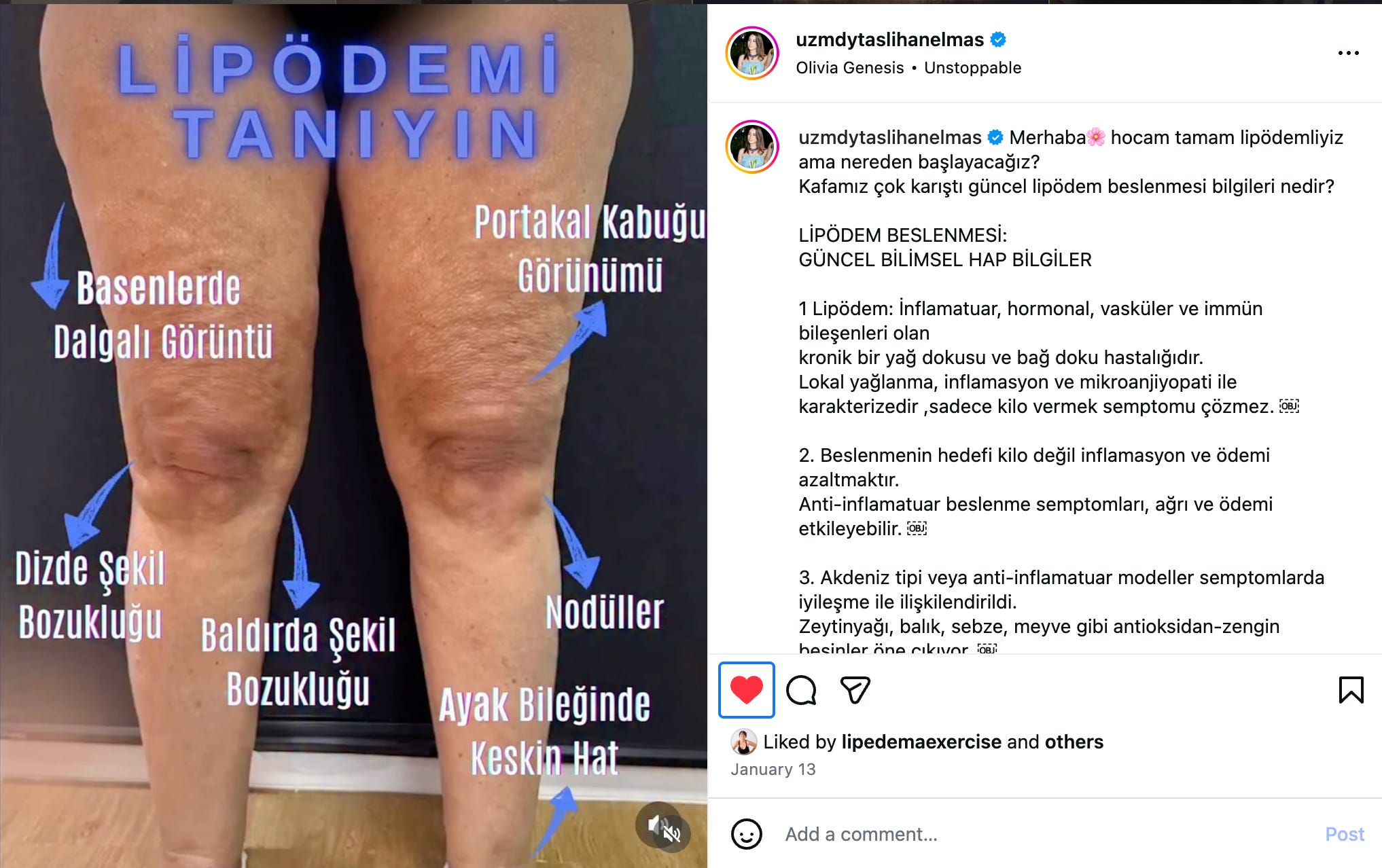
For Aslıhan, the single most harmful misconception about lipedema is the belief that it is simply excess weight. That misunderstanding is not only scientifically incorrect. It is psychologically destructive. Most women with lipedema have already spent years trying to lose weight, often with intense effort and increasing self criticism. When the lower body remains resistant, the assumption that the condition is purely a consequence of eating or activity places women in the wrong framework altogether.
She emphasizes that lipedema is a chronic adipose tissue disorder with inflammatory and metabolic features. Connective tissue characteristics, lymphatic burden, hormonal transitions, and inflammation are all part of the picture. Weight may be relevant, but it is never sufficient as an explanation. A purely weight based interpretation leaves women feeling morally responsible for something that is biological. In Aslıhan’s view, correcting that misunderstanding is essential not only for better treatment, but also for a woman’s psychological well being.
A personal meaning shaped by memory and grief
When Aslıhan speaks about what lipedema means to her personally, the conversation deepens. For her, lipedema is not only a diagnosis. It is also a symbol of how long the female body has been misunderstood, and how slowly women’s health has been taken seriously. It is tied to her own story, but also to the story of her mother. Looking back, she believes her mother may also have lived with a body affected by lipedema, though there was no language for it at the time. There was leg pain, heaviness, fatigue, and the ache of not being fully understood.
Her mother died of a brain hemorrhage at the age of fifty two, while Aslıhan was abroad for training. That loss left a profound mark on her life. It also gave her work an emotional depth that cannot be manufactured. She now sees part of her role in lipedema care as an act of responsibility shaped by grief. In helping women be understood earlier than previous generations were, she is also, in some sense, responding to the story her mother never had the chance to name.
Clean eating as regulation rather than punishment
Aslıhan’s concept of clean eating is far removed from wellness culture slogans or rigid purity based ideas about food. For her, clean eating is an approach that matured through clinical work, personal experience, and years of listening carefully to what women’s bodies were asking for. When she co founded Eat Clean Turkey, the deeper aim was not to build a brand around aesthetics. It was to build a system that would place less burden on the body and help regulate, calm, and support it.
That means emphasizing real and minimally processed foods, anti inflammatory choices, gut support, blood sugar stability, and sustainability. Yet what may be even more important is the philosophy beneath those principles. Clean eating, in her view, is not about perfection, punishment, or endless restriction. It is about listening to the body’s feedback and building a more respectful relationship with it. This is especially significant for women with lipedema, whose bodies have often already been treated like problems to be fixed.
How chronic illness transformed her nutritional philosophy
Although Aslıhan’s academic training gave her a strong foundation in physiology, metabolism, and nutritional biochemistry, she says that living through lipedema, endometriosis, surgery, cysts, recurrences, and hormonal instability changed her understanding of nutrition profoundly. It showed her in a far more personal way that nutrition is never only about calories. It can affect inflammatory burden, gut permeability, hormone metabolism, immune signaling, edema, pain experience, and even a woman’s relationship to her own body.
Because of that, her clinical approach no longer centers weight loss as the primary goal. Instead, she focuses on helping regulate the body, reduce burden on tissues, support metabolic and hormonal balance, and create a sense of safety within the body again. Her work is less about forcing the body to comply and more about reducing the conditions that keep the body in a constant state of alarm.
What truly supports women with lipedema
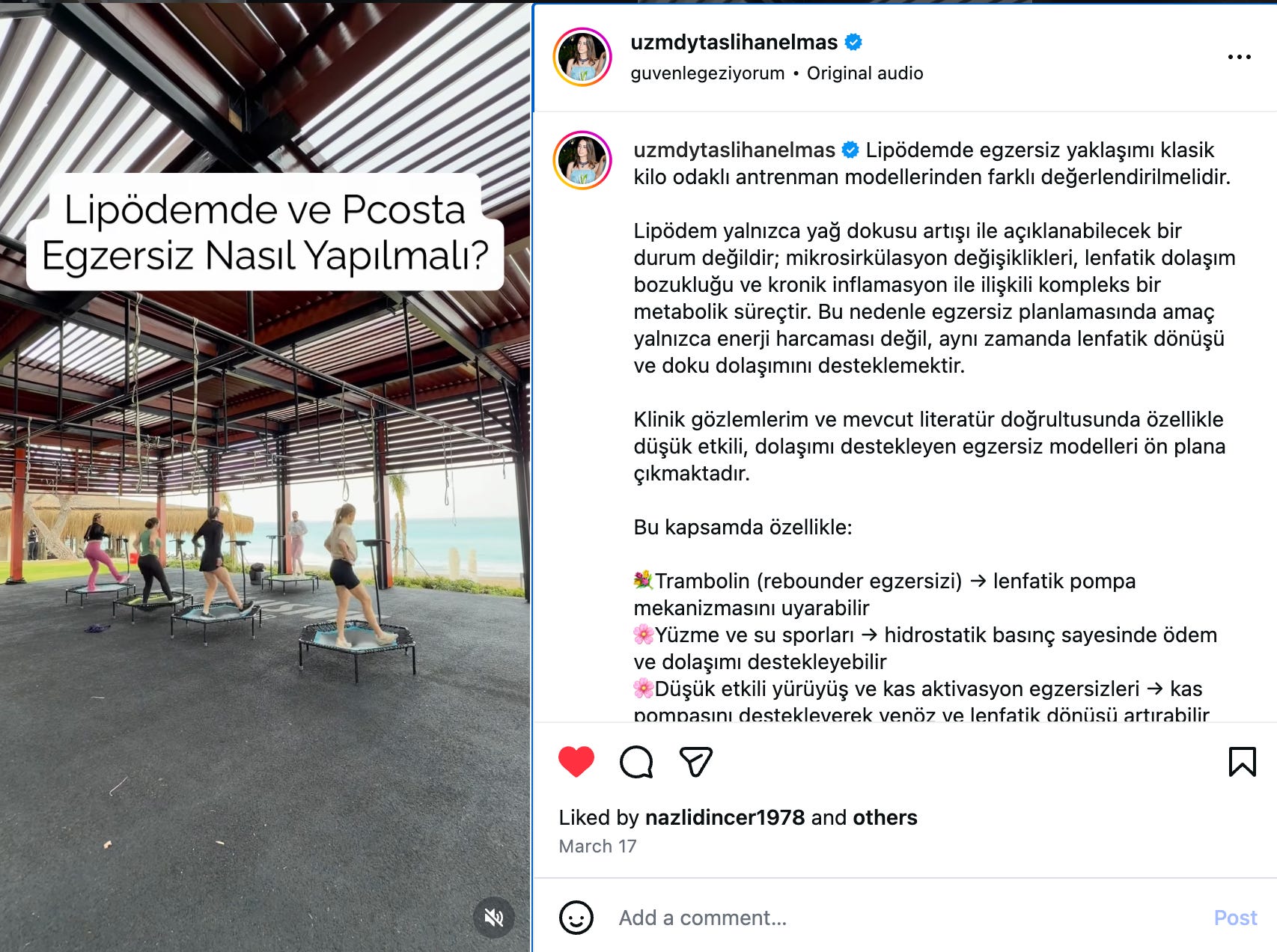
Aslıhan is clear that she does not believe in one universal diet for lipedema. Every woman comes with her own metabolic profile, hormonal context, stress burden, gut patterns, lifestyle, and symptom presentation. Even so, she sees some principles emerge repeatedly as helpful. These include reducing inflammation, maintaining blood sugar balance, supporting gut health, identifying food sensitivities with care rather than fear, and creating eating patterns that are sustainable rather than extreme.
Just as important is what she does not recommend. She sees many women approach their bodies through repeated detoxes, severe calorie restriction, rigid meal plans, fasting protocols, and quick fix systems that promise dramatic results. While these may sometimes create short term changes, they often lead to metabolic stress, more edema, greater disappointment, disordered eating patterns, and a deepening sense of failure. In her view, the most common nutritional mistake is not a specific food. It is approaching the body with a mindset of punishment.
Stress, emotion, and the invisible burden
For Aslıhan, stress is not a secondary issue in lipedema. It is central. Chronic stress can influence cortisol, sleep, inflammation, fluid retention, and hormonal balance, but she also emphasizes the emotional dimension that is harder to measure. Women with lipedema often carry years of being minimized, criticized, or dismissed because of their bodies. That emotional burden does not disappear simply because it is invisible.
This is one reason she believes psychological support, nervous system regulation, and a compassionate clinical approach should be part of lipedema management rather than optional extras. In her work, she has seen again and again that what a woman may need first is not another list of rules, but an experience of being heard without judgment. Sometimes the beginning of healing is not a diet plan, but the first moment a woman feels understood.
Pain, swelling, and the exhaustion of not being believed
When asked what women with lipedema struggle with most, Aslıhan returns to three themes that surface repeatedly in both clinic and conversation. The first is pain. The second is swelling and heaviness. The third, and sometimes the most exhausting of all, is not being understood. Many women are told again and again that if they would simply lose a little more weight, their problem would disappear. Such comments may seem casual from the outside, but they can do profound internal harm.
That is because most of these women have already tried. They have often done everything asked of them. What wears them down is not only the symptom burden itself, but the way their symptoms are continually interpreted through simplistic and moralizing narratives. In this sense, lipedema is not only a physical condition. It is also a social one, shaped by the language and assumptions women encounter around their bodies.
Changing the relationship with the body
Living with lipedema changed Aslıhan’s relationship with her own body in a deep and lasting way. She describes moving from a harsher, more critical perspective toward one rooted in understanding. Earlier in life, she often found herself asking why her body would not change despite effort. Over time, she came to see the body not as an enemy, but as a system trying to communicate.
That shift may sound simple, but it changes everything. When the body is no longer viewed as a mistake to correct, treatment itself begins to look different. The goal becomes less about control and more about cooperation. Today, Aslıhan sees the body as a structure that sends signals, seeks protection, and requires partnership rather than force. It is a perspective that brings both scientific sophistication and emotional maturity into the same frame.
Making the invisible visible
Aslıhan began creating content about lipedema because she realized how many women were alone. When she first started speaking publicly, the messages she received made it unmistakably clear that many women were encountering the word lipedema for the first time through her work. For some, it was the first time they could connect years of symptoms to a real and meaningful name. That moment of recognition mattered deeply.
Her motivation was never visibility for its own sake. It was about breaking a collective silence. She wanted to create a language around lipedema that was scientific, understandable, empathetic, and hopeful all at once. Accurate information, when offered with care, can do something powerful. It can allow a woman to stop blaming herself and begin breathing more freely inside her own body.
Building research from lived clinical reality
Alongside her clinical and educational work, Aslıhan is conducting academic research focused on dietary habits, supplement use, exercise behavior, inflammation, and lifestyle factors in women with lipedema. She believes it is not enough to observe patterns in the clinic. Those observations must be translated into data and into contributions that can strengthen the scientific literature. In Türkiye, she sees a major need for more nutrition and lifestyle focused lipedema research, and she has chosen to help build that field rather than wait for it to appear.
Her research questions are shaped by what she sees in real women’s lives. She is especially interested in the relationship between inflammation and metabolism, including the roles of gut microbiota, hormone metabolism, dietary patterns, symptom burden, and exercise in quality of life. What she ultimately wants to understand is which strategies genuinely help reduce symptom burden, improve well being, and restore trust in the body rather than simply offering superficial management.
What lipedema research still lacks
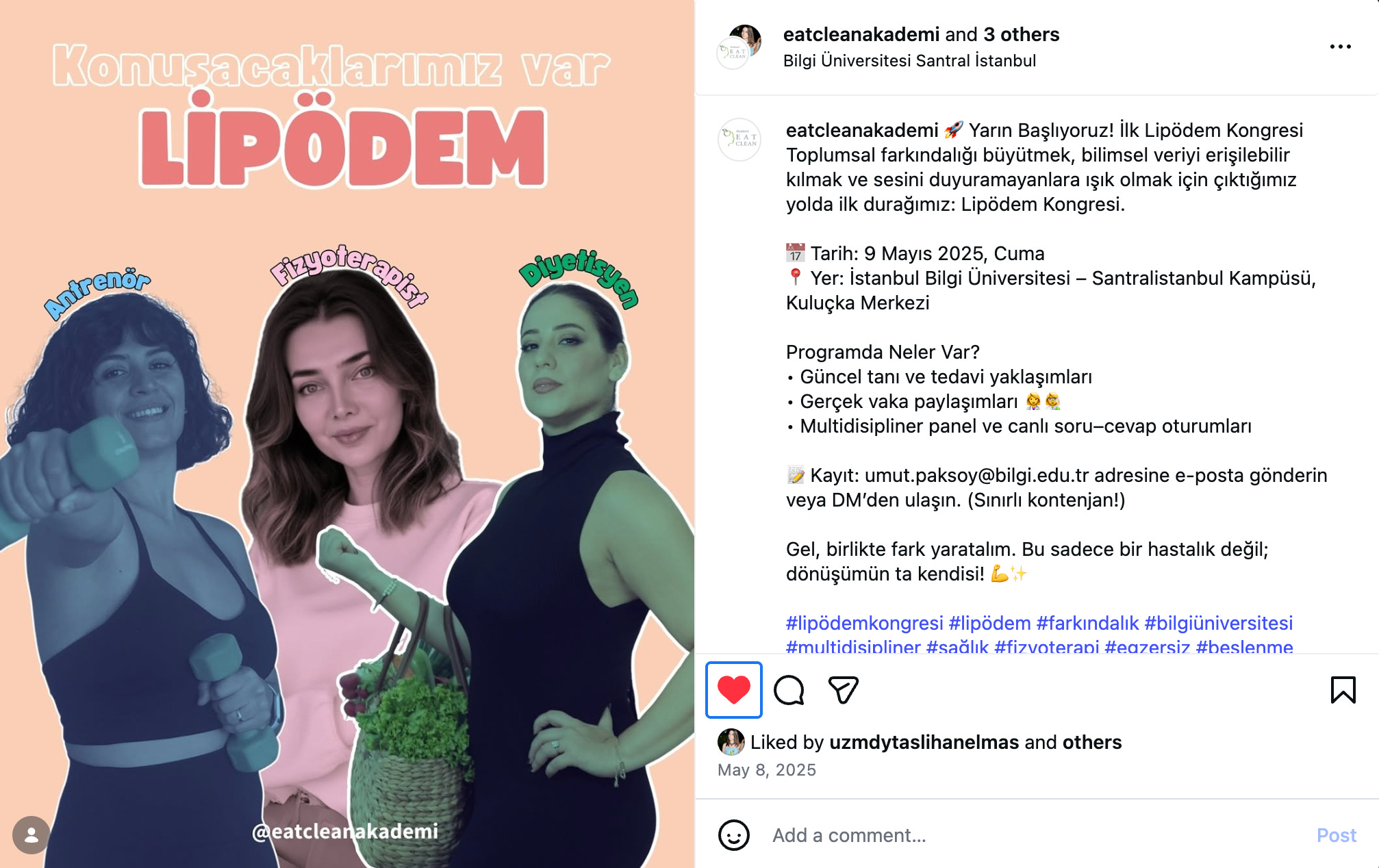
Aslıhan believes one of the biggest gaps in lipedema research is the absence of a truly multidisciplinary framework. Too often, lipedema is discussed through only one lens. In some settings, the conversation is dominated by surgery. In others, by lymphatics, nutrition, or aesthetics. Yet the reality of lipedema does not respect those divisions. Connective tissue, hormones, inflammation, metabolism, lymphatic burden, psychology, and quality of life are deeply intertwined.
What is needed, she argues, is not more fragmentation, but more listening across disciplines. More long term follow up, more women centered data, more quality of life research, and a stronger bridge between clinical practice and scientific inquiry are all essential. Lipedema cannot be adequately understood through what is visible alone. The future of the field depends on taking seriously what women have long been saying about their bodies.
Women with lipedema in Türkiye deserve to be seen
Aslıhan is passionate about making sure the world understands that women with lipedema in Türkiye are living through the same delays, uncertainties, and burdens that women elsewhere know so well. Delayed diagnosis remains common, and many women move through years of symptoms without clear recognition. In a cultural environment where critical language about the female body can already be widespread, that uncertainty becomes even heavier.
What she wants the world to know is that these women exist, that their stories are powerful, and that they need more than treatment alone. They need visibility, scientific representation, and respectful clinical language. They need to feel that their bodies are not being reduced to appearance, but understood in their full biological and human complexity.
What she would say to a woman who suspects lipedema
If a woman suspects she may have lipedema, Aslıhan’s first message is simple and profound. She is not alone. It is understandable if she has spent years struggling to explain what she feels, hearing the same dismissive comments, and blaming herself for something she could not change. What she is experiencing may have a name, and it can be understood.
Her second message is just as important. The path forward should not be built on punishment, but on accurate information and the right professionals. Lipedema management does not require perfectionism. It requires awareness, regulation, informed support, and a willingness to work with the body rather than against it. Not everything changes overnight, but being understood is often the first real step toward healing.
Hope rooted in change
Despite all that remains unfinished, Aslıhan is hopeful. She finds hope in the fact that lipedema is being taken more seriously, that more research is emerging, that more women are speaking openly, and that younger healthcare professionals are beginning to approach women’s health with greater holism and sensitivity. She believes the future belongs not to isolated disciplines, but to team based care that sees biological, psychological, and emotional wholeness as inseparable.
After years of work, she has seen enough change to know that transformation is possible. That knowledge gives her strength. It also gives others something equally valuable, which is a sense that the silence around women’s health is not fixed. It can be challenged. It can be rewritten.
A story that reaches far beyond one woman
What stays with you after hearing Aslıhan Elmas speak is not only her knowledge, though that is substantial. It is the way she insists that women’s bodies deserve to be understood without blame. Her story is personal, but it also reflects something collective. It speaks to the long history of women being told that their pain is normal, their swelling is cosmetic, their fatigue is unimportant, and their bodies are simply personal failures in need of more discipline.
Against that history, Aslıhan offers something else. She offers a language of science joined with empathy. She offers a model of care that does not fragment the body into isolated problems, but sees the full network of inflammation, hormones, metabolism, connective tissue, emotion, and lived experience. Most of all, she offers women the possibility of being seen earlier, more clearly, and with more dignity than previous generations were.
That may be one of the most powerful forms of progress we have.
