
Lipedema Defined by the World Health Organization
A milestone in medical recognition – moving lipedema from misunderstanding to science. A turning point for awareness.

The global recognition of lipedema by the World Health Organization marks a profound change in how the condition is seen and discussed. For decades, women with lipedema have been misunderstood, often told that their symptoms were related to weight or lifestyle. In 2022, the WHO officially included lipedema as a distinct diagnosis in its International Classification of Diseases, ICD-11, under the code EF02.2.
This milestone moves lipedema out of the shadows of cosmetic or weight-related stigma and into the realm of legitimate medical research. It sends a clear message to healthcare systems around the world: lipedema is real, chronic, and biologically complex.
The Official WHO Description
The WHO’s definition describes lipedema as a “non-pitting diffuse fatty swelling”, usually confined to the legs, thighs, hips, and upper arms. It can sometimes be mistaken for lymphedema, though the underlying mechanisms differ. Interestingly, WHO notes that lipedema can also occur in the scalp—a lesser-known but documented manifestation.
ICD-11 Code: EF02.2
The classification includes related terms such as lipoedematous scalp and lipoedematous alopecia, and recognizes overlapping conditions like lipo-lymphoedema under connected categories. This level of detail matters—it helps clinicians, researchers, and insurance systems align on a shared understanding of what lipedema is, and what it is not.
A Systemic and Hormone-Driven Disease
Lipedema is now recognized as a chronic disease of the subcutaneous fat tissue, primarily affecting women. Its exact cause is still being uncovered, but science points strongly toward hormonal and genetic factors. The disease often appears or worsens after major hormonal shifts such as puberty, pregnancy, or menopause.
Research suggests that these phases may trigger changes in how estrogen interacts with fat tissue. Abnormal expression of estrogen receptors in adipose cells appears to drive both fat accumulation and the painful inflammation seen in lipedema. This biological link confirms what many women have felt for years: the problem lies not in willpower or lifestyle, but in cellular signaling and hormone metabolism.
Living with Lipedema: What Science Now Emphasizes
While there is still no known cure for lipedema, recognition of its hormonal and metabolic basis opens new doors for care. Treatment today focuses on symptom management, pain reduction, and prevention of further progression. Maintaining mobility and function, reducing swelling, and protecting the lymphatic system are central goals.
Lifestyle strategies such as anti-inflammatory nutrition, regular low-impact movement, and maintaining a stable body composition can make a measurable difference. Understanding how hormones, inflammation, and metabolism interact gives women a stronger foundation for self-management—and for seeking medical support grounded in science rather than stigma.
Looking Ahead
With the WHO’s inclusion of lipedema in the ICD-11, the conversation is changing. What was once dismissed as a cosmetic concern is now being examined as a complex, hormone-sensitive disorder that deserves serious attention.
For women living with lipedema, this shift represents more than a new medical code—it is validation, hope, and a new era of understanding. As research grows, so too does the possibility of targeted treatments that address the biology beneath the surface.
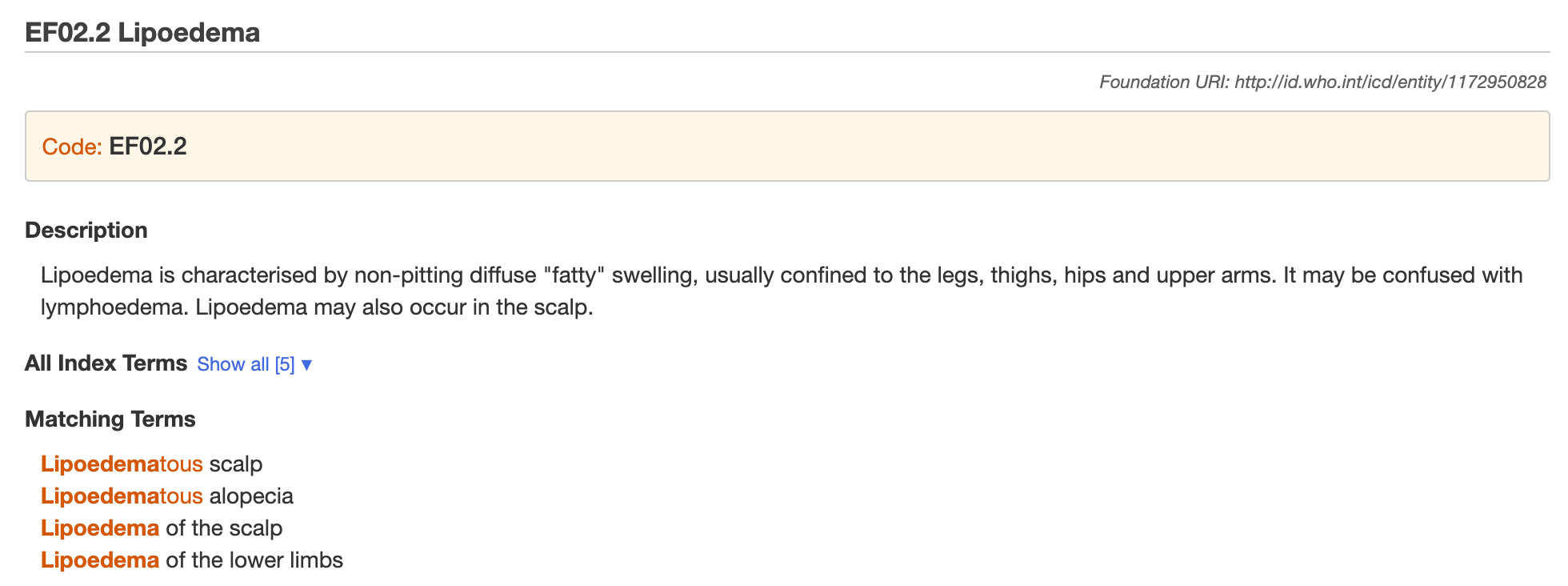
ICD-11 for Mortality and Morbidity Statistics (https://icd.who.int/browse/2025-01/mms/en)