

In March 2026, two researchers from Germany, Katharina Helena Morawitz and Julia Christina Gross, published a new scientific article about lipedema in the journal Frontiers in Cell and Developmental Biology. This is not an old review but a very recent “hypothesis” paper, which means the authors pull together what is known and suggest how different pieces might fit together rather than testing one single treatment. Their focus is on how cells in lipedema fat tissue talk to each other using tiny “message bubbles” called extracellular vesicles, and how this might help explain pain, swelling, bruising, and why the fat in lipedema behaves differently from ordinary weight gain.
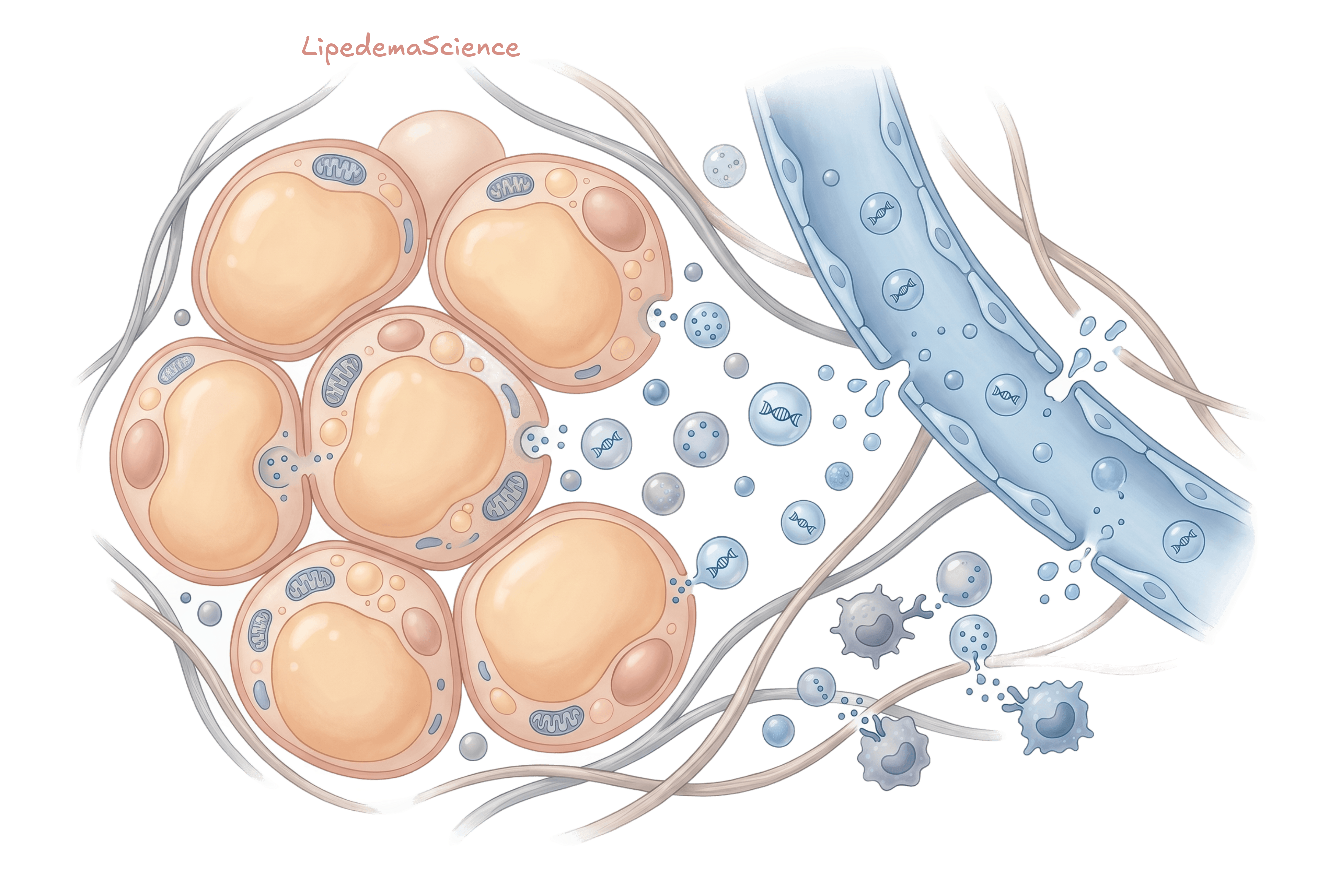
The goal of this article is to translate that complex paper into everyday language, so you can understand what scientists are currently thinking about lipedema – without needing any medical or biology background.
What is lipedema, in simple terms?
The authors describe lipedema as a long‑lasting condition where fat under the skin builds up in a very specific way, mainly on the legs (and often the hips and sometimes arms) in a symmetrical pattern. This fat can be painful or tender to touch, the affected areas bruise easily, and many people feel their legs are heavy and tight.
Important points the paper underlines:
Lipedema happens almost only in women and tends to start or get worse around times of major hormone changes such as puberty, pregnancy, or menopause.
It is common – up to about 10–15% of women may be affected – but still often missed or mistaken for “just obesity” or for lymphedema.
The extra fat in lipedema is mostly under the skin (subcutaneous fat), and it is often resistant to diet and exercise.
Many people with lipedema do not have the blood sugar and cholesterol problems that go along with metabolic syndrome and typical obesity.
In other words, the authors stress that lipedema is not simply a matter of “eating too much” or “not moving enough”, but a specific fat‑tissue disease with its own biology.
How is lipedema different from “regular” obesity?
The article spends time comparing lipedema to obesity and metabolic syndrome, because at first glance they all involve “too much fat”.
Some of the key differences they highlight:
