

I typed it because sometimes the clearest way to see the truth is to stare at the mirror you have been avoiding. Also because there is a particular kind of dark comedy in asking a machine to outline your own self sabotage, then realizing it basically describes modern life with better grammar.
And the answer was so brutally predictable that I laughed out loud. Not the fun laugh. The one where you are laughing because otherwise you might start negotiating with your pantry at midnight.
The AI said, in essence, if you want lipedema progression to sprint, treat your body like a flooded basement and then act surprised when the walls start growing mold.
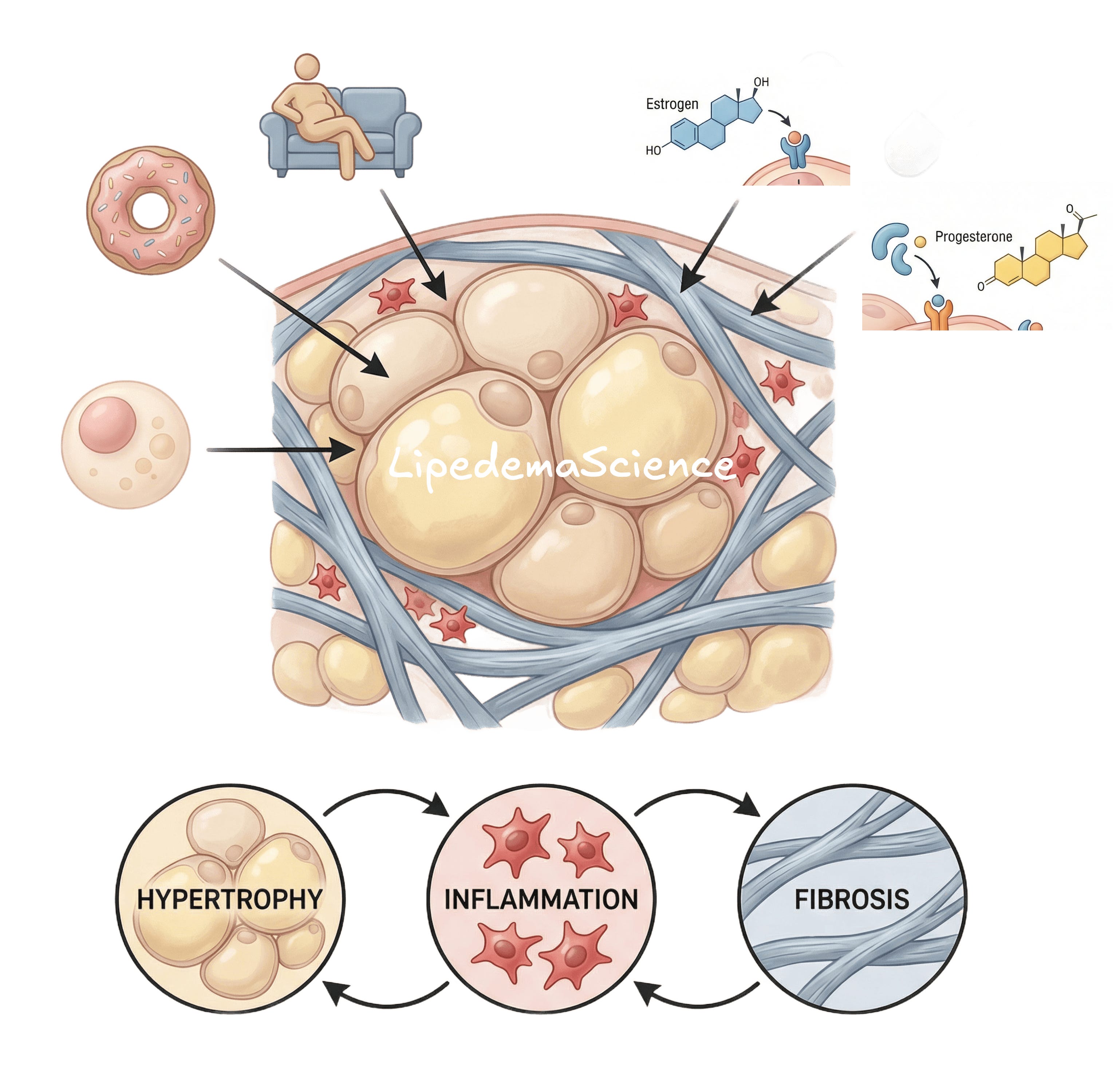
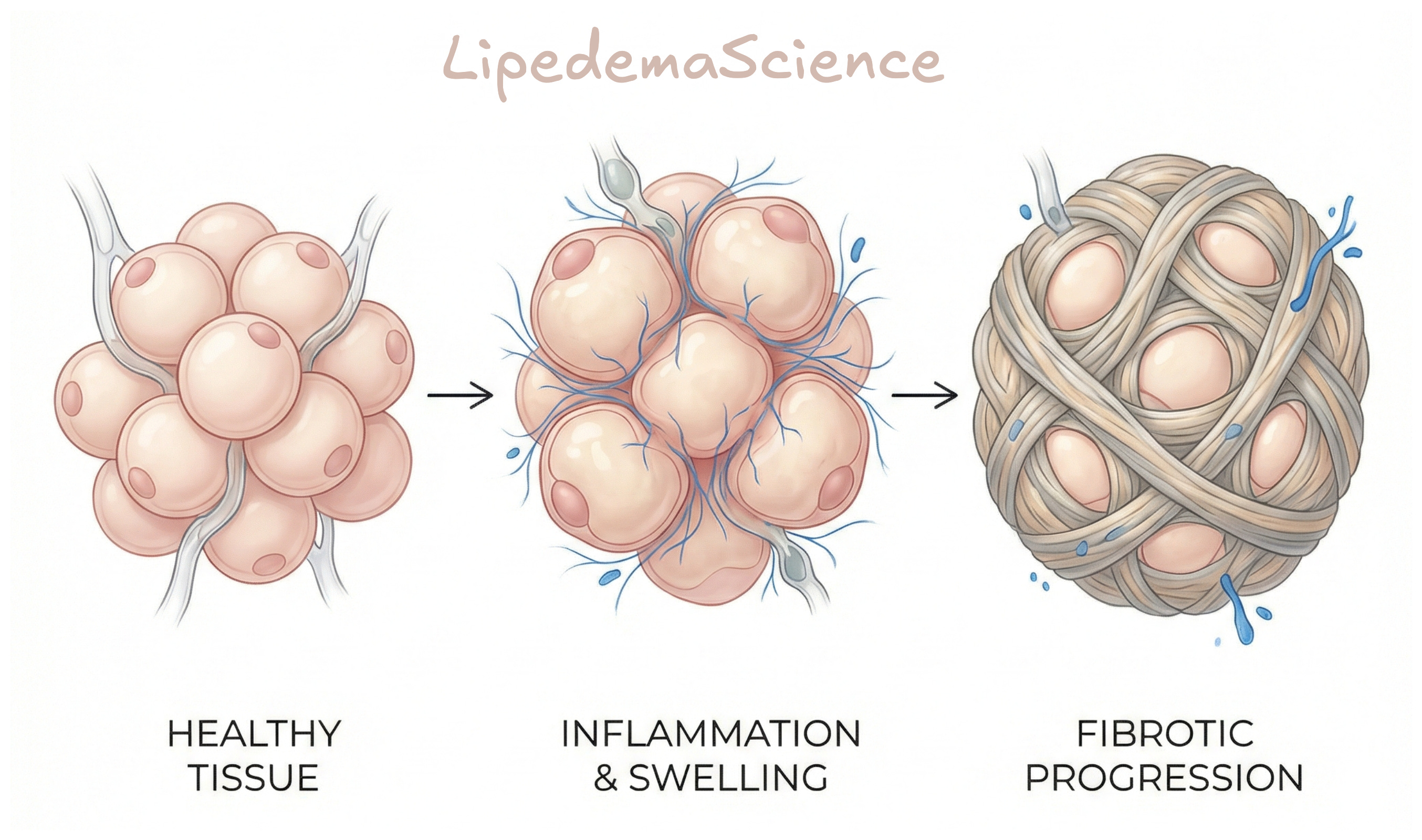
It talked about inflammation, swelling, low oxygen in tissue, and that slow drift from soft and reactive tissue toward stiffer, more fibrotic, less forgiving tissue. It described a spiral where swelling and pain make you move less, moving less makes swelling worse, and worse swelling makes movement feel like punishment. Then, over time, the tissue stops behaving like a sponge and starts behaving like a mattress someone left out in the rain.
Here is the part that landed for me.
Progression rarely looks like a dramatic overnight change. It looks like small permissions you give to the wrong direction.
One more week of white knuckling stress. One more month of eating like you are trying to win a speed run competition against your own nervous system. One more season of thinking you will deal with it when life calms down. One more year of “I know what I should do, I just cannot right now.”
And suddenly you are not just managing symptoms. You are managing a shape shifting relationship with your own body.
So let’s talk about lipedema progression the way it often happens in real life. Not in perfect patient brochures. Not in the neat before and after fantasies. In the messy human middle.
You know that feeling when your legs do not just feel heavy, they feel full. Like the tissue is holding a grudge. Like it has its own weather system. Some days it is calm. Some days it is a thunderstorm. And you can almost trace it back. The salty dinner. The travel day. The weeks of poor sleep. The month you stopped walking because it was cold and dark and your brain said “hibernation is self care.”
Have you ever noticed how lipedema does not just respond to what you do, but to what you do repeatedly?
One flare is not the story. The pattern is the story.
There is a moment many women describe, and once you see it, you cannot unsee it. The moment where you realize the tissue is not only bigger, it is different. It is less compressible. More nodular. Less willing to bounce back. More like it is settling into a new normal.
That is the concept that scares people, and also empowers them, when handled honestly.
Because if tissue can change in an unhelpful direction over time, then tissue can also be influenced in a helpful direction over time. Not magically. Not perfectly. Not through punishment. Through steady pressure in the right direction.
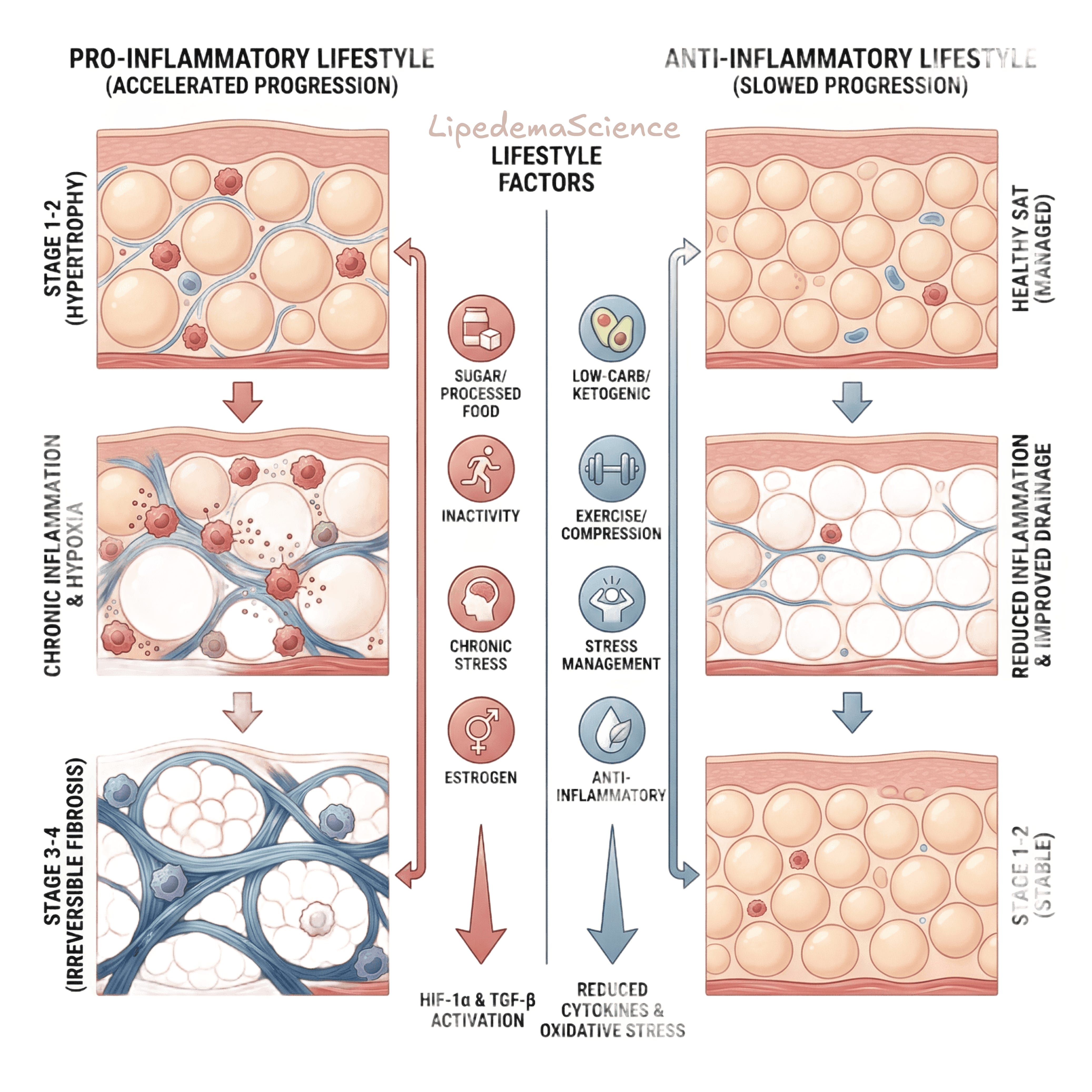
The AI’s “how to worsen it” list was basically a greatest hits album of chronic inflammation and stagnant circulation.
Eat in a way that spikes and crashes your blood sugar so often your body starts treating every afternoon like an emergency meeting. Sit still for long stretches so the muscle pump in your legs basically clocks out. Ignore swelling until swelling becomes your baseline. Stay chronically stressed so your nervous system never returns to neutral. Sleep like it is optional. Treat movement like a moral performance where you either do an intense workout or you do nothing.
Does any of this sound familiar? Not as a character flaw. As a season of life.
Here is the inconvenient truth. Lipedema progression is not simply about fat. It is about the environment around that fat. The fluid. The microcirculation. The immune activity. The connective tissue remodeling that happens when a tissue lives under ongoing stress signals.
You do not need to memorize molecular pathways to understand the logic.
When tissue is swollen and inflamed, it becomes a crowded city with traffic jams. Oxygen delivery gets worse. Waste removal gets worse. The cells start behaving like they are under threat. The body responds by building more scaffolding. More structure. More collagen. And structure sounds nice until you remember that too much structure is literally what fibrosis is.
It is the body trying to stabilize a problem by building a cage.
And the cage is not built in a week. It is built in tiny daily deposits. Like lint in a dryer filter that nobody cleans because “it is fine.”
This is where the humor gets uncomfortably personal.
If you wanted to speed run lipedema progression, you would pick a lifestyle that is basically designed to make lymph and circulation miserable.
You would start your day with caffeine and urgency. You would eat something quick and sweet because you are “too busy” for real food. You would sit for hours. You would be so mentally tired that cooking feels like climbing a mountain, so dinner becomes something packaged, salty, and engineered to be impossible to stop eating once you start. You would go to bed too late because nighttime is the only time nobody needs anything from you. Then you would wake up and wonder why your body feels like it is wearing a weighted blanket.
And you would blame yourself…
But what if the more useful question is not “What is wrong with me” but “What direction is my day pointing”?
Because your day has a direction. Even when you feel stuck, your routines are voting.
Are your habits creating more swelling, more inflammation, more stagnation, more tissue stress. Or are they creating more drainage, more stability, more oxygenation, more resilience.
This is where I want you to pause and get specific.
When do you feel your lipedema is most reactive.
Is it after sugar. After alcohol. After a long flight. After a week of terrible sleep. After standing still for long periods. After intense high impact workouts that leave you sore and puffy. After emotional stress that sits in your chest like a stone.
And when do you feel even a little bit better..?
Not cured. Not perfect. Just slightly more comfortable in your own legs.
Is it after a walk that is gentle enough to do again tomorrow. After water, protein, and real meals that do not create chaos. After compression that actually fits and does not feel like a wrestling match with your own body. After you stop trying to fix everything at once and instead build a few habits that are boring and effective.
Boring is underrated, by the way. Boring is where progress lives.
Progression loves drama. Progress loves consistency.
There is also a psychological trap that deserves to be named.
Many women live with a constant low grade sense of urgency around their bodies. Like they have to fix it fast, or they are failing. So they try extreme diets, punishing workouts, strict rules. It works for ten days. Then life happens. Then the pendulum swings back. Then the body reacts. Then shame enters the room carrying a clipboard.
Have you noticed how lipedema tends to hate pendulums?
The tissue seems to prefer steadiness. The nervous system prefers steadiness. The lymphatic system definitely prefers steadiness. The immune system, too.
So what if your next chapter is not about intensity, but about reducing the things that provoke the tissue to behave like it is under siege.
What if your plan is not “do more” but “remove friction from the basics”..?
Food that steadies your energy. Movement that you can repeat. Tools for swelling that actually fit your life. Sleep that is protected like a budget line item. Stress that is handled like a real physiological input, not a personality test.
And yes, hormones matter for many women, but the daily inputs still matter. Hormones are the tide. Lifestyle is the weather. You cannot control the tide, but you can stop leaving your windows open in a storm.
Now I want to get even more honest.
Sometimes progression is not about a single choice, it is about a season.
The season where you are caring for others and your body becomes an afterthought. The season where work is brutal and your meals become whatever can be eaten one handed while answering messages. The season where grief hits and your nervous system is raw. The season where you are doing “all the right things” and your body still feels unfair.
If you are in that season, you do not need a lecture. You need a strategy that respects reality.
So here is a thought experiment that I find oddly calming.
Imagine you could watch your tissue like a time lapse video.
In the version where you do nothing to support drainage and stability, what do you think happens over five years.
In the version where you make a few steady changes, what do you think happens over five years.
Not the fantasy version. The realistic version.
Would your pain change. Your mobility. Your bruising. Your swelling swings. Your ability to travel. Your willingness to be photographed. Your mood. Your relationship with your own legs.
And what would it mean if the biggest lever is not perfection, but direction.
That is the aha that keeps returning for me.
Progression is often the result of repeated signals that tell the tissue “we are under stress” and not enough signals that tell it “we are safe, we are moving, we are draining, we are recovering.”
So the AI answer, while dramatic, gave me something useful.
It showed me what to stop normalizing.
Stop normalizing daily swelling as “just how my body is.” Stop normalizing constant fatigue as a personality trait. Stop normalizing being in fight or flight all day. Stop normalizing food that makes you feel inflamed as the price of convenience. Stop normalizing movement patterns that leave you worse for two days, so you avoid moving at all.
And replace it with a simple question you can ask in the moment.
Will this make my tissue feel more congested, or more supported.
Not morally better. Not more disciplined. More supported.
Because support is what slows spirals.
Before you go, I want to leave you with a few questions. Not the kind you answer perfectly. The kind that make you tell the truth to yourself, gently.
When did you first notice that your lipedema was changing, not just in size but in texture or behavior?
What are your most reliable early warning signs that a flare is brewing?
Which everyday habit do you suspect is quietly pushing you toward progression, even if you have been calling it normal?
What is one habit that reliably makes you feel a little more like you are living in your body rather than fighting it?
And if you feel comfortable sharing something personal..
What is the hardest part for you about lifestyle changes, not practically, but emotionally?
What are you afraid will happen if you stop coping the way you have been coping?
And what would you love to believe is still possible for your body over the next year?