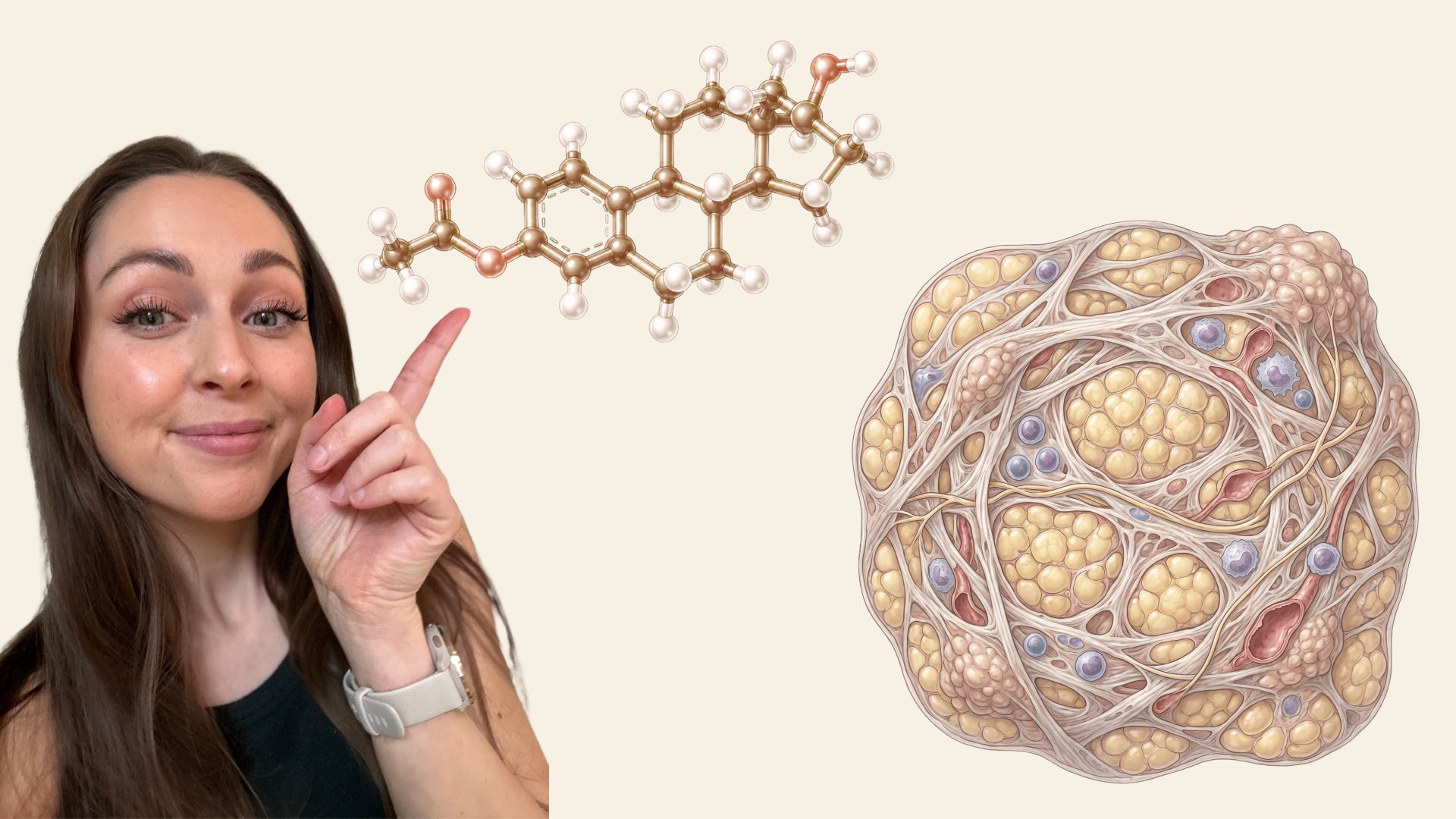
Many women living with lipedema notice the same pattern: the condition flares up when hormones shift — at puberty, during pregnancy, or around menopause. Researchers now believe this is no coincidence. Lipedema appears to be a hormone-sensitive fat disorder, in which estrogen plays a central role. That means the cause lies deeper than weight or lifestyle — in how the fat tissue itself responds to hormonal signals.
Estrogen – more than a “female hormone”
We often associate estrogen with fertility and menstrual cycles, but it does much more than that. Estrogen influences how the body uses energy, where fat is stored, how sensitive we are to insulin, and how inflammation is regulated.
For this to work properly, three types of cellular “receivers” — called receptors — cooperate to interpret estrogen’s message. In most women, they stay in balance. But in lipedema, that balance seems to be disturbed.
When the signals switch sides
In healthy fat tissue, one receptor (called ERα) helps the body store fat safely and maintain good metabolic function. Another (ERβ) keeps growth and inflammation under control. In women with lipedema, researchers have found that ERα weakens, while ERβ becomes dominant.
The result is fat tissue that behaves differently — cells grow larger and stiffer, inflammation rises, and circulation worsens. The body acts as if it’s protecting itself, but in a way that causes pain, swelling, and fatigue.