

Am I the only one who has been curious about this topic? I have seen histamine mentioned so many times in the lipedema community, people have asked me about it, and honestly, much of it was new to me.
What is histamine?
Histamine is a natural signalling molecule involved in immune responses, blood vessels, digestion and the nervous system. Mast cells are one important source of histamine in the body.
It is not particularly relevant to me personally. Except for white refined sugar, hormones and stress, which are my lipedema triggers, I do not have any known food intolerances or food allergies. My lipedema is not triggered by eating whole-grain bread, pasta or pizza, for example. White refined sugar is a completely different story for me.
But LipedemaScience is not only about what affects me. I want this to be an inclusive platform where we also explore things that may affect some of you, even when they do not affect me. We are different, our bodies are different, and our journeys with lipedema are different. This might be the one article that someone reads and thinks: This sounds like me. So I wanted to understand what the research actually says about histamine, mast cells and lipedema.
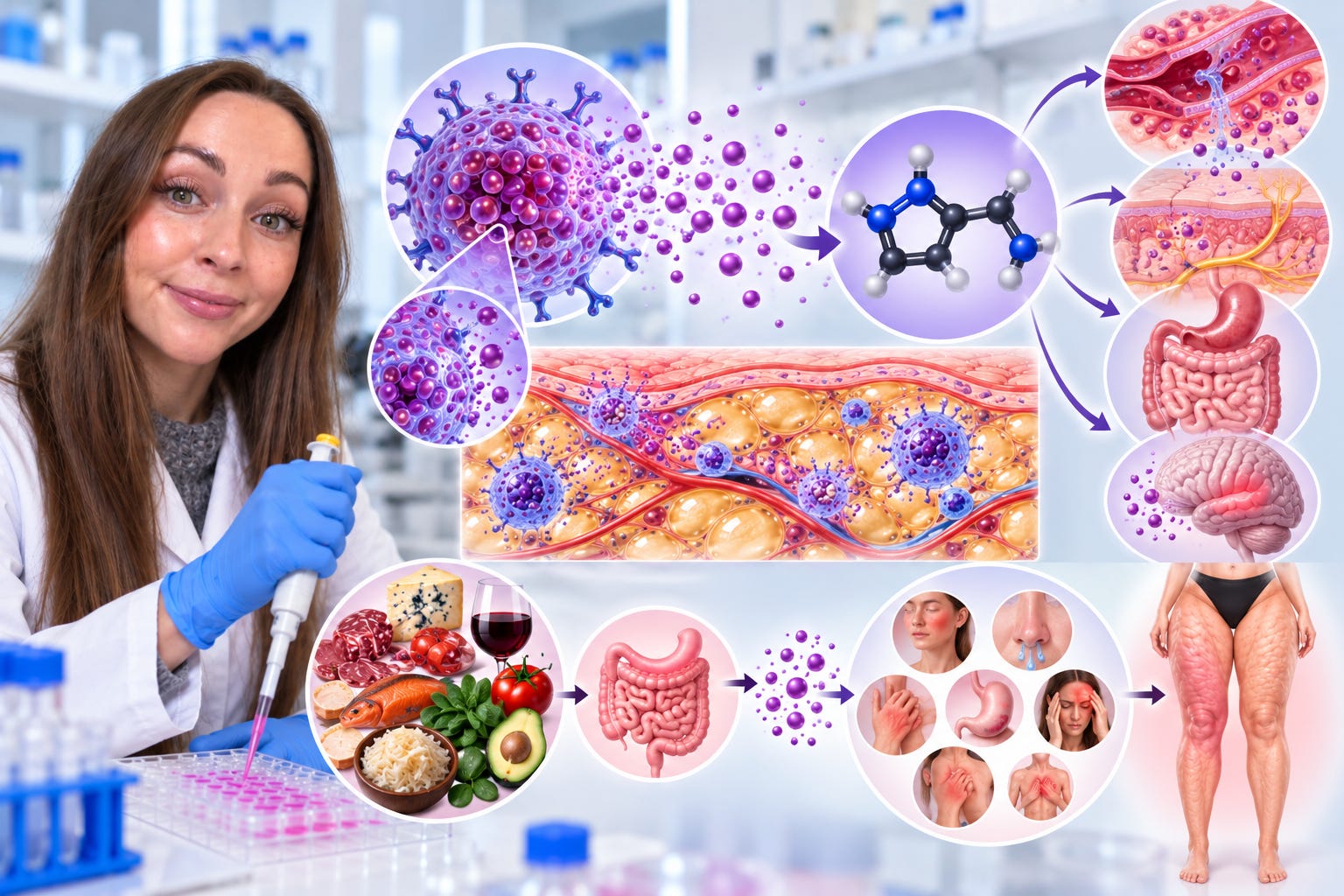
Why are histamine and mast cells interesting?
Histamine is a normal signalling molecule in the body. It is involved in immune responses, blood vessels, stomach acid production and the nervous system. Mast cells are immune cells that can release histamine together with many other signalling molecules.
What has been found in lipedema?
One small controlled study did not detect increased numbers of mast cells in lipedema tissue. A later study found higher histamine levels in lipedema adipose tissue compared with control tissue.
This makes mast cells interesting in lipedema research because histamine and mast-cell activity can influence vascular permeability, inflammation and nerve signalling, processes that could theoretically be relevant to pain and swelling. There is also research on mast cells in other conditions involving adipose tissue, pain and hormones. However, evidence from another disease, an animal model or a laboratory experiment cannot tell us that the same mechanism occurs in lipedema.

