

Do I really have lipedema… or is it just fat?
This is the question most women sit with quietly for years before they ever say it out loud. And when they finally do, it often comes with frustration, confusion, and a long history of trying to “fix” something that never quite responded the way it should.
Because if this was just fat… it should behave like fat.
And for many women, it doesn’t.
When your body doesn’t follow the rules
Most of us grow up with a simple understanding of how the body works. If you eat less and move more, you lose weight. If you gain weight, it distributes somewhat evenly. If you are consistent enough, the body responds.
But lipedema quietly breaks those rules.
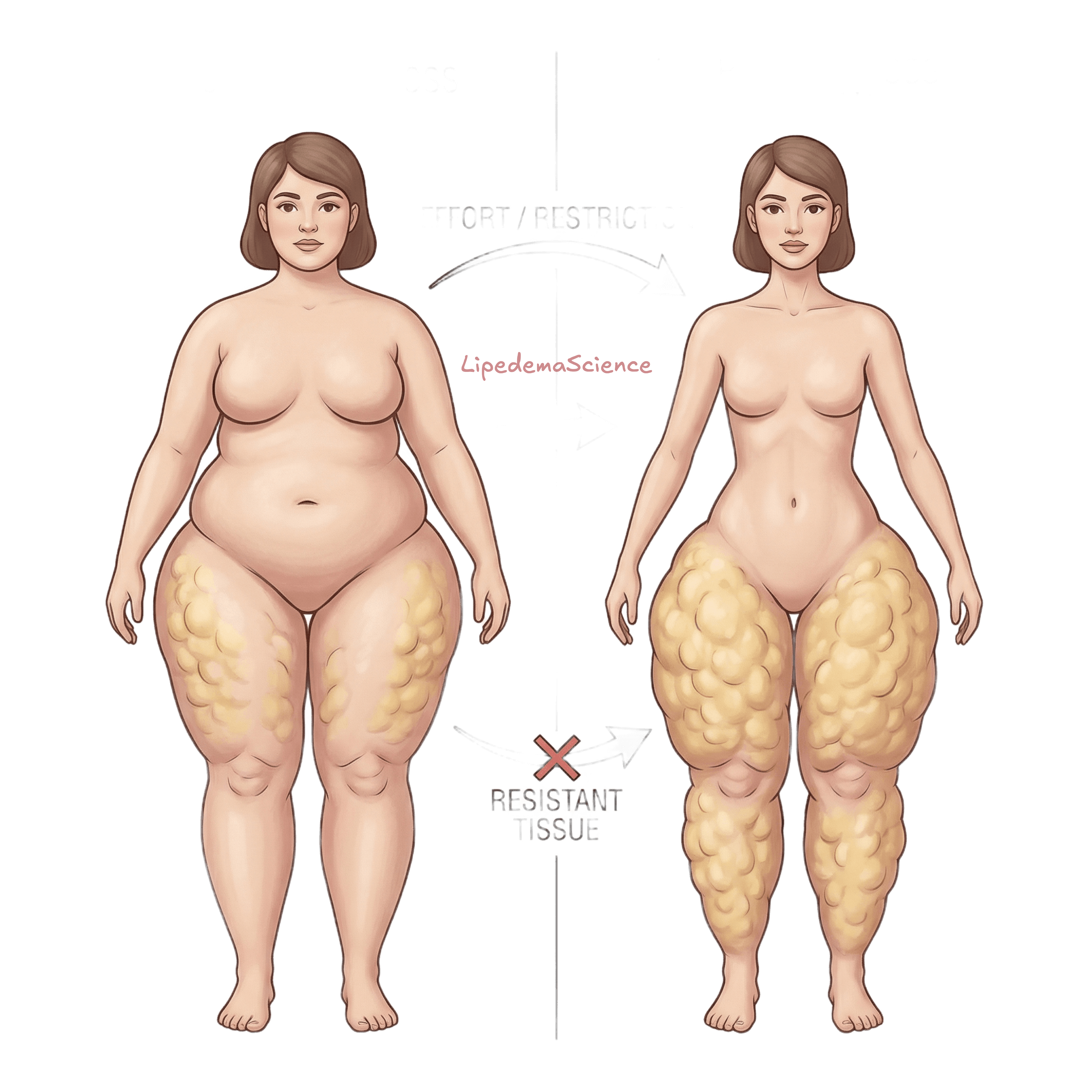
You might lose weight in your upper body, but your legs stay the same. Your waist becomes smaller, but your hips and thighs don’t follow. You might be doing everything “right”, and still feel like your body is working against you.
That is often the first signal. Not pain. Not diagnosis. Just a quiet sense that something doesn’t add up.
It’s not just fat – it’s tissue
One of the biggest misunderstandings around lipedema is the word “fat”.
Yes, lipedema involves fat. But not in the way we usually think about it.
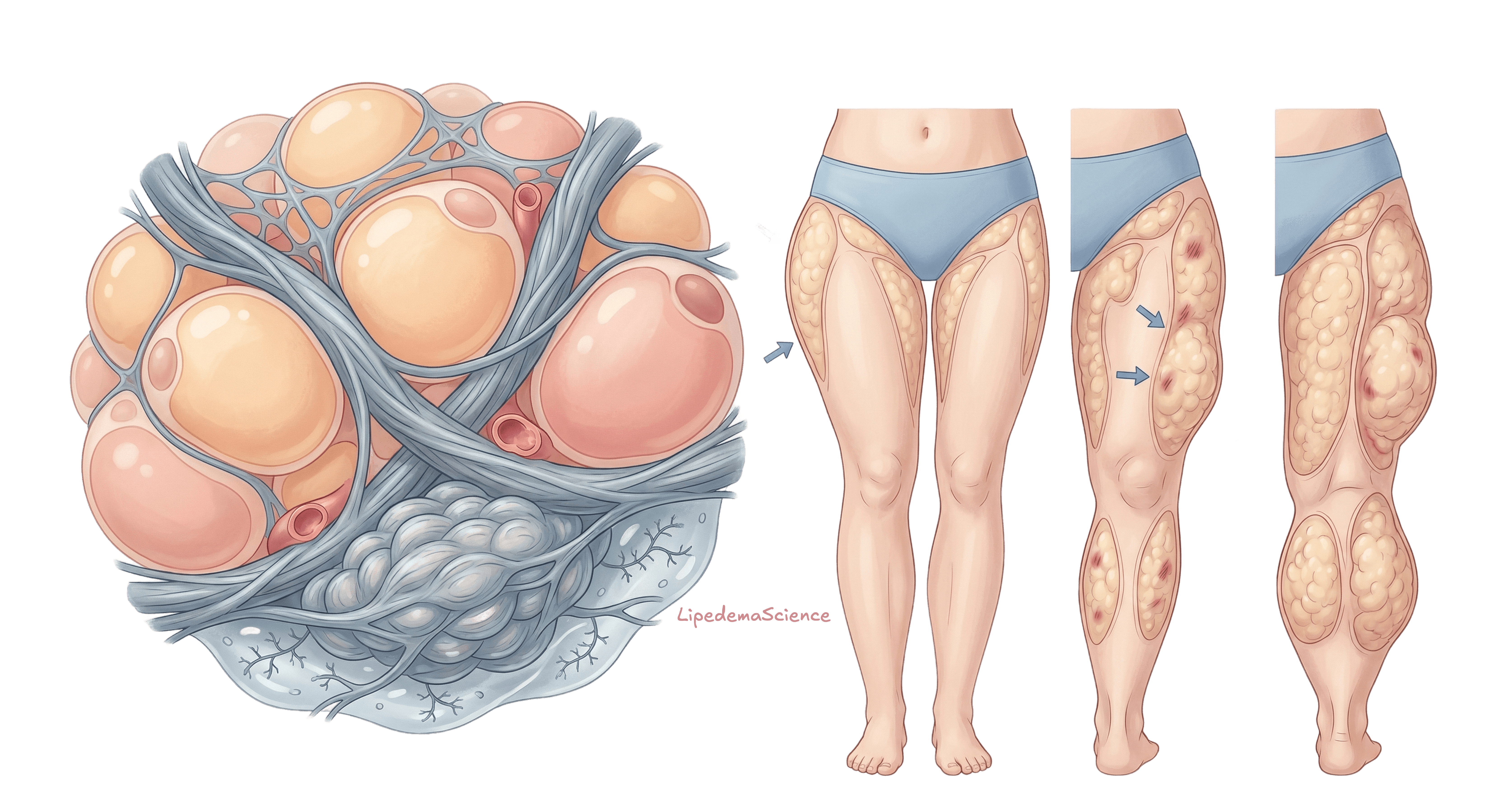
Lipedema is a disease of loose connective tissue. That means the tissue itself is structurally different. It is not just made up of fat cells, but also fluid, fibers, immune cells, and an altered extracellular matrix. This tissue becomes more fibrotic, more inflamed, and less responsive over tid.
This is why traditional approaches often fall short.
It is not a lack of discipline. It is a difference in biology.
The pattern is rarely random
Lipedema tends to follow a very specific pattern. It shows up symmetrically, most often in the hips, thighs, buttocks, and sometimes arms. The hands and feet are usually spared, which creates a kind of “cut-off” or cuff at the wrists or ankles.
That detail matters more than people think.
Because general weight gain does not behave like that. It is usually more evenly distributed, and it includes the hands and feet as well.
With lipedema, the body tells a more specific story. You just have to know what you are looking at.
It’s also about how it feels
A lot of women try to figure this out by looking in the mirror.
But lipedema is just as much about how it feels in the body.
The tissue can feel tender, sore, or painful when touched. Some describe it as a constant heaviness in the legs. Others notice that they bruise easily, without remembering any real trauma. Some feel nodules under the skin, like small beads or lumps.
And importantly, these symptoms can exist even in early stages. You don’t need to be “severe” for it to be real.
This is where many women start doubting themselves. Because they don’t look like what they think lipedema should look like.
But lipedema is not one look. It is a spectrum.
Why dieting often makes the confusion worse
Here is one of the most frustrating parts.
You can lose weight with lipedema.
But not evenly.
What often happens is that the upper body responds first. The waist becomes smaller. The face changes. Maybe even the arms. But the lower body stays disproportionately the same.
And suddenly, instead of feeling better, you feel more out of proportion than before.
This leads many women to push harder. More restriction. More control. More effort.
But the issue was never effort.
Lipedema tissue is known to be resistant to reduction through diet, exercise, and even bariatric surgery. Not completely unchangeable, but fundamentally different in how it responds.
So the question becomes…
How long do you keep trying to force something that is not built to respond the same way?
The long road to being taken seriously
One of the most consistent findings across research is how long it takes to get diagnosed.
Years. Often decades.
Many women develop symptoms in puberty, pregnancy, or menopause. Moments where hormones shift and the body changes. But instead of being recognized, the changes are often dismissed as normal weight gain.
Women are told to try harder. Eat better. Move more.
And when that doesn’t work, they start blaming themselves.
This is not a small thing.
Studies show that lipedema significantly impacts quality of life, physical function, and mental health. Not just because of the symptoms themselves, but because of the experience of not being understood.
So how do you actually tell the difference?
There is no single test that gives you the answer.
Diagnosis is based on pattern, symptoms, and clinical assessment. Which is why so many women end up trying to piece it together themselves.
But there are some questions worth sitting with:
Does my fat distribution feel disproportionate compared to the rest of my body?
Does it stay the same even when I lose weight elsewhere?
Do I experience pain, tenderness, or heaviness in the tissue?
Do I bruise easily?
Did this start during a hormonal shift?
Do my hands and feet stay relatively unaffected?
If several of these resonate, it is worth looking deeper.
Not to label yourself too quickly. But to stop dismissing what your body has been trying to tell you.
The part no one tells you
Even if it is lipedema, it does not mean everything you have been told about health no longer matters.
Lifestyle still matters. Movement still matters. Nutrition still matters.
But the intention changes.
It is no longer about trying to “fix” your body.
It is about supporting it.
Reducing inflammation. Supporting lymphatic flow. Maintaining mobility. Preventing progression.
Working with your body instead of constantly fighting it.
A different kind of understanding
The question “Is it lipedema or just fat?” is not really just about diagnosis.
It is about permission.
Permission to stop blaming yourself.
Permission to question what you have been told.
Permission to approach your body differently.
Because for many women, the most important shift is not the label itself.
It is finally understanding why nothing worked the way it was supposed to.
And realizing that maybe… it was never supposed to.
Standard of care for lipedema in the United States (DOI: 10.1177/02683555211015887)
Women with lipoedema: a national survey on their health, health-related quality of life, and sense of coherence (DOI: 10.1186/s12905-022-02022-3)
Dealing with lipoedema: women’s experiences of healthcare, self-care, and treatments—a mixed-methods study (DOI: 10.1186/s12905-025-03707-1)