

One of the things I have been genuinely hopeful about for a long time is that surgery will not always be the only way we can directly treat lipedema tissue.
I say this as someone who has had lipedema surgery myself. My surgeries helped me enormously, particularly with pain, and I am very grateful that this treatment existed when I needed it. But I am also only in my mid-thirties. When I think about living with lipedema for another 40 or 50 years, I don’t expect that the management I have needed so far will necessarily be everything I need for the rest of my life.
Dercum’s disease (also known as Adiposis Dolorosa) is a rare chronic disorder characterized by multiple, painful growths of fatty tissue (lipomas) located just beneath the skin or deeper in the body.
I am actually being reminded of that at the moment. I am going through hormonal changes, and I can see changes in my body again. I know my body very well after living with lipedema for so many years, and something is changing. What I cannot tell from looking at myself is exactly what is changing. Is there more fluid in the tissue? Has the adipose tissue changed? Am I seeing actual progression? It would be very easy for me to look at my body and decide that I know the answer, but I don’t.
What reassures me is that the pain is still nowhere near what it was before my surgeries. At the same time, I cannot know what will happen as I get older. Lipedema has long been associated clinically with periods of hormonal change, although exactly how sex hormones contribute to its onset or progression is still not well understood. I still have many hormonal transitions ahead of me. That is one of the reasons I am so interested in what the treatment landscape might look like ten or twenty years from now.
Lipedema and Dercum’s disease both cause painful fat tissue, but they differ significantly in how the fat forms and where it spreads.
This is also why a small clinical trial in Dercum’s disease caught my attention this week.
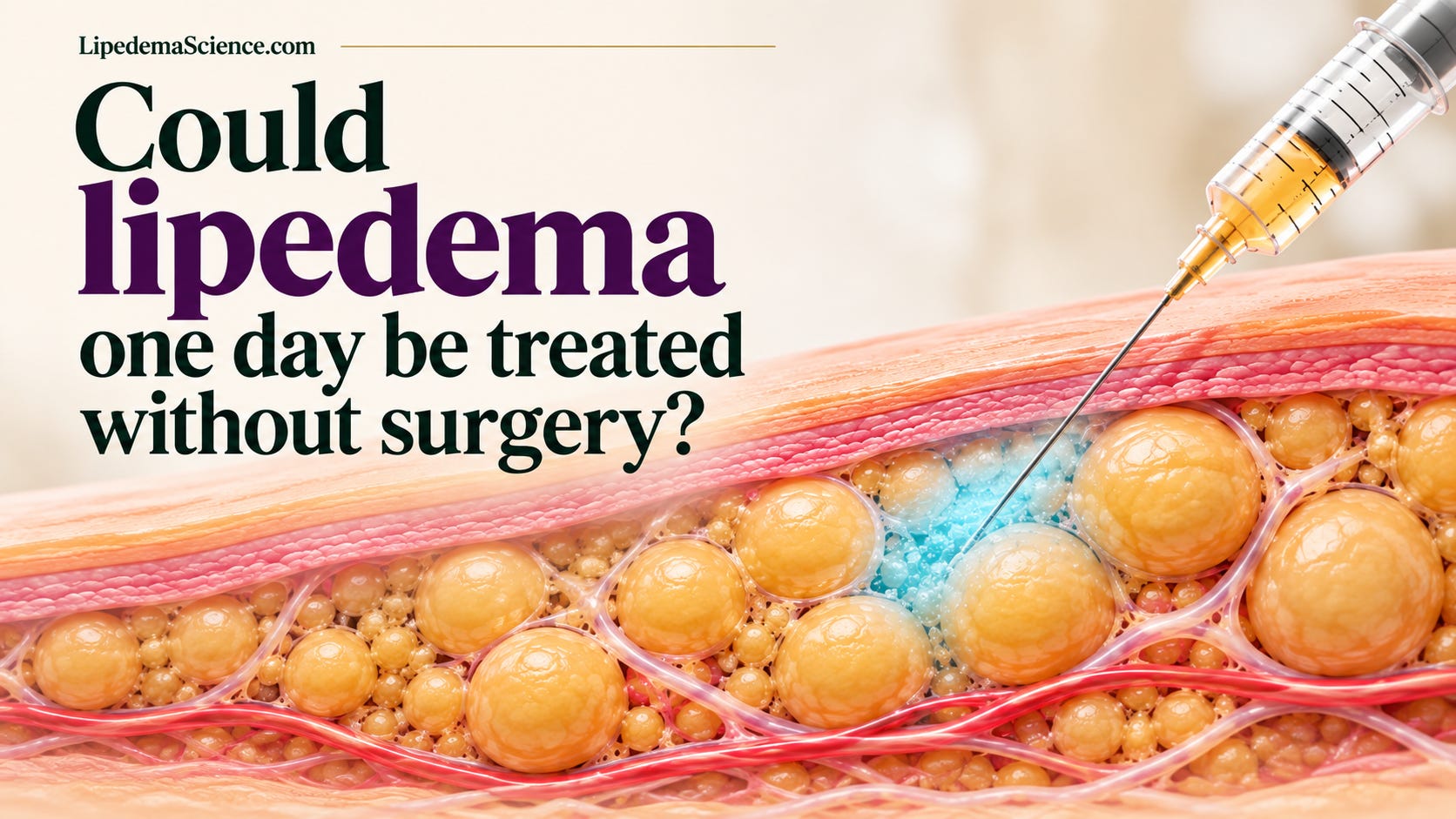
Not because we suddenly have a new treatment for lipedema. We absolutely do not. But because a drug designed to act directly on adipose tissue has produced interesting clinical results in another painful adipose-tissue disorder, and the company developing it has now explicitly said that it plans to investigate whether development for lipedema could be feasible.
The drug is called CBL-514.
A drug that targets adipocytes
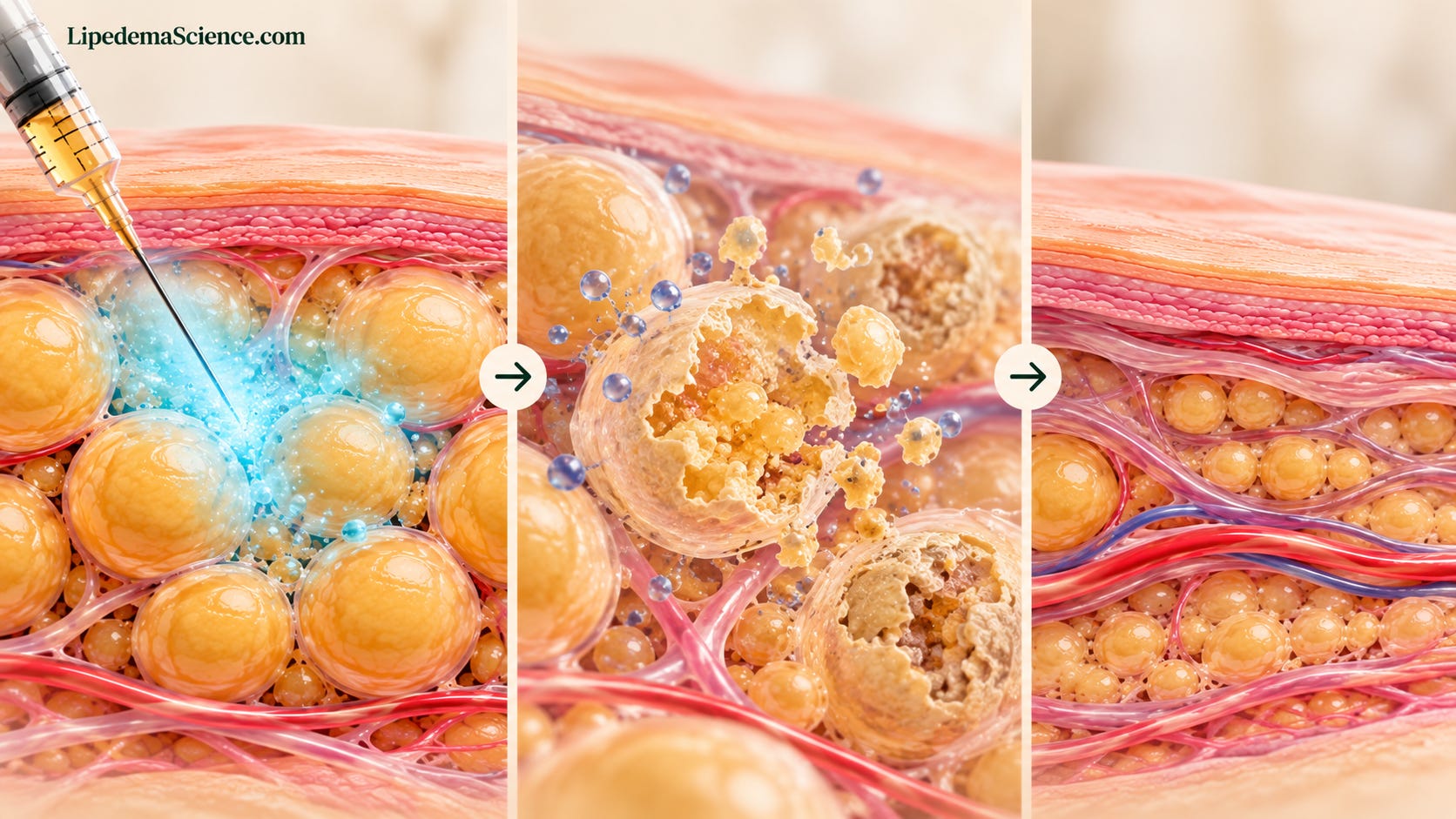
CBL-514 is a locally injected small molecule developed by Caliway Biopharmaceuticals. It is designed to induce apoptosis, or programmed cell death, in adipocytes. This is conceptually very different from liposuction. Instead of physically removing adipose tissue, CBL-514 is injected into the target area to pharmacologically reduce adipose tissue.
The idea is not entirely new or limited to Dercum’s disease. CBL-514 has already been investigated in humans for localized subcutaneous fat reduction. A randomized Phase IIa study published in Aesthetic Surgery Journal in 2022 evaluated CBL-514 in abdominal subcutaneous fat, and subsequent clinical development has continued.
