

Lipedema is one of those conditions where hormones seem to appear in the story again and again. Many women describe the first signs around puberty. Others notice worsening during pregnancy, perimenopause, or menopause. For years, another question has circulated quietly in patient communities and clinics alike.
Could hormonal contraceptives also worsen lipedema symptoms in some women?
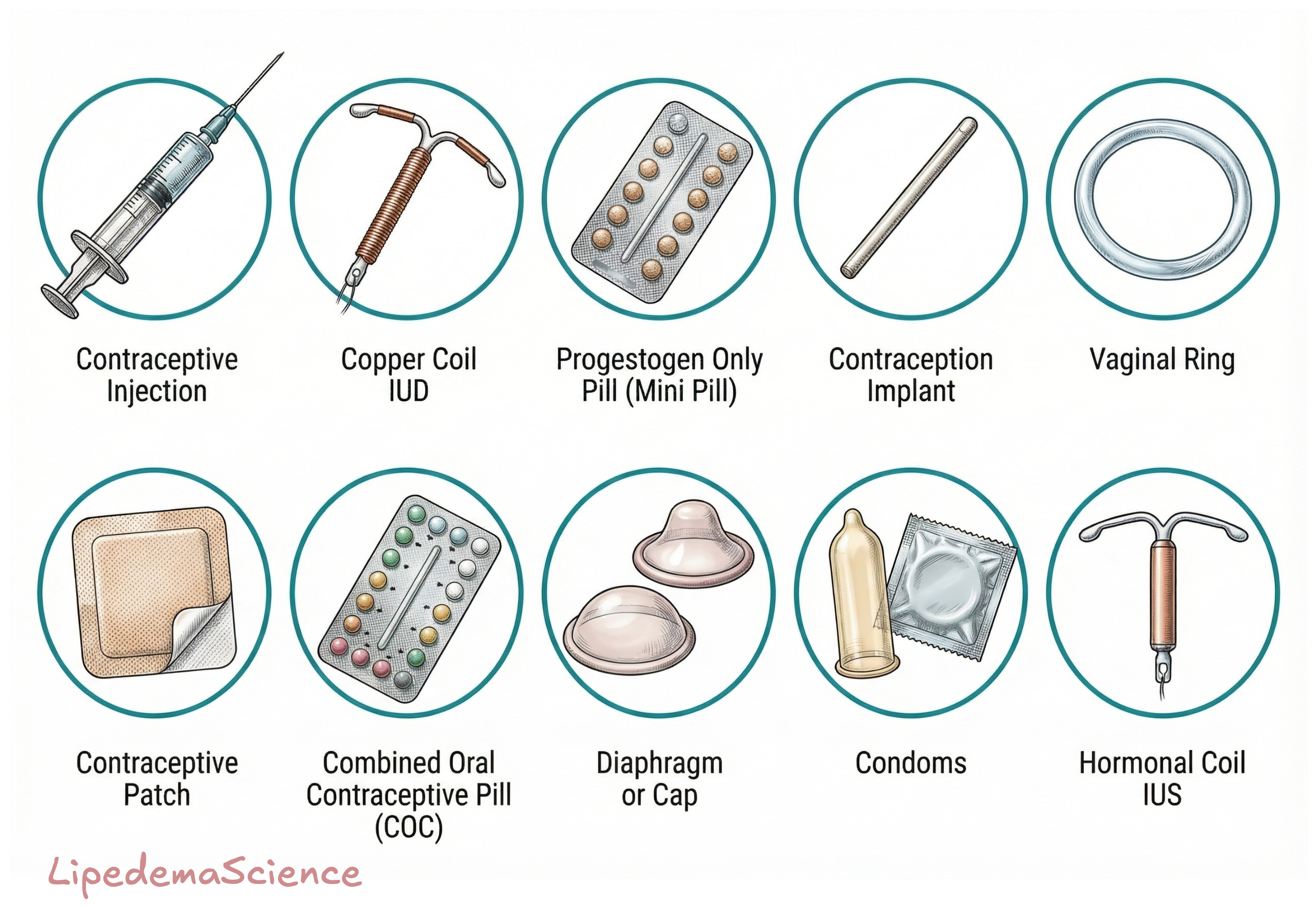
A new 2025 cross-sectional study from Brazil brings that question into sharper focus. In a sample of 637 women with lipedema, researchers found that hormonal contraceptive use was frequently linked to self-reported symptom worsening. Among women who had used hormonal contraceptives, 58.8 percent said their symptoms became worse after starting them. Even more striking, 15.1 percent reported that the onset of their lipedema symptoms coincided with contraceptive initiation.

These numbers are attention-grabbing. They also deserve careful interpretation.
This study does not prove that hormonal contraceptives cause lipedema or directly worsen the disease in a biological sense. But it does suggest that for a substantial subgroup of women, exogenous hormones may be associated with a worsening of symptoms, particularly in those who already carry a heavier symptom burden.
What the study looked at
The study was conducted in Brazil between August and November 2025 using a structured online questionnaire. The final sample included 637 adult women living in Brazil who had suspected or confirmed lipedema and completed the key sections of the survey. Most participants had a confirmed diagnosis, and more than 92 percent were current or former users of hormonal contraceptives.
The researchers calculated a symptom score based on common lipedema features such as pain, swelling, worsening with heat, tenderness, easy bruising, disproportionate fat accumulation, resistance of leg size to diet and exercise, and family history. They also created a quality of life impact score and examined pain levels, self-esteem, reproductive history, contraceptive exposure, and perceived changes after starting hormonal birth control.
One of the more unusual methodological features of the study was the use of natural language processing to categorize free-text responses. That allowed the authors to systematically extract patterns from patient descriptions of side effects, symptom onset, comorbidities, and treatment experiences.
The main finding
The headline result is simple and clinically important. Among 588 women who had used hormonal contraceptives, 346 reported some degree of worsening after starting them. Of those, 34.5 percent described the worsening as severe, while 24.3 percent described it as slight. Only 40.3 percent reported no change, and fewer than 1 percent reported improvement.
This does not mean that hormonal contraceptives are universally harmful in lipedema. It does mean that worsening was not a rare or isolated experience in this sample. It was common enough that the issue can no longer be dismissed as anecdotal noise.
The study also found that 15.1 percent of participants linked the onset of their lipedema symptoms to the time they began hormonal contraception. Puberty remained the most commonly reported trigger period, but contraceptive initiation emerged as the third most frequently reported time of onset, ahead of pregnancy and menopause.
That temporal pattern is interesting, but it is still not proof of causation. A cross-sectional study captures associations and patient memories at one point in time. It cannot determine whether contraceptives triggered the disease, unmasked pre-existing but unnoticed symptoms, or were simply introduced during the same life phase in which lipedema would have emerged anyway.
Who seemed most vulnerable
One of the most important parts of the paper is not the overall prevalence of worsening, but who seemed more likely to report it.
In the multivariable analysis, the strongest independent predictor of worsening was the baseline symptom score. In practical terms, women who already had a higher symptom burden were more likely to report that contraceptives worsened their lipedema. Each one-point increase in symptom score was associated with a substantial increase in the odds of perceived worsening.
That matters because it suggests vulnerability may not be evenly distributed. The response to hormonal contraceptives may depend less on the fact of exposure alone and more on the underlying biological terrain of the individual woman.
Interestingly, duration of contraceptive use was not associated with worsening. This is one of the more thought-provoking findings in the paper. If worsening were mainly about cumulative hormonal exposure over time, one might expect longer use to predict greater risk. That did not happen here.
Instead, the results point toward a susceptibility model. Some women may be more hormonally sensitive from the start, while others may tolerate exposure without noticeable aggravation. The study cannot prove that explanation, but it raises an important possibility. In lipedema, the problem may not simply be how long hormones are used, but who is using them and what kind of tissue vulnerability already exists.
Weight gain, swelling, and mood changes
The study also explored reported side effects during hormonal contraceptive use. The most common were weight gain and swelling, both reported by about 40 percent of participants. Headache and mood changes were also common.
These side effects mattered because they were associated with higher rates of symptom worsening. Women who experienced weight gain were substantially more likely to report worsening than women who did not. Mood changes were also linked to higher rates of worsening.
This does not tell us exactly what is happening biologically. Weight gain and swelling may reflect direct side effects of the contraceptives themselves. They may also overlap with lipedema symptoms in ways that make the condition feel worse, even if the underlying disease process has not objectively changed. Another possibility is that these side effects are markers of a broader hormone sensitivity phenotype, where the same women who react metabolically or emotionally to contraceptives are also the ones whose lipedema symptoms become more active.
The study cannot separate these possibilities. But it does show that worsening was not occurring in isolation. It often appeared alongside other bodily changes that patients themselves perceived as meaningful.
The burden of pain and quality of life
Beyond contraceptive use, the study also paints a familiar and sobering picture of life with lipedema.
Pain scores were moderate to high on average, and self-esteem was often low. More than 70 percent of participants reported fair or low self-esteem. In the regression analysis, pain emerged as the strongest predictor of quality of life impairment, followed by BMI. That is an important reminder that while hormones may influence symptom patterns in some women, the daily burden of lipedema is still shaped most powerfully by pain, functional limitation, and the emotional weight of living in a body that feels chronically inflamed, heavy, tender, and misunderstood.
Interestingly, after adjustment for other variables, the degree of contraceptive-related worsening did not independently predict quality of life impact. In other words, the broader lived burden seemed to be carried mainly by pain and body composition rather than by contraceptive response alone.
What the study does and does not prove
This is where the conversation needs to stay disciplined.
The study is valuable because it gives structure and scale to a question many women with lipedema have been asking for years. It shows that perceived worsening with hormonal contraceptives was common in this sample and that those with more severe baseline symptoms appeared especially vulnerable.
But it does not prove that contraceptives cause lipedema. It does not prove that the worsening represents true disease progression rather than fluid retention, weight fluctuation, symptom amplification, or perceptual overlap. It does not tell us whether specific formulations are safer or riskier in a reliable way. And because the participants were recruited through support groups, clinics, and patient communities, the sample may overrepresent women with more severe symptoms or stronger opinions about hormone-related worsening.
The data were also self-reported. There were no objective measures such as standardized circumferences, bioimpedance, ultrasound, lymphatic imaging, inflammatory biomarkers, or tissue analysis. That means the study cannot distinguish between at least three possibilities. First, genuine worsening of the lipedema process. Second, side effects of contraceptives such as edema being interpreted as lipedema worsening. Third, recall bias or symptom hyperawareness in women who are already highly burdened.
These are not small caveats. They are central to interpreting the findings responsibly.
Why the findings still matter
Even with those limitations, this paper matters because it shifts the conversation.
For too long, the role of exogenous hormones in lipedema has lived in a gray zone between patient testimony and speculation. This study does not close the case, but it does strengthen the argument that hormonal contraceptive counseling in women with lipedema should be more individualized and more honest.
If a woman has confirmed or suspected lipedema, especially with a high symptom burden, it may no longer be enough to discuss hormonal contraception in generic terms. She may need a more tailored conversation about potential symptom changes, close follow-up after initiation, and the possibility of considering non-hormonal alternatives depending on her priorities, symptom severity, and medical context.
That does not mean hormonal contraception should be demonized. It means lipedema should be treated as relevant clinical context, not as background noise.
A broader biological question
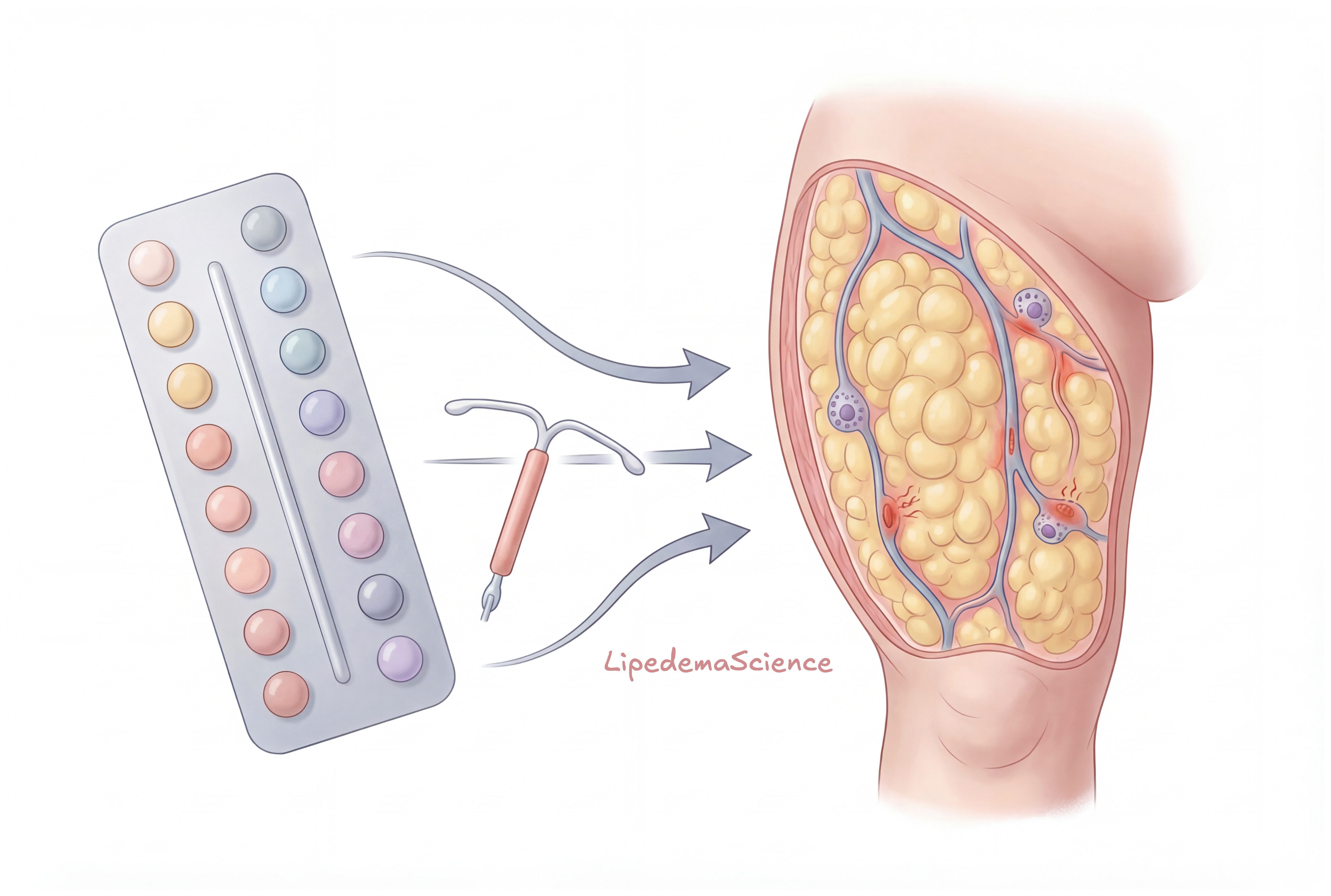
The authors place their findings within a broader model of lipedema as a hormonally modulated and inflammation-linked disorder involving vascular permeability, lymphatic dysfunction, mast cell signaling, adipose remodeling, and pain sensitization. That framework is biologically plausible and consistent with many current discussions in the field.
Still, the study did not directly measure inflammation, lymphatic dysfunction, endothelial markers, or mast cell activity. So these mechanistic explanations remain hypotheses rather than conclusions drawn from the data itself.
That distinction is important. It is tempting to move quickly from association to mechanism, especially in a condition where so many women feel dismissed and are hungry for explanations. But the science has to move in steps. This study contributes an important epidemiological signal. It does not yet map the pathway.
Where research should go next
The next step is clear. Prospective studies are needed.
We need studies that follow women before starting hormonal contraceptives and then track symptom changes over time using objective measures. That means standardized circumference measurements, body water assessment, pain scores, inflammatory markers, perhaps even vascular and lymphatic imaging where feasible. We also need better stratification by contraceptive type, dose, route, and progestin profile.
Only then can researchers begin to answer the questions that matter most. Are some women with lipedema more hormonally sensitive than others. Are some contraceptive formulations better tolerated. Are certain symptom phenotypes or inflammatory patterns predictive of worsening. And are the changes reversible when the hormonal exposure is removed.
Until then, this study stands as an important signal rather than a final verdict.
The bottom line
This 2025 Brazilian study found that hormonal contraceptive use was commonly associated with self-reported worsening of lipedema symptoms. More than half of users reported worsening, and a notable minority linked symptom onset to contraceptive initiation. Women with higher baseline symptom scores appeared especially vulnerable, while duration of use did not predict worsening.
The findings are clinically meaningful, but they do not prove causation. They should not be used to make sweeping claims that hormonal contraceptives cause lipedema or inevitably worsen it in everyone. What they do support is a more individualized and cautious approach to contraceptive counseling in women with suspected or confirmed lipedema.
For women who have long felt that their bodies changed after starting hormonal contraception, this paper offers something important. Not certainty, but validation that the question is real, worthy of study, and finally being taken seriously.
Association Between Hormonal Contraceptive Use and Lipedema: A Cross-Sectional Study With 637 Brazilian Women (DOI: 10.7759/cureus.99189)