

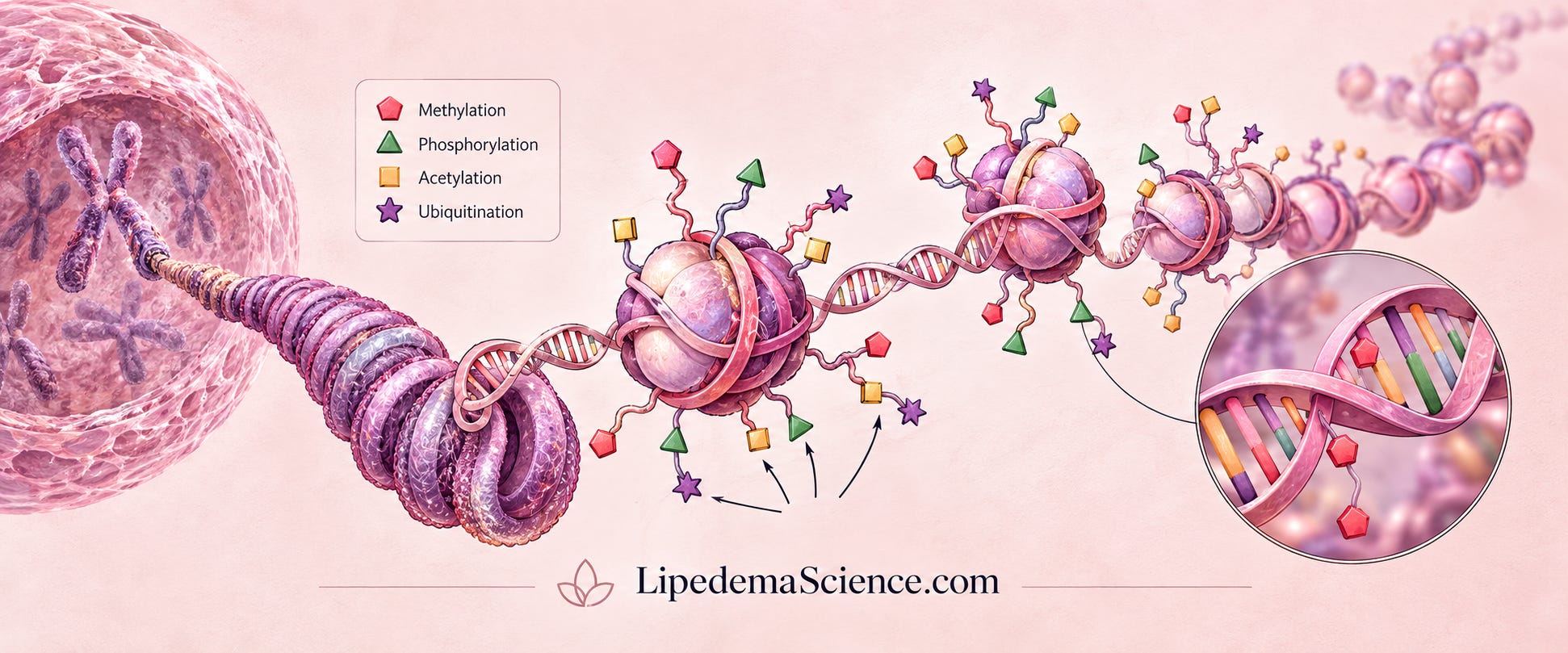
We know that lipedema often appears or becomes more noticeable during major hormonal changes, particularly puberty, pregnancy and menopause. But we still don’t fully understand why. I believe epigenetics is one of the most interesting areas to investigate.
To understand why, we first need to understand what epigenetics actually means.
And fortunately, the basic idea is quite simple.
Imagine your DNA as an enormous instruction book containing all the information your cells need to function. Almost every cell in your body contains the same book, but different cells read different instructions. A fat cell needs different instructions from a muscle cell, even though they contain essentially the same DNA.
Epigenetics helps control which instructions are used. You can imagine small switches that make certain genes more or less active, without changing the DNA itself. These switches are influenced by complex biological processes, including hormonal signals and environmental conditions.
What makes this particularly interesting is that some epigenetic changes can persist over time. In other words, a cell may continue behaving differently even after the original signal has disappeared.
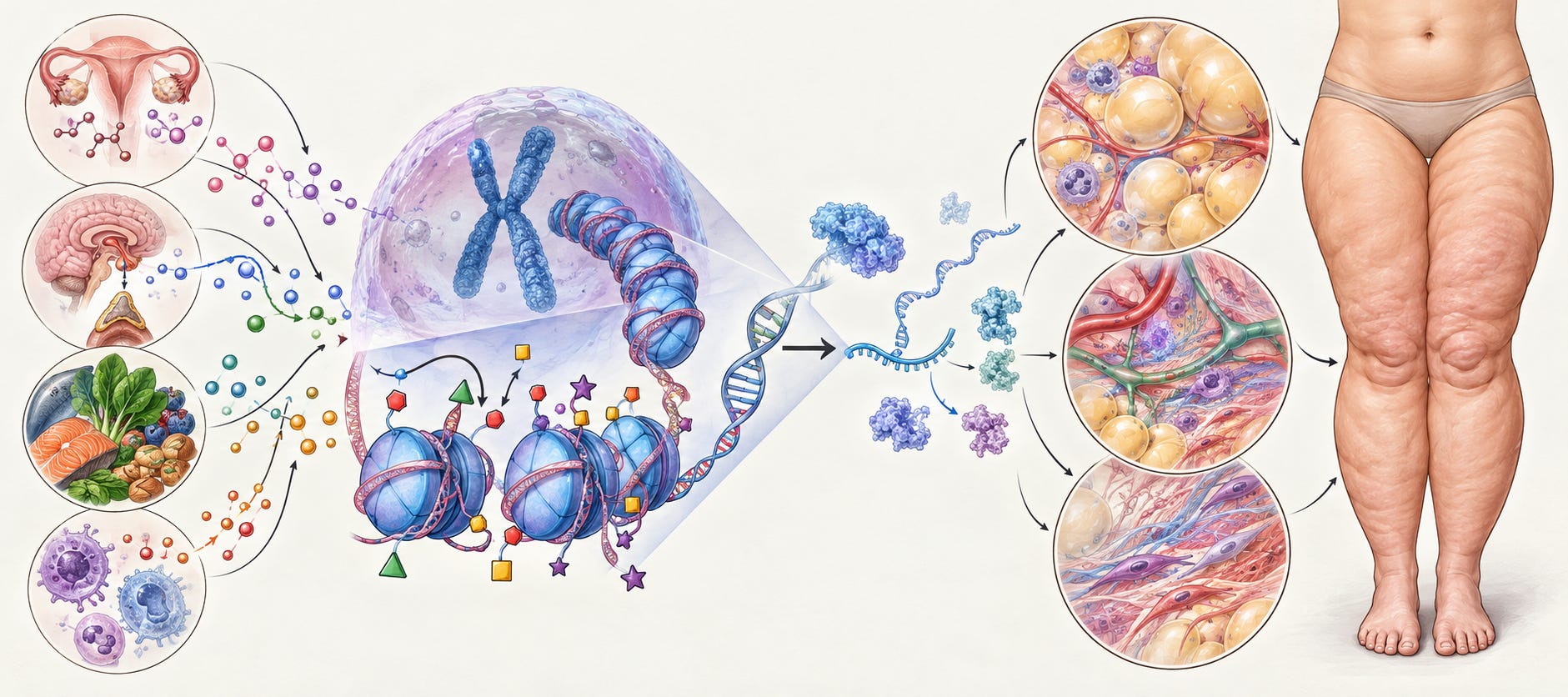
What might this mean for lipedema?
We already have evidence that genetics contribute to lipedema, and many women report that their symptoms began around puberty, pregnancy or menopause. These observations make hormonal regulation an important part of understanding the condition.
But genetics and hormones may not tell the entire story.
My hypothesis is that some women may inherit a predisposition to lipedema, while epigenetic changes could contribute to when and how that predisposition becomes noticeable.
During puberty, for example, estrogen levels change substantially. We know from research outside lipedema that estrogen can influence gene activity in fat cells, including through epigenetic mechanisms. It is therefore reasonable to investigate whether hormonal transitions might also change the activity of certain genes in lipedema-prone tissue.
Such changes could potentially affect how fat cells develop, store fat or interact with their surrounding tissue. If some of those changes persist, they might help explain why symptoms sometimes continue after hormone levels have stabilized.
This remains a hypothesis, not an established mechanism.
What does the research show?
In January 2026, a small study published in the Journal of Translational Medicine identified differences in DNA methylation, an important epigenetic mechanism, between fat samples from women with and without advanced lipedema.
The researchers examined samples from just eight women, and the tissue came from different body regions. This matters because fat tissue naturally has different epigenetic characteristics depending on where it is located.
We therefore cannot conclude that the observed differences caused lipedema. They might reflect normal differences between body regions, changes resulting from the condition, or other factors.
Nevertheless, the study introduces an interesting research direction that deserves further investigation.
A question worth exploring
My interest in epigenetics comes partly from my background in molecular biology and partly from living with lipedema myself. I have long been interested in why the condition can seem relatively quiet during some periods of life and become more noticeable during others.
Epigenetics offers one possible way of studying that question, especially when combined with what we already know about genetics, hormones and regional differences in fat tissue.
We need studies that examine epigenetic changes in comparable fat tissue, ideally following women through hormonal transitions, before we can determine whether these mechanisms contribute to triggering lipedema.
For now, I see epigenetics as a promising research question rather than an answer. Understanding why certain genes become more or less active at particular stages of life could eventually help us understand something fundamental about how lipedema develops. And that is a question I would love to see researchers explore further.
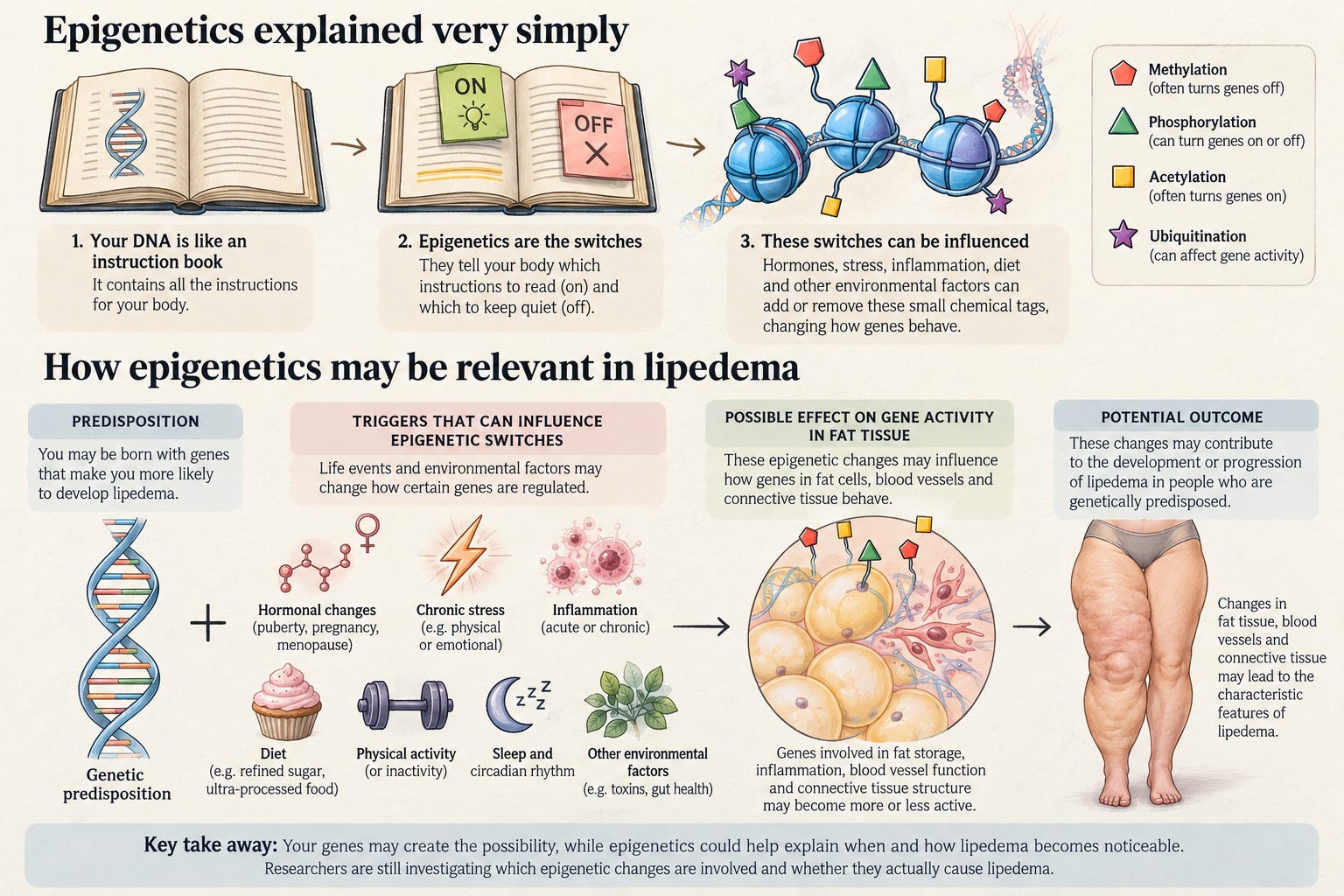
I don’t appreciate the poster below the article that points to blaming and shaming the victim once again. You could lock me in a room with only water and it wouldn’t change my body. And the image of the woman’s body is also incorrect, that depicts LYMPHEDEMA not Lipedema. Lymphedema results from cancer treatments, not hormones. That is how Johns Hopkins in MD, USA explained it to me.