

Women ask it after weight gain. After a stressful year. After stopping exercise. After a period of emotional eating. After pregnancy. After menopause. After looking at old photos and wondering whether they somehow caused the body to change.
And beneath the question there is often an even more painful thought
Did I do this to myself
The honest answer is more complicated, but also kinder than many people expect.
No, you did not create lipedema by failing. But yes, some things can make the condition feel heavier, more symptomatic, and possibly more advanced over time. The problem is that people often hear that message in a simplified way, as if lipedema is merely the result of lifestyle. That is not what the research shows.
Lipedema is not a lifestyle disease. But lifestyle, body weight, comorbidities, aging, hormonal shifts, and delayed care may still influence what happens around it.
That difference matters.
The first thing to understand
You are not “making” yourself have lipedema.
The disease usually starts during periods of hormonal change such as puberty, pregnancy, and menopause. Family history is common. In the Swiss referral centre study, about half of the women reported a family history, and most had symptom onset during adolescence. That fits with what the field has described for years. Lipedema tends to appear in female bodies, often during hormonally active phases, and it clearly does not begin because someone lacked discipline.
That is an important foundation because many women try to interpret the course of their body through a moral lens. They look at worsening symptoms and assume there must have been a personal failure behind it. But lipedema research does not support that way of thinking. The disease is still not fully understood, but it is recognized as a real pathological condition, not a cosmetic issue and not simply the result of overeating.
So if your body has changed, the first step is to stop assuming the explanation must be shame.
But can lipedema get worse over time
Probably yes.
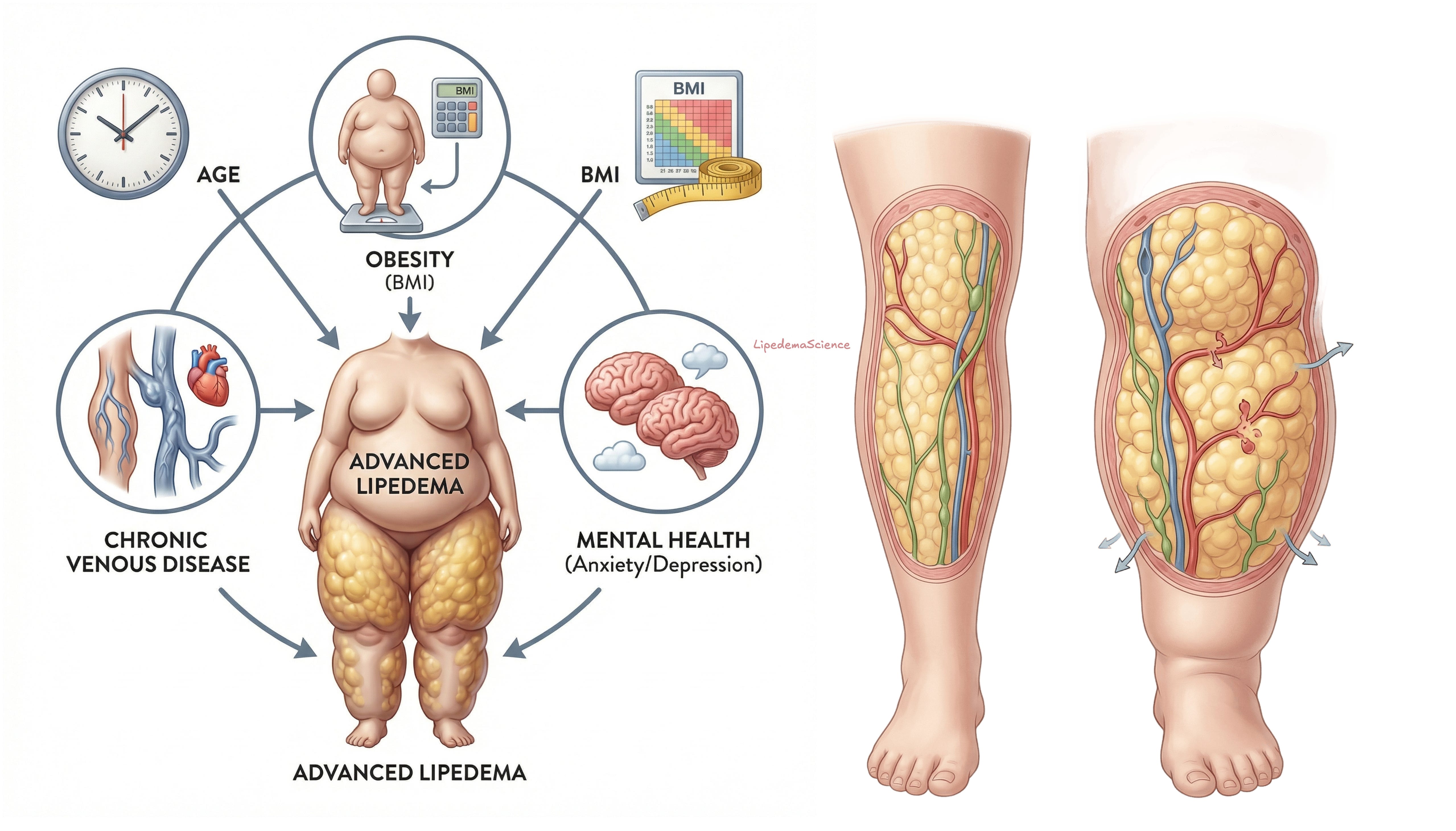
This is where the conversation gets delicate. Lipedema has long been considered progressive in clinical practice, even though the exact speed and mechanisms of progression are still being studied. The newer Swiss study adds to that discussion. Women with more advanced stages were, on average, older and had higher BMI. In the multivariable analysis, age and BMI remained significantly associated with advanced disease stage.
That does not prove direct causation. A retrospective study cannot tell us with certainty that age or higher BMI causes progression in a simple linear way. But it does support something many women already suspect from lived experience and clinical follow-up. Over time, and particularly with additional weight gain, the disease often seems harder to carry.
The important thing here is not to turn that into blame. Age is not a choice. Hormonal transition is not a choice. Stress, injury, reduced mobility, pregnancy, grief, financial strain, and burnout can all change how a body functions and how much capacity a person has to manage symptoms. So yes, lipedema may become more advanced over time, but that is not the same as saying women are choosing it.
The role of weight without turning it into blame
Weight is one of the most emotionally loaded parts of lipedema, and it needs to be handled carefully.
The Swiss study found that BMI rose significantly across lipedema stages. Women with stage 3 to 4 disease had a much higher average BMI than those in stage 1. Obesity was also far more common in advanced stages. That aligns with broader literature suggesting that advanced lipedema is often accompanied by overweight or obesity.
But this is where nuance is everything.
The research does not say that obesity causes lipedema to begin. Lipedema and obesity are not the same thing. Lipedema fat has a different distribution and different clinical behavior. At the same time, weight gain may still worsen the total burden on the body. More tissue means more mechanical stress, more strain on mobility, more venous and lymphatic pressure, and often more difficulty staying active. That can create a loop where symptoms worsen, movement becomes harder, and overall health becomes more fragile.
This is why the better question is not “Did I cause my lipedema by gaining weight?” but rather “Is extra weight adding to the load my body already has to carry?”
For many women, the answer is yes.
And that answer should lead to support, not judgment.
What “worse” actually means
Many women imagine worsening only in terms of appearance. Bigger legs. More visible tissue. More disproportion.
But lipedema worsening is not just visual. It can mean more heaviness, more aching, more friction around the knees or thighs, more exhaustion with daily activity, more difficulty tolerating standing, more venous symptoms, more swelling, more clothing limitations, more joint strain, and more psychological burden.
The Swiss study is helpful here because it reminds us that comorbidities are not a side note. They are part of the real-life burden of the condition. Over 92 percent of patients had at least one comorbidity, and the number of comorbidities increased with advanced stage. Chronic venous disease was extremely common. Obesity was common. Hypothyroidism, hypertension, psychiatric conditions, rheumatic disease, and fatigue were also part of the picture.
So sometimes when a woman says “my lipedema is getting worse,” what she may actually be noticing is not just the lipedema tissue itself. She may also be feeling the effects of venous disease, poor sleep, depression, thyroid dysfunction, deconditioning, pain sensitization, or reduced mobility.
That matters because it changes the next step. It means worsening should not automatically be interpreted as hopeless progression. Sometimes it is a signal that the whole system needs attention.
Can stress, poor sleep, and mental overload make it feel worse
Very likely yes, even if they are not the root cause of the disease.
The Swiss cohort reported high levels of anxiety, depression, fatigue, and reduced quality of life. Earlier studies from Sweden showed similar patterns. Women with lipedema often live with years of pain, misunderstanding, self-management, and delayed diagnosis. That affects the nervous system. It affects sleep. It affects motivation. It affects appetite and movement and self-trust.
When people are stressed or mentally exhausted, inflammation-related symptoms often feel louder. Pain thresholds may shift. The body becomes harder to regulate. You may move less, recover worse, eat more chaotically, tolerate compression poorly, or lose the routines that were helping you cope.
That does not mean stress creates lipedema tissue from nothing. But it can absolutely make the experience of living in a lipedema body feel worse.
And again, the point is not self-surveillance. The point is understanding that your body does not exist in separate boxes. Your legs, your nervous system, your sleep, your mood, your hormones, and your daily load all talk to each other.
Are you making it worse if you are not exercising enough
Not in the simplistic way social media often suggests.
Exercise does not cure lipedema. It does not “melt” lipedema away. And women with lipedema often have real reasons why movement feels difficult. Pain, heaviness, friction, instability, fatigue, hypermobility, and shame can all interfere.
But movement still matters.
Not because it erases the disease, but because it supports everything around it. It can help preserve mobility, support circulation, reduce stiffness, maintain muscle strength, improve mood, and make the body more resilient overall. Many guidelines recommend individually adapted movement for exactly that reason.
So if you have become less active, that may contribute to feeling worse. But the answer is not punishment. It is finding forms of movement your body can live with consistently. Walking, swimming, cycling, water exercise, low-impact strengthening, or other tolerable forms of exercise may all be useful depending on the person.
The best movement plan in lipedema is usually not the most aggressive one. It is the one you can still do when life is difficult.
What about hormones
Hormones are central to the story of lipedema, even if the exact mechanisms are still being worked out.
The disease often begins during puberty, pregnancy, or menopause. That alone tells us hormones are not a side detail. It also explains why many women feel their body changed suddenly during one of these phases and never fully returned.
Does that mean hormonal contraception, pregnancy, fertility treatment, or menopause automatically “make lipedema worse”? Not in a simple or universal way. But hormonal shifts can clearly interact with the disease. Some women notice acceleration around certain life phases. Others do not. The research still leaves a lot unresolved here.
What is clear is that women often blame themselves for body changes that happened during hormonally intense periods. That blame is usually misplaced. Hormonal biology is not a personal weakness.
Can delayed diagnosis make things worse
In a practical sense, yes.
Not because a label itself changes the tissue, but because lack of recognition delays support. If a woman spends years being told she simply needs more willpower, she may miss out on compression, symptom management, venous assessment, pain support, physical therapy, psychological support, and realistic counseling about weight and mobility.
She may also cycle through increasingly harsh attempts to “fix” herself, which can damage her relationship with food, movement, and her body.
This is one of the quiet tragedies of lipedema. The delay does not just postpone understanding. It can reshape the entire way a person treats herself.
So when women ask whether they are making it worse, sometimes the more truthful answer is that they were left alone with a condition they were never taught to understand.
The question that may help more
Instead of asking “Am I making my lipedema worse?”, it may be more useful to ask:
What is increasing the load on my body right now?
Is my weight higher than before?
Have I become less mobile because my symptoms increased?
Am I sleeping badly?
Am I under chronic stress?
Do I have untreated thyroid issues or venous problems?
Have I stopped wearing compression because it became too uncomfortable?
Am I exhausted, depressed, or burned out?
Am I trying to manage this with shame instead of support?
That is a much more productive question because it opens doors instead of closing them.
If you find value in these articles, consider subscribing and supporting my work. Every subscriber truly means a lot. It tells me that this work matters, that it reaches the right people, and that it contributes something meaningful to the lipedema community.
What the article should leave you with
The honest answer is this
You are probably not causing your lipedema. But some factors may be increasing the burden around it and may be linked with more advanced disease over time. Higher body weight, increasing age, more comorbidities, reduced mobility, and delayed support all seem to matter. That does not mean lipedema is your fault. It means the body is living inside a bigger context.
And once you understand that, the goal changes.
Not perfection..
Not punishment..
Not chasing a fantasy of full control..
But reducing load where you can.
Getting support where you need it.
And stopping the reflex to turn every worsening symptom into self-blame.
Because in lipedema, that reflex is often one of the heaviest burdens of all.
The bottom line
No, you are not making yourself have lipedema.
But yes, lipedema may become harder to live with over time, and weight gain, aging, and untreated comorbidities may be part of that picture. The right response is not shame. It is informed care, realistic support, and a much more compassionate understanding of what this disease actually is.
Sometimes the most important shift is not asking
“What did I do wrong”
But asking
“What does my body need now”
Clinical characteristics, comorbidities, and correlation with advanced lipedema stages: A retrospective study from a Swiss referral centre (DOI: 10.1371/journal.pone.0319099)
Lipedema Research—Quo Vadis? (DOI: 10.3390/jpm13010098)
Lipedema—Pathogenesis, Diagnosis, and Treatment Options (DOI: 10.3238/arztebl.2020.0396)
Dette er ein hårfin balanse, og vi får stadig påminning utanfrå om å spise sunt og trene mer og ikkje gå opp i vekt.. men ja, eg skal øve meg på å tenke på kva kroppen treng no! Takk for påminninga! <3