

These two weeks were unusually busy for things that are not studies. A professional association moved to change the name of the condition, Canada began training physicians to diagnose it inside a live patient clinic, and one of the two competing international organizations in the field launched a patient-facing campaign that states positions many patients will find surprising.

None of this is new evidence. All of it affects what patients are told, what clinicians are taught, and in some countries who gets treated.
An international association wants to rename the condition
On 10 September the board of the International Lipoedema Association unanimously endorsed renaming lipoedema to lipalgia syndrome. The reasoning is that the word oedema implies fluid and lymphatic dysfunction, and the association holds that this is not what defines the disease. Lipalgia, from the Greek words for fat and pain, puts pain at the center instead.
The proposal itself is old. It came out of the 2020 European consensus document led by Tobias Bertsch and colleagues, and several services have already adopted it. Lymphoedema Wales uses it, as does Lymphoedema Network Northern Ireland, the Földi Clinic in Germany and Klose Training in the United States. What changed on 10 September is that an international professional body endorsed it as an organization.
Nothing changes today for diagnosis, coding or access to treatment. ICD terminology is unaffected, and the association says so itself.
The claim that needs care is the statement that the evidence is overwhelmingly clear that this is not a lymphatic disorder. Lymphatic and microvascular abnormalities have been found in at least some lipedema cohorts, and whether they are cause, consequence or disease modifier is still open. The defensible version is that oedema is not sufficient to define the disease, which is a narrower statement than removing lymphatic biology from the picture.
Why this is a dispute rather than a decision
The field has been split into two international organizations since the 2020 consensus document, and that is the context missing from most coverage of the renaming.

The ILA supports the 2020 document and its terminology. The Lipedema World Alliance, founded in 2022 and led by Sandro Michelini with Karen Herbst as vice president, does not. It published its own Delphi consensus in Nature Communications in January 2026, with 59 statements agreed by specialists from 19 countries, and that document uses lipedema throughout.
So no single body decides the name. Two organizations, both with credible clinicians, are making different recommendations at the same time. A patient who reads only one of them comes away with a noticeably different picture of the disease.
Wales is the closest thing to a preview of what a name change does in practice. NHS services there already use lipalgia syndrome, and a psychology service for people with lymphoedema and lipalgia syndrome was set up as a UK first.
The experience is not uniformly positive. UK patient advocates have argued that diagnostic pathways built on the revised criteria leave some women outside the definition and without treatment. A service evaluation of 60 lymphoedema practitioners across Wales, carried out in 2024, found continuing difficulty with differential diagnosis and a sense of having too few treatment options to offer. The naming question is clearly only part of what is going wrong there.
A patient-facing campaign with contested claims
Alongside the renaming, the ILA is running an awareness campaign called Dispelling 8 Myths About Lipedema, a series of eight videos featuring board experts.

The positions are substantive, not cosmetic. The campaign states that there is no edema in lipedema, that lipedema is not a lymphatic disorder, that it is not inherently progressive, that the true prevalence is unknown and not as high as commonly claimed, that lipedema occurs only in the extremities and not the abdomen, that easy bruising is probably not caused by lipedema, that lipedema does not cause weight gain, and that weight loss cannot cure it but can reduce symptoms.
Some of these are well supported. The prevalence point is one of them, since figures of 10 to 15 percent of women have circulated for years on thin evidence. The point about weight loss is defensible too, and it is more nuanced than the version patients usually hear in either direction.
Others are stated more categorically than the evidence allows. The flat denials of lymphatic involvement and of progression are the clearest examples, and both are disputed by the other international group.
If a clinician tells you something in the next year that contradicts what you were told two years ago, this campaign is part of the reason.
Canada starts training doctors to diagnose lipedema
The first Lipedema Canada Conference ran from 10 to 12 September in Winnipeg, accredited for continuing medical education through the CPD Medicine Program at the University of Manitoba. The full programme carries up to 14 hours of continuing professional development.
The more significant part was the teaching clinic on 10 September, called Doctor Is In. Canadian physicians and nurse practitioners were paired with experienced lipedema clinicians to assess real patients using a standardized head-to-toe method, with two physicians examining each patient independently. It carried up to 4.5 assessment credits.
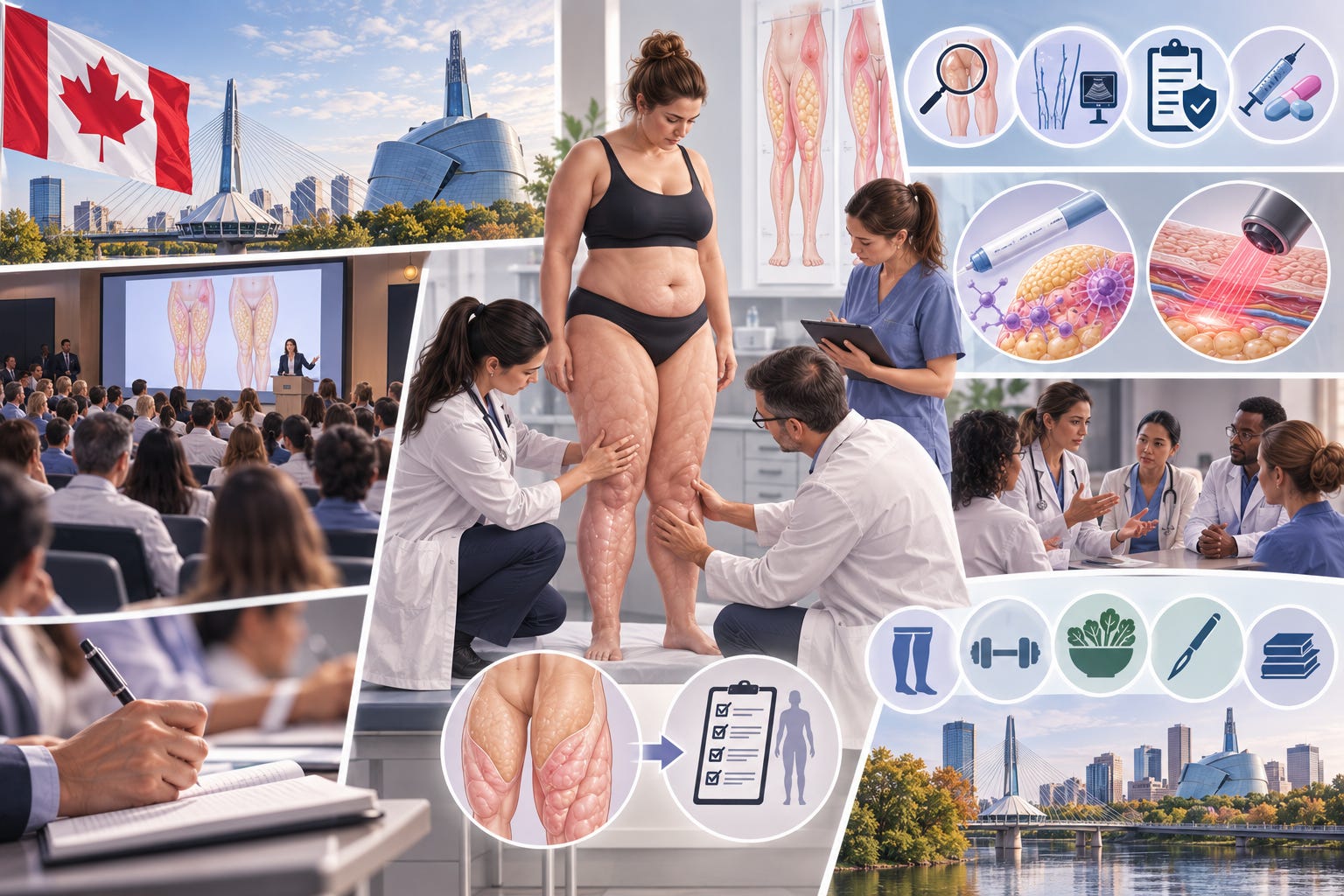
Fifty-eight assessment appointments were offered at no extra cost, and all of them were booked within two hours. That number describes the Canadian care gap better than any awareness campaign could.
The programme covers diagnosis, differential diagnosis, comorbidities, documentation and insurance pathways, rehabilitation, compression, nutrition, drug treatment, surgery and basic science. A few sessions preview unpublished work, including inflammatory changes during GLP-1 treatment and near-infrared spectroscopy as a possible diagnostic tool. Nothing from those talks should be treated as a finding until methods and data are available.
Other movement in the field
The ILA also announced a new leadership team on 10 September, the same day as the renaming announcement, after co-president Ad Hendrickx stepped down at the start of August. Organizational change is worth noting when the same board is making definitional decisions.
On 3 September the ILA published a report from the third International Földi Clinic Days, which drew 450 participants from 27 countries, with lipedema as a central topic. On 4 September it announced that co-founder Robert Damstra had been appointed Officer in the Order of Orange-Nassau.
What this means if you live with lipedema
You may start seeing lipalgia syndrome in referral letters, clinic names and patient information, particularly in the UK and in services aligned with the ILA. Your diagnosis, your code and your entitlement to treatment do not change because of this announcement.
You are also likely to meet direct contradictions between reputable sources over the coming year, on whether the condition involves the lymphatic system, whether it progresses, and how common it is. That is not because one side is uninformed. It is because the underlying biology is unsettled and the two organizations have chosen to communicate very different levels of certainty about it.
The development most likely to change ordinary care is the Canadian one. Teaching general physicians to assess patients with a standardized method addresses the problem patients report most often, which is finding anyone qualified to examine them at all.