

A new paper on GLP-1 receptor agonist therapies and lipedema was published recently, and I think it is relevant for many people in the lipedema community, but probably not for everyone. That distinction matters.
Lipedema management is not one-to-one. The same intervention will not necessarily make sense for every person with lipedema, because lipedema itself is not experienced in exactly the same way by everyone. Some people have clear metabolic complications. Some do not. Some have insulin resistance, obesity, or metabolic syndrome alongside lipedema. Others have a relatively stable weight, normal metabolic markers, and still experience pain, heaviness, swelling, fibrosis, and disproportionate fat accumulation.
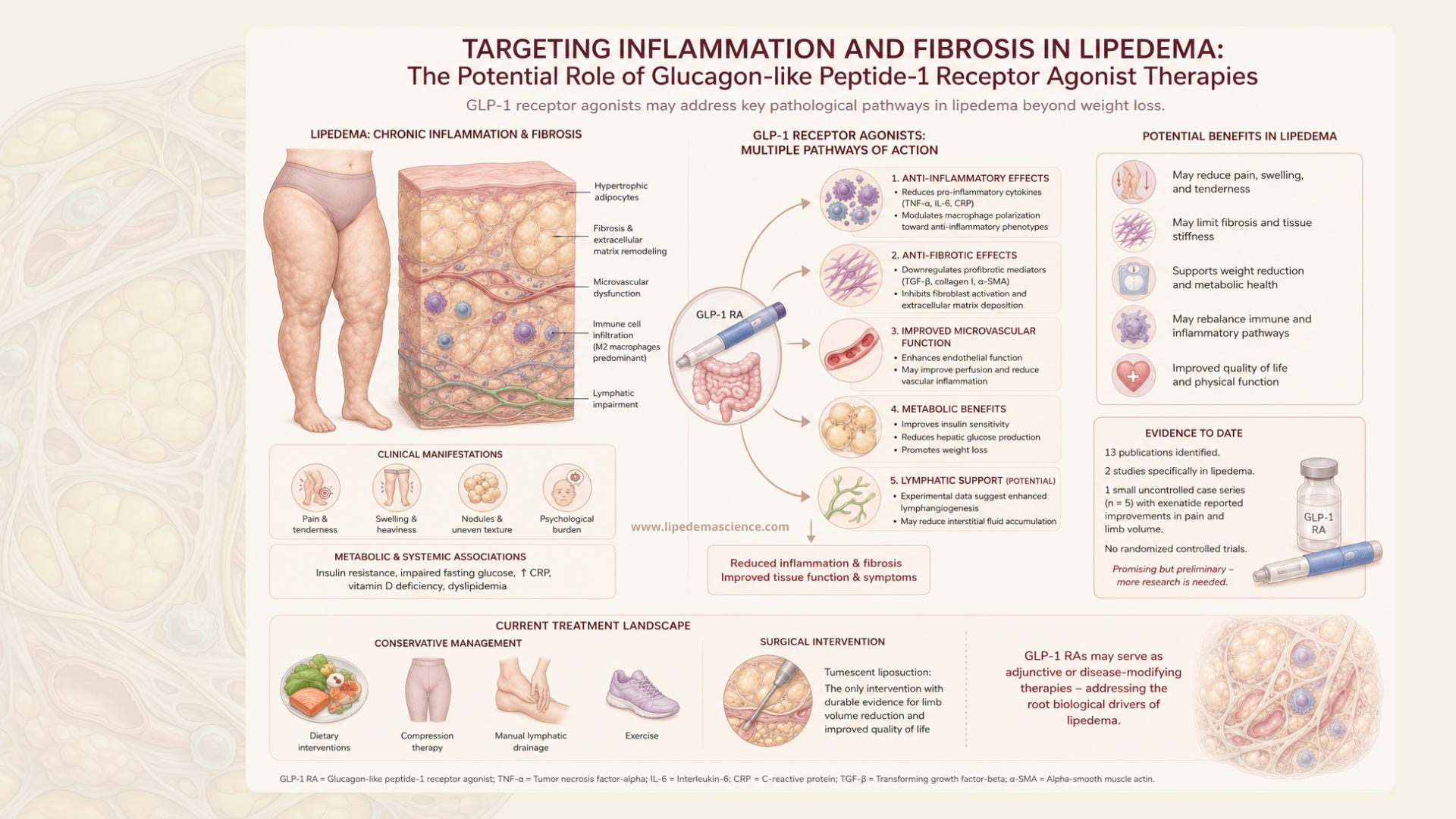
Personally, I do not use GLP-1 medication. But I find this area of research very interesting to follow, because it may become relevant for certain patients with lipedema, especially where metabolic dysfunction, inflammation, fibrosis, or obesity coexist. At the same time, the current evidence does not support presenting GLP-1 receptor agonists as a proven lipedema treatment.
The study is titled Targeting Inflammation and Fibrosis in Lipedema: The Potential Role of Glucagon-like Peptide-1 Receptor Agonist Therapies. It was written by Yasmine Mohseni, Aria Vazirnia, Ardalan Minokadeh, David M. Amron, and William P. Coleman III, and published in Dermatologic Surgery.
The central question of the paper is whether GLP-1-based therapies could have a role in lipedema management.
This is a timely question because lipedema remains a condition with very limited medical treatment options. Conservative management may help symptoms for some patients, and liposuction remains the main intervention with lasting evidence for limb volume reduction. But there is still no established pharmacological therapy that directly treats the underlying lipedema tissue.
The authors describe lipedema as a chronic disorder characterized by disproportionate subcutaneous fat accumulation, most commonly affecting the extremities, and associated with pain, inflammation, and fibrosis. This is important, because it frames lipedema as more than a question of body size or weight. The paper also emphasizes that lipedema tissue shows changes such as enlarged adipocytes, extracellular matrix remodeling, fibrosis, chronic inflammation, microvascular dysfunction, and impaired lymphatic vessel formation.

This is where GLP-1 receptor agonists become scientifically interesting.
GLP-1 receptor agonists are best known for their role in obesity and diabetes treatment. They affect appetite regulation, glucose metabolism, insulin sensitivity, and body weight. But research outside lipedema has also suggested that these therapies may influence inflammatory and fibrotic pathways. The newer dual GLP-1 and GIP receptor agonist tirzepatide is of particular interest because the paper discusses its potential effects on fat oxidation, mitochondrial function, inflammatory signaling, macrophage behavior, and fibrosis.
However, this is where we need to be careful. A biological rationale is not the same as clinical proof.
The paper does not show that GLP-1 medications cure lipedema. It does not show that they reverse lipedema progression. It does not establish them as a disease-modifying treatment for lipedema. What it does show is that there is a plausible scientific reason to study them further, especially in patients where lipedema overlaps with insulin resistance, obesity, metabolic syndrome, or inflammatory burden.
That is an important distinction. For me, this study is not a reason to say that everyone with lipedema should consider GLP-1 medication. It is a reason to say that lipedema research is beginning to move into more targeted biological questions. Instead of only asking whether weight loss changes lipedema, researchers are beginning to ask whether specific pathways such as inflammation, fibrosis, insulin signaling, macrophage activity, and tissue remodeling could be clinically relevant. That is the part I find most interesting.
The rest of this article looks more closely at what the study actually found, what the current evidence is, and why the results should be interpreted with both interest and caution.
