

For many women with lipedema, the feeling that “this runs in my family” is strong—and often confirmed. Mothers, daughters, sisters, grandmothers. Yet science has struggled to explain why. This Australian study from 2024 is the largest family-based genetic investigation ever published on lipedema. It doesn’t offer a single cause, but it moves us one important step forward by showing that the genetics of lipedema are truly complex.
What the Researchers Did
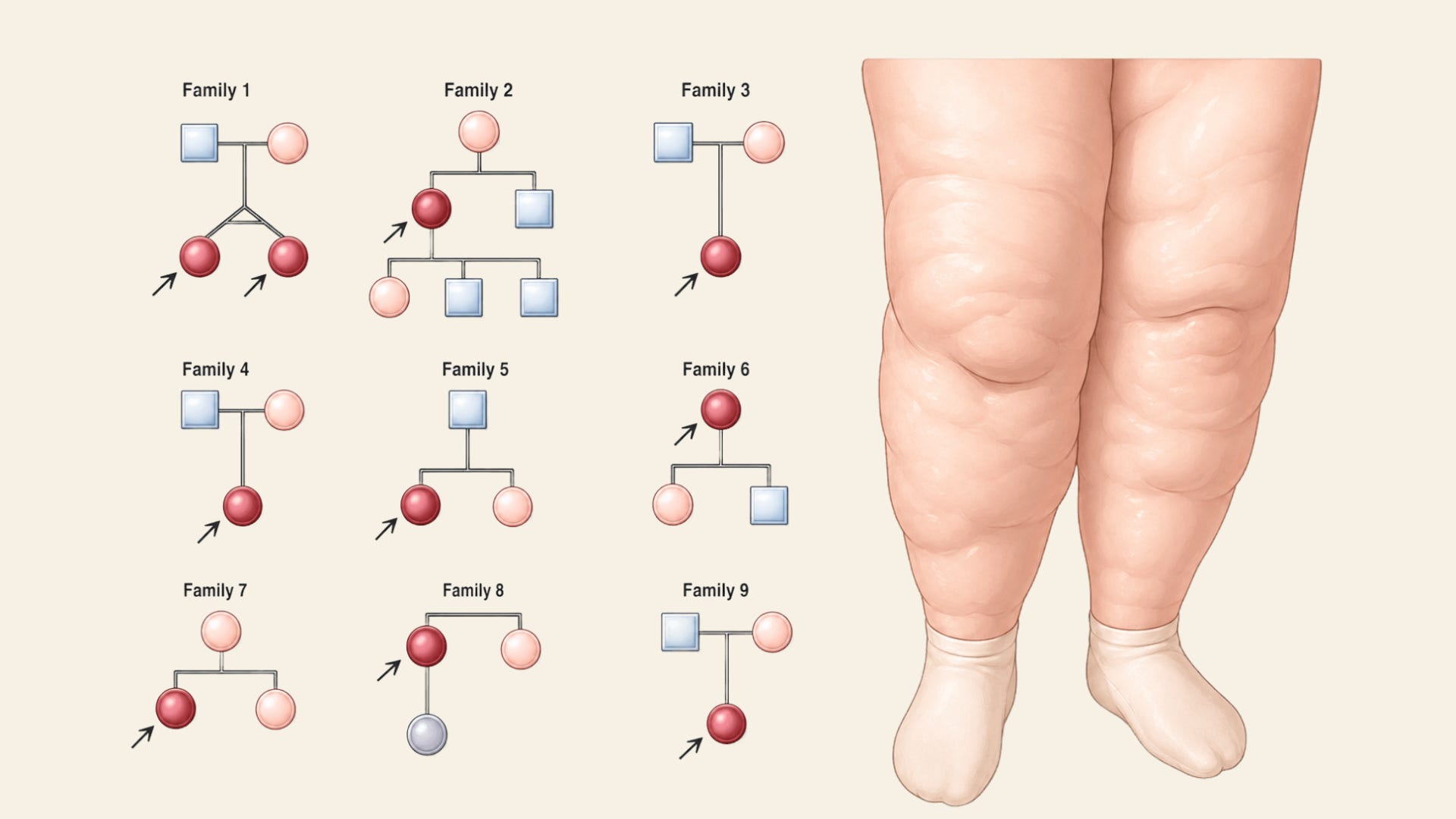
The team collected DNA from 31 people across nine families, each with at least one woman diagnosed with lipedema. They focused on the parts of the DNA that contain instructions for proteins—the exome—to see whether affected family members shared genetic changes that could help explain the condition.
They ended up analyzing nearly 2.8 million small genetic differences. After filtering for very rare and potentially harmful changes, they identified candidates across 469 different genes.
What the Study Found—and What It Didn’t
Importantly, no single gene showed the same mutation across all nine families. This means there is no universal “lipedema gene”—at least not in the protein-coding part of our DNA.
Instead, the study points toward genetic heterogeneity, which means different women may develop lipedema because of different combinations of genetic factors. In other words, lipedema likely has multiple genetic roads that all lead to similar symptoms.
This fits what many patients already know: lipedema doesn’t look exactly the same in every family, and symptoms vary widely from person to person.
A Few Genetic Themes Emerged
Even though the exact genes differed, the researchers found that many of the genetic variants clustered around three biological areas:
Vasopressin receptor activity
Vasopressin is a hormone involved in water balance, fluid regulation, and blood vessel tone. Differences in how its receptors work could help explain features such as swelling and fluid sensitivity in lipedema.Microfibril binding
Microfibrils are structural fibers in connective tissue. Variants affecting these fibers draw attention to lipedema as a connective-tissue disorder, not just a fat-accumulation disorder. This aligns with symptoms like pain, easy bruising, and hypermobility.Patched binding (related to the Hedgehog signaling pathway)
This pathway affects tissue development, fat cell behavior, and regeneration—key processes that may be altered in lipedema.
These findings don’t prove cause and effect, but they highlight directions for future research—and give patients validation that the condition is rooted in biology, not in lifestyle choices.
Connective Tissue Genes: A Strong Signal
Several interesting gene findings support what many lipedema researchers and patients have long suspected: the connective tissue plays a major role.
The study found variants in STAB1 and TNXB, both involved in the extracellular matrix (your body’s structural network). TNXB is especially noteworthy because mutations here are linked to Ehlers–Danlos syndrome (EDS), a condition marked by joint hypermobility and bruising. Many women with lipedema report similar symptoms.
This overlap strengthens the idea that lipedema is partially a connective tissue disorder, not just a fat disorder.
